

Jilin University Achieves Breakthrough in High-Concentration Ginseng Essential Oil Extraction via Deep Eutectic Solvent-Supercritical CO₂ Coupled Chromatography Technology
Recently, Jilin University released a public notice on the transformation of scientific and technological achievements, proposing to license relevant technologies through ordinary licensing agreements.“Method for Extracting Ginseng Essential Oil by Combined Deep Eutectic Solvent-Supercritical Technology and Column Chromatography”The relevant patents have been licensed to Zhenjishen Biotechnology (Changchun) Co., Ltd., with a licensing fee of4 million yuan, with annual sales royalty payments; the license term is10 years. The inventors of this patent areWang Fang and His Team。
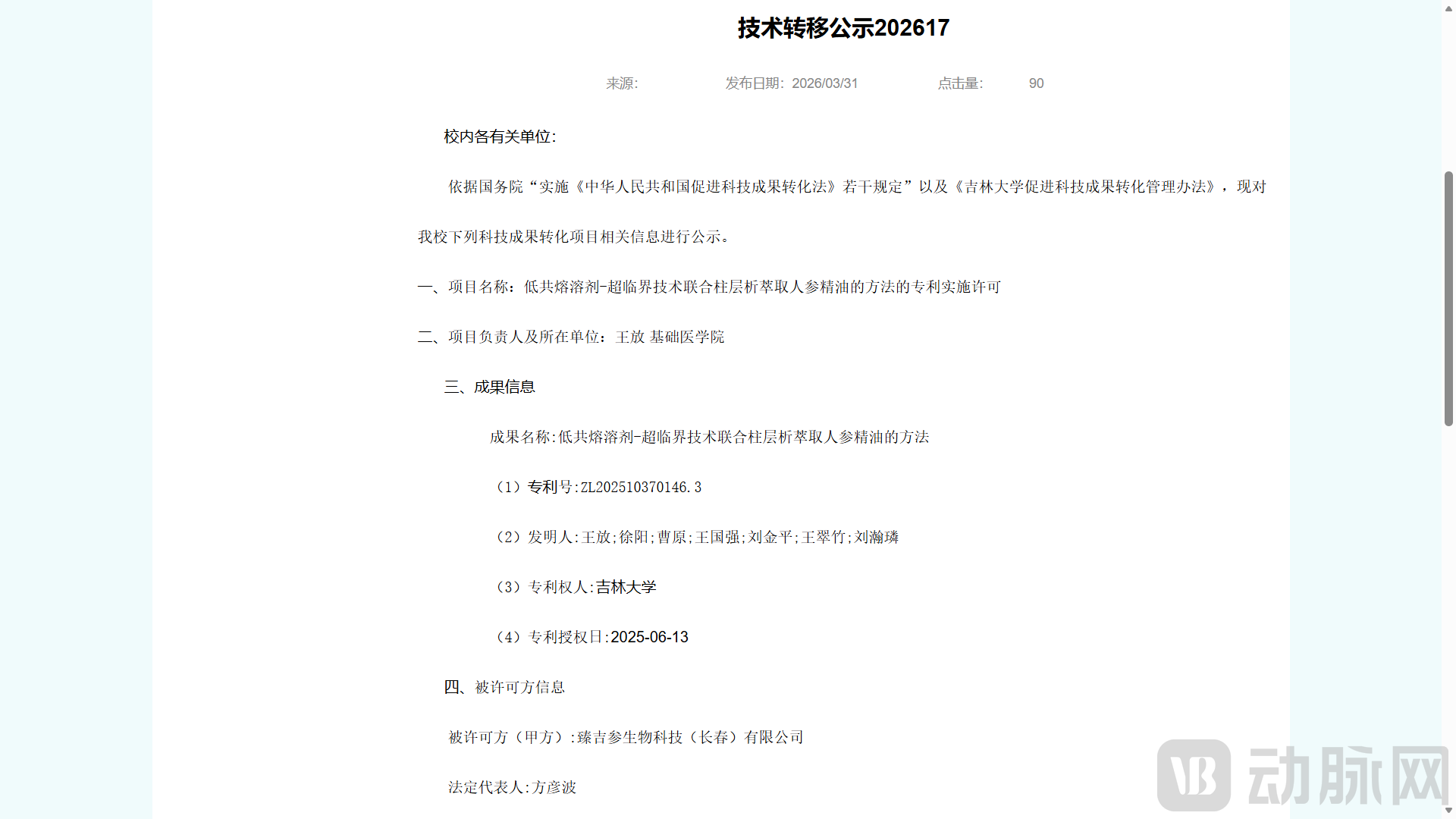
Image from the official website of Jilin University
This technology is a patented method developed by Jilin University for the extraction of ginseng essential oil using deep eutectic solvent-supercritical CO₂ combined column chromatography, with its core application beingEfficient, high-purity extraction of ginseng essential oil from ginseng rootlets, with a focus on enriching panaxynol.
Ginseng Essential Oil (Ginseng Volatile Oil)Owing to its multiple biological activities, including anti-inflammatory, anti-fatigue, lipid-lowering, and tumor-inhibiting effects, it holds broad application prospects in the fields of pharmaceuticals, health supplements, and high-end skincare, among whichPanaxynolAs a core active ingredient, it boasts prominent anti-cancer, neuroprotective, and anti-aging properties, making it a key raw material for high-value-added ginseng products. However, traditional extraction processes suffer from inherent limitations that are difficult to overcome, resulting in low yield, poor purity, and inadequate safety. These issues constitute the primary bottleneck restricting the large-scale application and high-value development of ginseng essential oil.
From a production perspective, existing extraction technologies suffer from poor adaptability and low efficiency, failing to meet industrial-scale requirements.
On the one hand, steam distillation requires high-temperature heating, which can easily cause the decomposition and inactivation of heat-sensitive components such as falcarinol, leading to charring of raw materials and off-flavors in the essential oil. Furthermore, the difficulty in separating trace amounts of moisture significantly reduces product quality and aromatic value. On the other hand, conventional solvent extraction poses risks of residual toxic solvents, such as petroleum ether and carbon disulfide. This method requires complex purification processes, involves flammable and explosive hazards, causes environmental pollution, and fails to meet food and pharmaceutical safety standards.
On the other hand, although conventional supercritical CO₂ extraction is relatively environmentally friendly, it has limited efficiency in extracting ginseng essential oil and panaxynol. Publicly available data indicate a yield of only about 0.5%, with industry-wide yields remaining below 3%. This makes efficient enrichment difficult to achieve, resulting in low raw material utilization and persistently high production costs.
From the perspective of product quality, existing processes struggle to produce high-purity panaxynol products, limiting product competitiveness.
Panaxynol contains both double and triple bonds in its structure, making it extremely unstable under light and heat. Traditional extraction processes often lead to the degradation of this compound, resulting in low panaxynol content in the final product and significantly reduced pharmacological activity. Consequently, it fails to meet the high-purity, high-activity raw material requirements of premium pharmaceuticals and functional skincare products. Meanwhile, the extracted product contains numerous impurities and is difficult to separate, further diminishing its added value and hindering the industrial upgrading of deep processing for ginseng.
Furthermore, existing technologies generally suffer from prolonged extraction cycles, high energy consumption, and significant environmental pressure, which contradicts the modern trends in pharmaceuticals and natural product extraction that emphasize green, efficient, and low-carbon practices. Against the backdrop of rising demand for the high-value utilization of ginseng and increasingly stringent market requirements for natural, safe, and efficacious ingredients, traditional extraction techniques can no longer meet the industrial production demands for high yield, high purity, environmental sustainability, and compositional stability.There is an urgent need for a novel extraction technology that is highly efficient, stable, safe, and environmentally friendly., breaking through the core bottlenecks in the industrialization of ginseng essential oil.
This patented technology, throughDes Deep Eutectic Solvent-Modified Supercritical CO₂ Extraction and Macroporous Resin Column ChromatographySynergistic innovation systematically addresses core pain points of traditional extraction processes, such as low yield, significant degradation of active ingredients, solvent residues, and poor environmental performance. It achieves comprehensive upgrades in extraction efficiency, ingredient retention, purity control, and green safety, providing a stable and viable new solution for the industrialized, high-value production of ginseng essential oil.
From the perspective of core extraction processes, coupling technology significantly enhances extraction efficiency and component retention rates.
On the one hand, innovative introductionAnhydrous Deep Eutectic Solvents Combined with Anhydrous Ethanol as a Composite Entrainer, forming a highly synergistic extraction system with liquid CO₂. This enables efficient dissolution of ginseng essential oil under mild conditions (25°C–60°C), thereby preventing the decomposition and inactivation of heat-sensitive polyacetylene components such as falcarinol due to high temperatures, and ensuring the bioactivity and aromatic quality of the essential oil at the source. Furthermore, by precisely controlling key parameters—including rootlet moisture content ≤9%, particle size of 20–60 mesh, and extraction pressure of 15–45 MPa—mass transfer efficiency is significantly enhanced. This boosts the essential oil yield to over 1.0%, substantially higher than the approximately 0.5% achieved by traditional supercritical CO₂ extraction, thereby markedly improving raw material utilization.
From the perspective of separation and purification, column chromatography enables precise enrichment for the preparation of high-purity target components.
Gradient elution using D101/AB‑8/D4020 macroporous resins—comprising water washing, impurity removal with 2%–5% ethanol, and targeted elution with 10%–20% ethanol—efficiently eliminates interfering impurities such as polysaccharides and saponins, precisely enriches the panaxynol fraction, and stabilizes the panaxynol content in the final product at >10%, thereby significantly enhancing the pharmacological activity of the essential oil and its added value. Meanwhile, mild post-processing methods, including vacuum concentration and vacuum drying, are employed throughout the process to further protect heat-sensitive components from degradation, ensuring more stable product quality.
From the perspectives of production and application, the technology offers industrial advantages characterized by high efficiency, environmental sustainability, and low cost.
The extraction cycle takes only 1–2 hours, featuring a streamlined process and reduced processing time, which significantly enhances production efficiency. The system primarily utilizes CO₂, ethanol, and food-grade deep eutectic solvents (DESs), eliminating residual toxic organic solvents such as petroleum ether and dichloromethane. It complies with safety standards for pharmaceuticals, food, and cosmetics, while generating no waste gas, wastewater, or solid waste, thereby being environmentally friendly and aligned with green manufacturing trends. Furthermore, the composition of deep eutectic solvents is tunable and highly adaptable, allowing flexible optimization based on raw material quality. The process offers high stability and ease of scale-up, effectively reducing costs in large-scale production.
In summary, this technology utilizes“Mild and Efficient Extraction + Precise Purification”as the core advantage, while simultaneously achievingHigh Yield, High Purity, High Activity, Zero Contamination, thoroughly overcoming the inherent limitations of traditional steam distillation, solvent extraction, and conventional supercritical fluid extraction. For the deep-processing industry of ginseng, this technology not only enhances the utilization rate of by-products such as ginseng rootlets but also meets the demand for high-purity ginseng essential oil in high-end pharmaceuticals, functional skincare, and natural fragrances, providing key technical support for the high-value utilization of ginseng resources and industrial upgrading.
Currently, aroundGinseng Essential Oil: High Extraction Yield, High Falcarinol Content, Green and Safe, Scalable for Industrial Productioncore demands, domestic natural extract companies and research institutions have established clear technological layouts, with mainstream approaches focusing onSteam distillation, conventional supercritical CO₂, supercritical + molecular distillationThree Major Directions: Deep Eutectic Solvents Coupled with Supercritical Fluid + Column Chromatography Remains an Exclusive Innovative Route.
Jiangxi Hairui Natural Plant Co., Ltd. Mass-Produces Ginseng Essential Oil Using Steam Distillation, the product is supplied in stock in 25kg drums, focusing on low-cost, daily chemical fragrance-grade applications, with a labeled purity of 99%, and is a mainstream supplier in the basic raw material market for ginseng essential oil.
Tonghua Jinkaiwei Biotechnology Products Co., Ltd. is equipped with supercritical CO₂ extraction production lines in multiple specifications, ranging from 5L to 300L., offering custom contract manufacturing services for ginseng essential oil from laboratory scale to industrial mass production, leveraging Changbai Mountain raw material resources and large-scale extraction capabilities. The process employs conventional supercritical fluid extraction, without the use of deep eutectic solvents or column chromatography-based targeted enrichment.
In summary, this patentDeep Eutectic Solvent–Supercritical CO₂ Combined Column Chromatography Extraction Technology for Ginseng Essential Oil, achieving full-chain innovation from raw material pretreatment and extraction systems to purification processes. This approach effectively addresses industry pain points associated with traditional extraction methods, such as low yield, susceptibility of falcarinol to degradation, solvent residues, and environmental pollution. It has achieved core breakthroughs with an extraction yield of >1.0% and a falcarinol content of >10%, while offering prominent advantages including mild and efficient processing, short production cycles, green and residue-free operations, and industrial scalability.
This technology provides a novel solution for the high-value utilization of ginseng resources, significantly enhancing the competitiveness of ginseng essential oil products. It holds broad application prospects in the fields of pharmaceuticals, health supplements, high-end skincare, and natural fragrances, and will strongly drive the upgrading of the ginseng deep-processing industry toward greater efficiency, sustainability, and higher added value.