

Non-Invasive Fecal Metabolite Test for Early Detection of Thyroid-Associated Ophthalmopathy Receives Patent Transfer Approval
Recently, Union Hospital, Tongji Medical College of Huazhong University of Science and Technology, released a public notice on the transformation of scientific and technological achievements. The university intends to transfer its jointly held rights with Meiyitian Biopharmaceutical (Wuhan) Co., Ltd. through agreed pricing.“Anionic Metabolic Biomarkers, Products, and Applications for Thyroid-Associated Ophthalmopathy”The relevant patents were transferred to Wuhan Tongxin Medical Technology Co., Ltd. for a transfer amount of308,000 yuan. The inventors of this patent areShi Bingjie and Her Team。
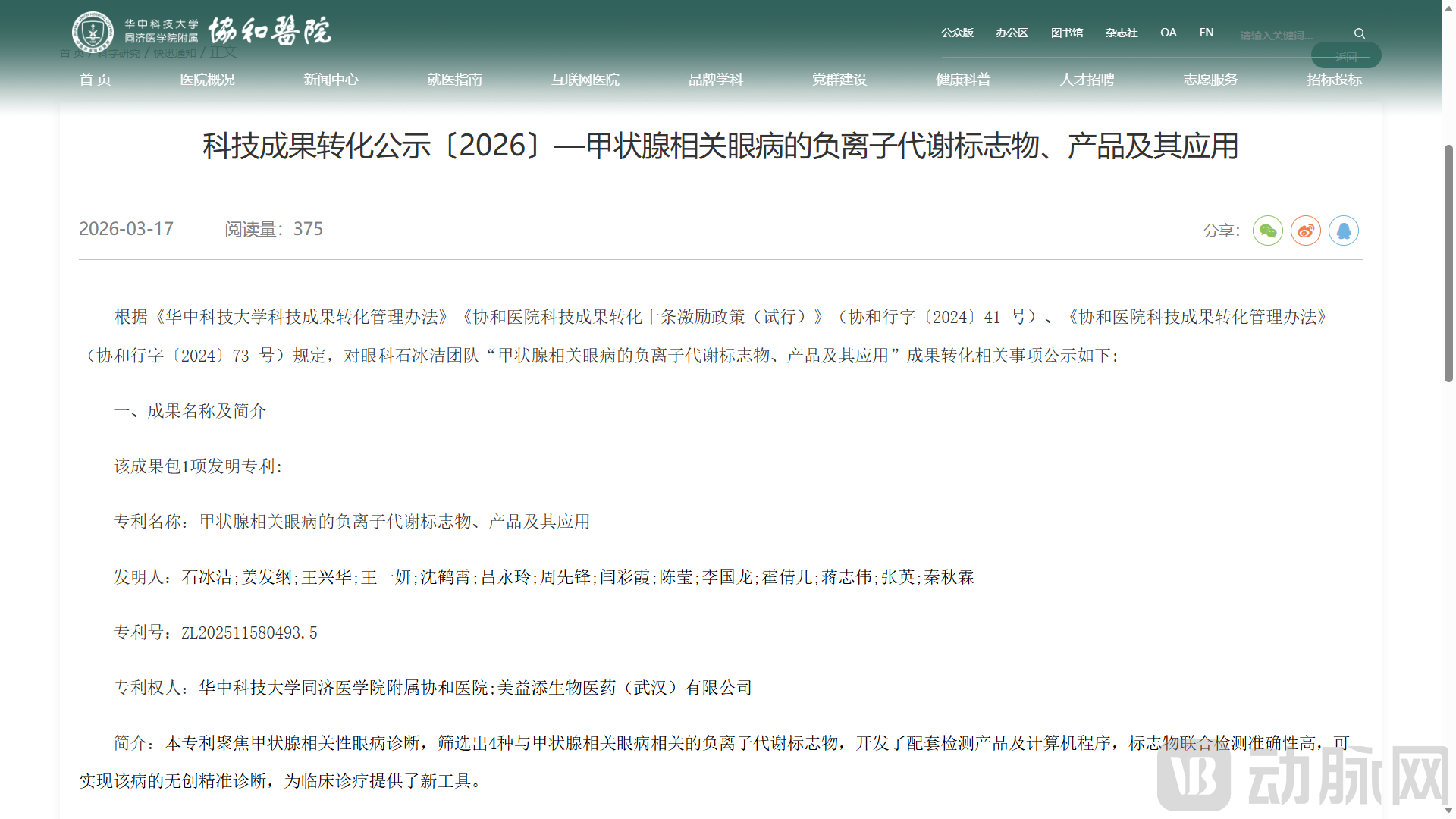
Image from the official website of Union Hospital, Tongji Medical College, Huazhong University of Science and Technology
This technology is based onNegative Ion Mode in Mass Spectrometry, a patented technology that identifies four fecal metabolic biomarkers for the non-invasive and precise diagnosis of thyroid-associated ophthalmopathy (Graves' ophthalmopathy), with its core application being early and auxiliary diagnosis rather than treatment.
Thyroid-Associated Ophthalmopathy (Graves' Ophthalmopathy)As the most common orbital disease and autoimmune disorder in adults, clinical diagnosis and treatment heavily rely on early and precise diagnosis. However, the existing diagnostic and testing systems have many core pain points, making it difficult to meet the clinical needs for efficient, safe, and accurate diagnosis and treatment. This has become a key bottleneck for early screening, classification, and efficacy evaluation of the disease.
Current clinical diagnosis primarily relies on traditional methods, including symptom observation, thyroid function tests, and ocular imaging.Significant limitations exist:Early symptoms are insidious and prone to missed diagnosis; the disease can also occur in individuals with normal thyroid function, making it difficult to identify prematurely through routine examinations. Diagnostic criteria are highly subjective, lacking objective, quantifiable molecular biomarkers, which prevents accurate differentiation between patients and healthy individuals. Detection methods are either invasive or costly, hindering their large-scale application in routine screening and long-term follow-up.
From a technical perspective, existing diagnostic and testing methods have multiple shortcomings.
On the one hand,Absence of Specific Molecular Biomarkers, conventional testing fails to reflect disease-associated metabolic abnormalities, making it difficult to achieve early warning and precise subtyping; approximately 30% of patients respond poorly to hormone therapy, yet there are no effective predictive biomarkers.
On the other hand,Blind Spots in the Application Patterns of Mass Spectrometry TestingIn clinical practice, positive ion mode is commonly used for detection, which is more suitable for alkaline metabolites. However, acidic or weakly acidic metabolites that are highly associated with thyroid eye disease are difficult to capture sensitively, leading to the loss of key disease information and insufficient accuracy and completeness of detection.
Furthermore, existing detection methods are neither non-invasive nor convenient; approaches such as blood sampling and imaging suffer from low patient compliance, making them unsuitable for rapid, repeated, and large-scale population screening. Meanwhile, therapeutic drugs often have significant side effects, and targeted therapies are prohibitively expensive. Without precise prior diagnosis, there is a high risk of overtreatment or delayed treatment, leading to disease recurrence rates as high as 20–30%. Consequently, there is an urgent clinical need for novel diagnostic tools that are non-invasive, sensitive, and quantitative.
These pain points directly lead to thyroid-associated ophthalmopathy.Difficult Early Screening, Slow Diagnosis, Inaccurate Subtyping, and Inconvenient Follow-upPatients with moderate-to-severe disease often miss the optimal window for intervention, significantly compromising treatment efficacy. In light of the urgent clinical demand for non-invasive, precise, quantitative, and accessible tools for early diagnosis, existing technologies are no longer adequate. There is an pressing need for novel detection strategies based on specific metabolic biomarkers to address the core challenges in diagnosing thyroid-associated ophthalmopathy.
This patent relies onNegative Ion Metabolic Biomarkers and Innovative Mass Spectrometry Detection System, precisely addressing the shortcomings of existing diagnostic technologies for thyroid-associated ophthalmopathy, inNon-invasiveness, Sensitivity, Specificity, Clinical AdaptabilityEstablish core advantages to provide innovative solutions for early screening, diagnosis, and treatment efficacy assessment of Graves' ophthalmopathy.
From the perspective of technological innovation, the patent has for the first time identified metabolic biomarkers specific to the negative ion mode, enabling precise, targeted capture of diseases.
On one hand, this approach overcomes the limitations of conventional clinical detection in positive ion mode by designing a targeted assay for acidic and weakly acidic metabolites closely associated with thyroid-associated ophthalmopathy. It enables the stable capture of four specific negative-ion biomarkers, preventing the loss of critical disease signals and significantly enhancing detection sensitivity. On the other hand, it clearly distinguishes between bidirectional trends in biomarker expression—two are significantly elevated and two are significantly reduced in patients. These distinct signal characteristics markedly reduce the risk of misdiagnosis and missed diagnosis.
In addition,Patented Non-Invasive Detection + AI Quantitative Assessment System, Fully Adapted to Real-World Clinical Scenarios.
Utilizing stool sample testing, the process is entirely non-invasive, radiation-free, and non-intrusive, ensuring high patient compliance. It is suitable for large-scale screening, long-term follow-up, and dynamic monitoring. Coupled with a binary logistic regression algorithm and computer program product, it directly converts metabolite levels into a disease probability Z-score. Using 0.5 as the cutoff value for objective risk assessment, this approach eliminates the reliance on subjective experience inherent in traditional diagnostics, yielding standardized and reproducible results.
From a clinical value perspective, this technology achieves a dual breakthrough in high precision and strong practicality.
The combined detection of four biomarkers achieved an area under the curve (AUC) of 95.83%, while the single best-performing biomarker reached an AUC of 93.06%, demonstrating excellent diagnostic accuracy. This approach facilitates the development of standardized products such as test kits, primers, probes, and chips, enabling straightforward clinical translation and addressing the current lack of specific molecular diagnostic tools in clinical practice. Furthermore, it provides an objective basis for treatment selection, efficacy prediction, and recurrence monitoring, thereby supporting individualized precision medicine and reducing the risks of ineffective treatment and overmedicalization.
These advantages comprehensively upgrade the diagnosis and treatment workflow for thyroid-associated ophthalmopathy:Non-invasive sampling enables early screening, targeted biomarkers facilitate early disease detection, quantitative algorithms ensure objective and standardized diagnosis, and supporting products promote clinical adoption. This patented technology not only fills the gap in the application of anion metabolomics for diagnosing Graves’ ophthalmopathy but also provides a revolutionary tool for the full-cycle management of thyroid-associated ophthalmopathy, characterized by its non-invasiveness, precision, efficiency, and accessibility.
In the current global landscape for diagnosing thyroid-associated ophthalmopathy (TAO/TED), there are no commercially available kits for fecal anion metabolic biomarkers of the same type; mainstream competitors are concentrated inImaging Assessment, AI Ocular Surface Measurement, Routine Serological TestingThree categories, none of which have entered the stage of molecular metabolic diagnostics.
Serum TRAb Combined with Inflammatory Factor Prediction Model Is Constructed Based on Indicators Such as Serum Thyrotropin Receptor Antibody (TRAb) and Neutrophil-to-Lymphocyte Ratio (NLR), used to assess the activity of thyroid-associated ophthalmopathy, is currently in the clinical research stage and has not yet been commercialized as a kit; its AUC is approximately 0.716, with both specificity and sensitivity lower than those of metabolomics-based approaches.
Clinical-Imaging Integrated Assessment Model (Frontiers 2025): Construction of an Evaluation System Combining Clinical CAS Score, SPECT/CT Imaging, and Serological Markers, retrospective studies have shown that the AUC can reach 91.18%; currently, these findings are based on single-center retrospective research and have not yet been translated into clinically widely available diagnostic products or test kits.
South Korea's Thyroscope AI Diagnostic SystemAssessment of thyroid-associated ophthalmopathy activity and exophthalmos severity through ocular image analysis has obtained local medical device certification in South Korea and entered the commercialization stage.
In summary, this technology pioneers a diagnostic system for thyroid-associated ophthalmopathy (TAO) based on anion metabolic biomarkers. By leveraging non-invasive fecal testing with high specificity and sensitivity, it enables precise subtyping and early screening, thereby overcoming the limitations of traditional diagnostics that rely on imaging and serology, and filling the gap in clinical molecular diagnosis. In the future, it can be rapidly translated into test kits and intelligent detection tools, propelling the diagnosis and treatment of ophthalmic diseases into a new era characterized by non-invasiveness, precision, and quantification, thus holding significant clinical value and promising prospects for industrialization.