

Panlin Capital Showcases 17 Founders at the 2026 VB100 Healthcare Innovation Summit to Redefine High-Quality Chinese Medical Assets
China’s healthcare innovation industry is undergoing a profound qualitative transformation—evolving from a “fast follower” in the past to a “systemic innovator” on the global stage, and shifting from “trailing behind” to “running alongside or taking the lead.”
From the perspective of academic achievements, Chinese pharmaceutical companies have demonstrated remarkable prominence at recent top-tier international academic conferences, beginning to move from the periphery to the center:AACR 2026(at the world's premier oncology conference), there were104 companiesChinese Pharmaceutical Companies Bring Over250 Achievements Showcased, Breaking the Long-Term Monopoly of Multinational Giants for the First Time; 24 Chinese Pharmaceutical Companies Demonstrate Their Strength at JPM 2026,Seven companies delivered presentations at the main venue. Judging from previous ASCO (American Society of Clinical Oncology) annual meetings, Chinese pharmaceutical companies have achieved a qualitative leap in terms of the number of accepted abstracts, data quality, and academic standing.
Innovation is not only reflected at the academic frontier, but also more clearly in domestic approval data.Multiple Indicators Hit Record Highs in 2025. According to data from the National Medical Products Administration, 76 innovative drugs were approved for marketing in China in 2025, representing a year-on-year increase of 53.33% and reaching a record high, among which,Domestic production rate reaches 85.53% (65 domestically developed innovative drugs). Breakthrough innovations in the medical device sector have also been remarkable. In 2025, the National Medical Products Administration (NMPA) approved 3,402 medical device products, including 76 innovative medical devices, reaching a new high.
Record-breaking BD deals in the innovative drug sector have further propelled Chinese medical innovation to new heights.In the beginning of 2026, the total value of business development (BD) deals for Chinese innovative drugs has surpassed $49 billion, exceeding one-third of the full-year total for 2025, with upfront payments and milestone amounts repeatedly hitting record highs. The evaluation criteria used by multinational corporations (MNCs) for Chinese medical innovation assets have undergone a fundamental shift—moving away from the logic of "buying low at the bottom" toward strategic deployment: Big Pharma is willing to pay substantial sums for China’s innovative pipelines, technology platforms, and even talent teams.
Meanwhile, international talent with multinational corporation (MNC) backgrounds is accelerating its influx into China’s innovative pharmaceutical and medical device enterprises…
All of this further validates the innovative value of China’s healthcare sector, andPoints to a core narrative: the globalization of China’s independent medical innovation is continuously escalating, and the global industry’sThe cognitive framework for “China Innovation” is undergoing a fundamental restructuring.
In this context, how to redefine and reevaluate China’s high-quality innovative medical assets has become a focal point of global healthcare innovationThe core proposition of the industry. In this context,Panlin CapitalJointVCBeat, scheduled to"2026 VB100 Future Healthcare & Pharma Top 100 Conference""Panlin Capital Post-Investment Empowerment Seminar – Special Session on Innovative Biopharmaceuticals and Medical Devices", and inviteInnovative Drugs,Founders, entrepreneurs, and senior investors from leading enterprises in the three major fields of CGT and medical devices,Centered on the core proposition, “How to Redefine High-Quality Innovative Medical Assets in China in the New Era?”4-Hour Deep-Dive Collaboration, Jointly Answering the Call.
We will invite:
l Founders of Innovative Drug Companies with Genuine Innovation Value and Market Acclaim
l From “Platform Validation” to Exploring “Commercial Viability”Leading CGT Enterprise
l Medical device entrepreneurs whose technologies and products demonstrate global appeal
l Senior Investor and Head of Strategy at a Multinational Pharmaceutical Company
The forum features three keynote speeches and three roundtable discussions, directly addressing core industry issues:
· Haibo Pharma: How Can Chinese Innovative Pharmaceutical Companies Build a Competitive Pipeline?
· Yuesai Biotech: Stem Cell Therapy for Neurological Disorders
· 3N Eyecare: Next-Generation Contact Lens Care Technology
Roundtable 1: What Constitutes True “Hard Currency”—Reassessing High-Quality Assets in China’s Innovative Drug Sector
Normalization and High-Quality Development of BD Transactions,In fact, the strong interest shown by global buyers in Chinese innovative pharmaceutical companies is the result of a multi-dimensional resonance involving R&D pipelines, technology platforms, clinical trials, business development (BD) transactions, talent management, and capital support. How should high-quality assets be evaluated? How can deal structures be designed to ensure enforceability? How can one assess multinational pharmaceutical partners?"Good Buyers" Rather Than "Buy and Shelve"? This Section Invites Ribo Life Sciences(06938.HK), GenFleet Therapeutics(02595.HK), Yafei Biotechnology (Affinity), Lingtai Tianrun, Libo Biotechnology, and other outstanding companies with extensive experience or unique insights in building technical platforms, advancing clinical pipelines, and conducting business development (BD) transactions, jointly review the logic of real-world deals.
Roundtable 2: How CGT Can Successfully Transition from "Platform Validation" to "Commercial Viability"
As patience in the capital markets gradually wanes, the cell and gene therapy (CGT) industry is collectively facing a brutal transition from “telling technology stories” to “proving commercial logic.” Representatives from companies such as Zhixin Haozheng, Zhishan Weixin, Xizhuo Bio, and Lingtaike will explore the unique business proposition of “platform as pipeline,” discussing CMC costs, patent freedom-to-operate (FTO), indication selection (proof-of-concept in rare diseases vs. entry tickets for broad indications), and the debate over endgame strategies involving M&A and license-out deals.
Roundtable 3: China’s Medical Device Industry Enters a New Chapter of Independent Innovation
Moving Beyond the Cutthroat Competition of "Domestic Substitution," China’s Medical Device Industry Is Transitioning from "Me-too" Products to First-in-Class (FIC) and Best-in-Class (BIC) Solutions That Address Global Clinical Pain Points. Companies such as Dishi Medical, Yijiada Medical, Jinshi Bio/Antai Kangcheng will share practical insights on taking independently innovated products from the laboratory to large-scale commercialization, as well as strategic considerations for competing in global markets.
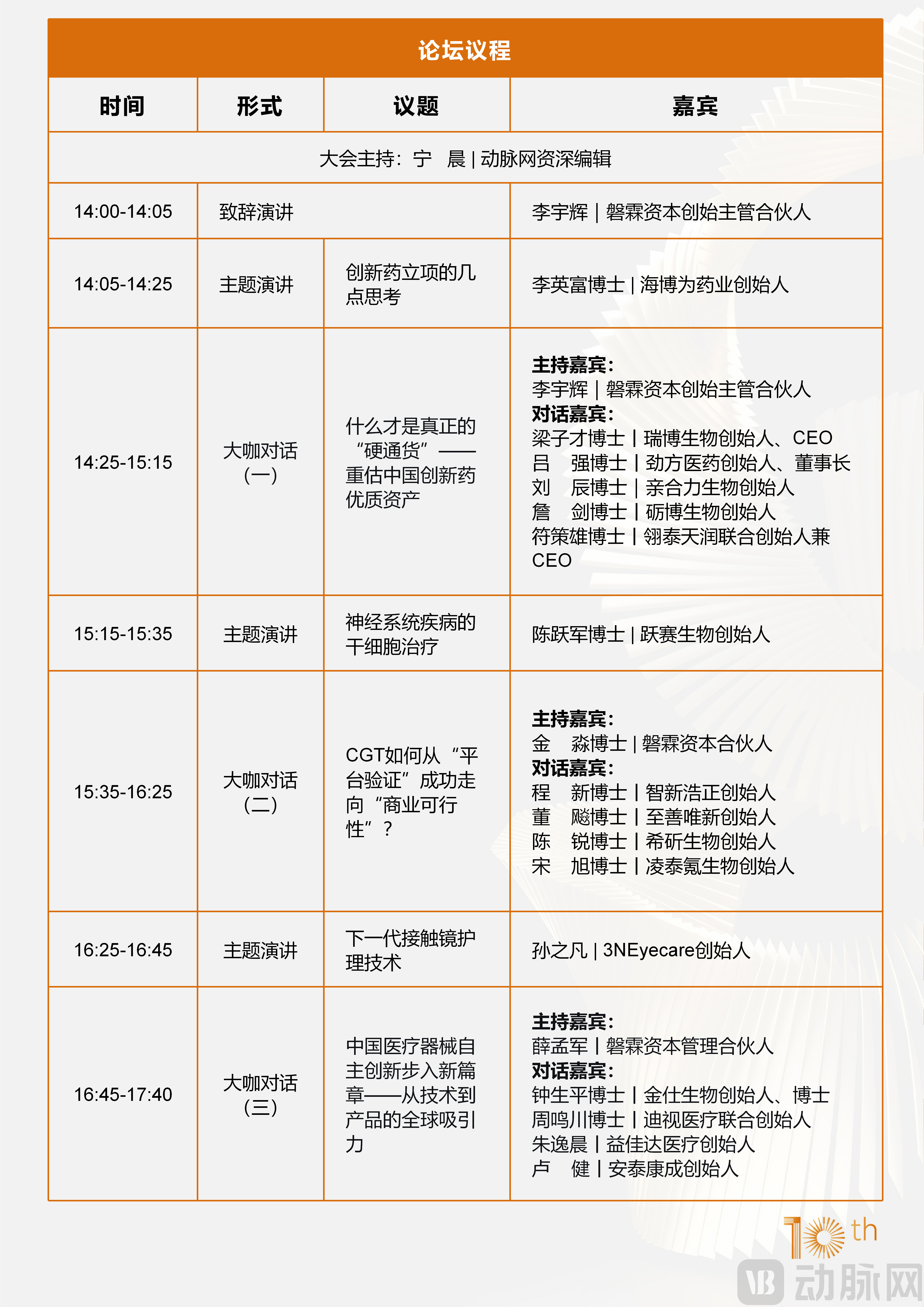
On May 19, at the Platinum Hanjue Hotel in Minhang District, Shanghai, you are cordially invited to join this industry summit. Walk alongside the core forces of China’s innovative medical sector, explore the new value cycle together, and build a new future for the industry!

Scan the QR code to register
About Panlin Capital
Panlin Capital is a venture capital firm with expertise and influence in both the healthcare and technology sectors.
Panlin Capital was founded in 2010. Adhering to the investment theme of “Technology Creates the Future, Innovation Leads Upgrading,” it focuses on the healthcare and technology sectors, identifying projects from the angel to Series A stages, and is committed to “finding entrepreneurs among scientists and empowering innovators among entrepreneurs.”
In the healthcare sector, Panlin Capital targets innovative pharmaceutical and medical device companies focused on the prevention, diagnosis, and treatment of major diseases with unmet clinical needs, while also seeking derivative investment opportunities in life sciences and biotechnology. In the technology sector, it focuses on B2B enterprises (enterprise services and data-intelligent equipment) that address business clients’ demands for cost reduction, efficiency enhancement, and quality improvement, as well as hard-tech companies (equipment and key components) that ensure the autonomy and controllability of critical technologies.