

Caffeic Acid as a Novel Epigenetic and Targeted Therapy for Esophageal Cancer: Precision Inhibition of Tumor Proliferation and Metastasis via GASC1 Targeting
Recently, the First Affiliated Hospital of Henan University of Science and Technology released a public notice on the transformation of scientific and technological achievements. The hospital intends to transfer its patent rights“Application of Caffeic Acid in the Treatment of Esophageal Cancer”The relevant patents have been assigned to Henan Micu Beta Pharmaceutical Technology Co., Ltd., with the inventors of the patented technology beingGao Shegan and His Team。
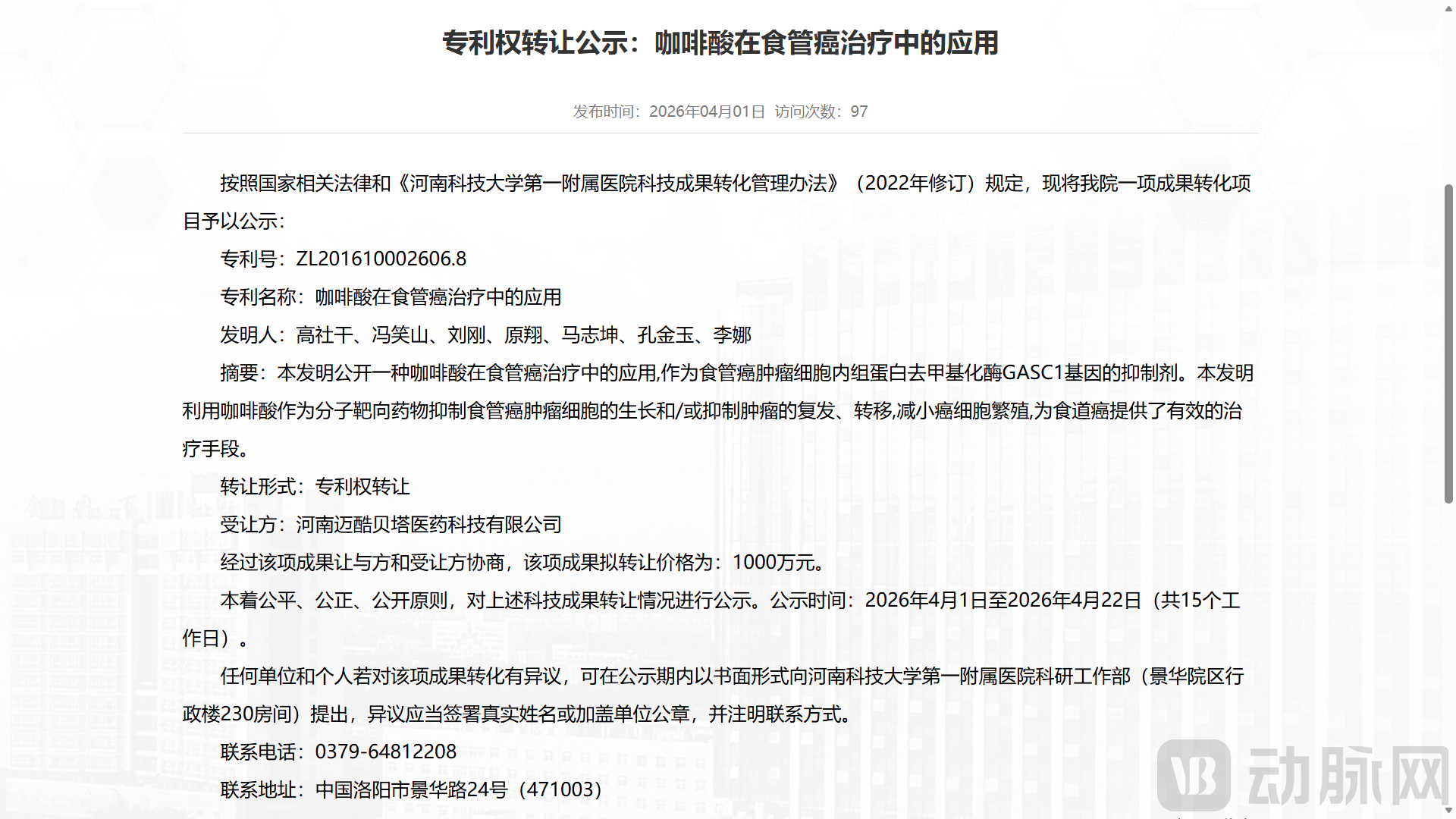
Image from the official website of the First Affiliated Hospital of Henan University of Science and Technology
This technology discloses a new application of caffeic acid in the treatment of esophageal cancer, toHistone Demethylase GASC1 as a Specific Target, maintains the hypermethylated state of H3K9me3 through epigenetic regulation, thereby inhibiting SOX2 transcriptional activity,Precisely block the proliferation, stemness maintenance, and self-renewal of esophageal cancer cells, significantly inhibiting tumor growth, recurrence, and lung metastasisAs a naturally derived molecular targeted and epigenetic drug, caffeic acid can be formulated into various oral dosage forms. With well-defined targets and a high safety profile, it can be combined with conventional chemotherapy to reduce toxicity and enhance efficacy, offering a novel therapeutic approach for primary, metastatic, and recurrent esophageal cancer.
Esophageal CancerEsophageal cancer is a highly prevalent malignant tumor of the digestive system in China, with its mortality rate ranking second among gastrointestinal malignancies, posing a serious threat to the life and health of the population. Current treatment for esophageal cancer focuses onSurgery, Radiotherapy and Chemotherapyas the core approach, with chemotherapy serving as a key treatment option for patients with advanced-stage disease and those in the postoperative setting. However, its clinical application has long been plagued by core challenges, including limited efficacy, significant side effects, and ill-defined targets, making it difficult to meet the demand for precise, safe, and durable therapeutic outcomes.
Conventional chemotherapy agents indiscriminately damage normal tissue cells while killing esophageal cancer cells, causing severe myelosuppression and adverse reactions such as leukopenia and thrombocytopenia. Poor patient tolerance often necessitates dose reduction or discontinuation of treatment. Furthermore, existing chemotherapy regimens are largely non-targeted therapies that fail to precisely act on key oncogenic sites in esophageal cancer. Their weak inhibitory effect on cancer stem cells makes it difficult to effectively prevent tumor recurrence and distant metastasis, resulting in poor prognosis and low five-year survival rates for patients.
Although existing studies suggest that some natural products possess potential antitumor activity, most are merely isolated case reports with unclear mechanisms of action, incomplete experimental data, and undefined targets, thus failing to establish standardized, generalizable clinical treatment protocols. CurrentlyThere is an acute shortage of targeted therapies for esophageal cancer that feature well-defined targets, low toxicity and side effects, the ability to inhibit cancer cell proliferation and metastasis, and efficacy in preventing recurrence., current methods are unable to crack it“Efficacy–Safety” Imbalance, “Tumor Control–Recurrence Prevention”Difficult to Balanceclinical challenges, urgently requiring novel targeted natural drugs to fill this gap.
This technology, based onCaffeic AcidAsNovel Molecular Targeted and Epigenetic Drugs for the Treatment of Esophageal Cancer, by leveraging its specific mechanism of action and advantages in dosage form, it comprehensively addresses the clinical challenges associated with traditional chemotherapy, such as severe side effects, ambiguous targets, and high risks of recurrence and metastasis, thereby providing a safe, highly effective, and precise novel solution for the treatment of esophageal cancer.
From the perspective of its core mechanism of action, the patent achieves precise anticancer effects through GASC1-targeted inhibition and epigenetic regulation.
Caffeic acid, as a specific inhibitor of the histone demethylase GASC1, blocks the demethylation of histone H3K9me3 on the core promoter of SOX2, thereby maintaining a hypermethylated state. This inhibits the proliferation, stemness maintenance, and self-renewal of esophageal cancer cells, curbing tumor growth at its source. Furthermore, as an epigenetic drug, caffeic acid enables multi-target synergistic effects; when combined with conventional chemotherapy, it reduces toxicity and enhances efficacy, addressing the limitations of single-target chemotherapy, which often suffers from narrow specificity and high toxicity.
From the perspective of drug properties and clinical compatibility, natural sourcing combined with diverse dosage forms balances safety and practicality.
Caffeic acid is an active ingredient extracted from natural plants such as Salvia miltiorrhiza and wild carrot. With well-defined sources and compliance with pharmaceutical standards, it causes less bone marrow suppression than chemotherapy drugs, offers a higher safety profile, and is suitable for long-term use. It can be formulated into various oral dosage forms, including tablets, capsules, granules, oral solutions, and pills, to meet the medication needs of different patients, thereby ensuring high clinical compliance.
In terms of anti-tumor efficacy, it provides whole-course tumor control plus inhibition of metastasis and recurrence, covering the entire treatment journey.
In vitro experiments have confirmed that caffeic acid significantly reduces the colony-forming ability of esophageal cancer cells and decreases the proportion of tumor stem cells. Animal studies have demonstrated its ability to inhibit subcutaneous tumorigenesis in nude mice, reduce tumor volume, and markedly decrease the number of pulmonary metastatic foci. It is effective against primary, metastatic, and recurrent esophageal cancer, addressing the critical clinical challenges of postoperative recurrence and distant metastasis.
These advantages translate directly into clinical value:The precise targeting mechanism reduces damage to normal cells and lowers treatment-related adverse reactions; natural ingredients and oral dosage forms improve patient tolerance and medication convenience; combiningAnti-tumor, Anti-metastasis, and Prevention of RecurrenceTriple Efficacy: Covering the Entire Disease Course of Esophageal Cancer Treatment. This technology breaks through the dual limitations of efficacy and safety in existing esophageal cancer treatments, achieving targeted epigenetic anticancer effects with natural products, and providing clinicians with an innovative and practical treatment option.
Current esophageal cancer treatment has formedChemotherapy, Immunotherapy, Targeted Therapy, ADC, EpigeneticsFive Major Technological Pathways: Domestic and International Enterprises Accelerate Strategic Layouts Around Targets, Safety, and Adherence, Shaping a Competitive Landscape Characterized by More Precise Targeting, Diversified Mechanisms, and Controllable Toxicity.
Camrelizumab is a domestically developed PD-1 inhibitor independently researched and developed by Hengrui Medicine.Based on the ESCORT-1st study, which confirmed its superiority in first-line combination chemotherapy for advanced esophageal squamous cell carcinoma (ESCC), it is recommended by the CSCO Guidelines for Diagnosis and Treatment of Esophageal Cancer. Covering the entire population of patients with advanced ESCC, it is one of the most commonly used immunotherapeutic agents for esophageal cancer in clinical practice in China, with high market penetration.
Pembrolizumab is a PD-1 immune checkpoint inhibitor developed by Merck & Co., has been approved by the NMPA and FDA for second-line and subsequent treatment of esophageal cancer. It can be combined with chemotherapy for advanced esophageal squamous cell carcinoma, significantly prolonging patients' overall survival. It is currently a mainstream therapeutic agent for advanced esophageal cancer in tertiary hospitals, with mature clinical application and inclusion in the national medical insurance reimbursement list.
Ramucirumab is a VEGFR-2-targeting monoclonal antibody developed by Eli Lilly and Company., approved by the NMPA for second-line treatment of advanced adenocarcinoma of the gastroesophageal junction, it is commonly used in combination with paclitaxel in clinical practice. It primarily exerts its therapeutic effect by inhibiting tumor angiogenesis, providing a standardized anti-angiogenic treatment option for patients with advanced esophageal cancer.