

Shenyang Pharmaceutical University Innovates Vitamin K2 Application to Alleviate Chemotherapy-Induced Hand-Foot Syndrome and Enhance Resistance to Endotoxin Injury
Recently, Shenyang Pharmaceutical University released a public notice on patent licensing, proposing to license the patent“Application of Vitamin K2 in the Preparation of Drugs for Reducing Antineoplastic Drug-Associated Hand-Foot Syndrome and Enhancing Resistance to Lipopolysaccharide Attack”Technology transfer to Hangzhou Heli Xinjian Biopharmaceutical (Group) Co., Ltd., with a proposed transfer amount ofRMB 500,000。
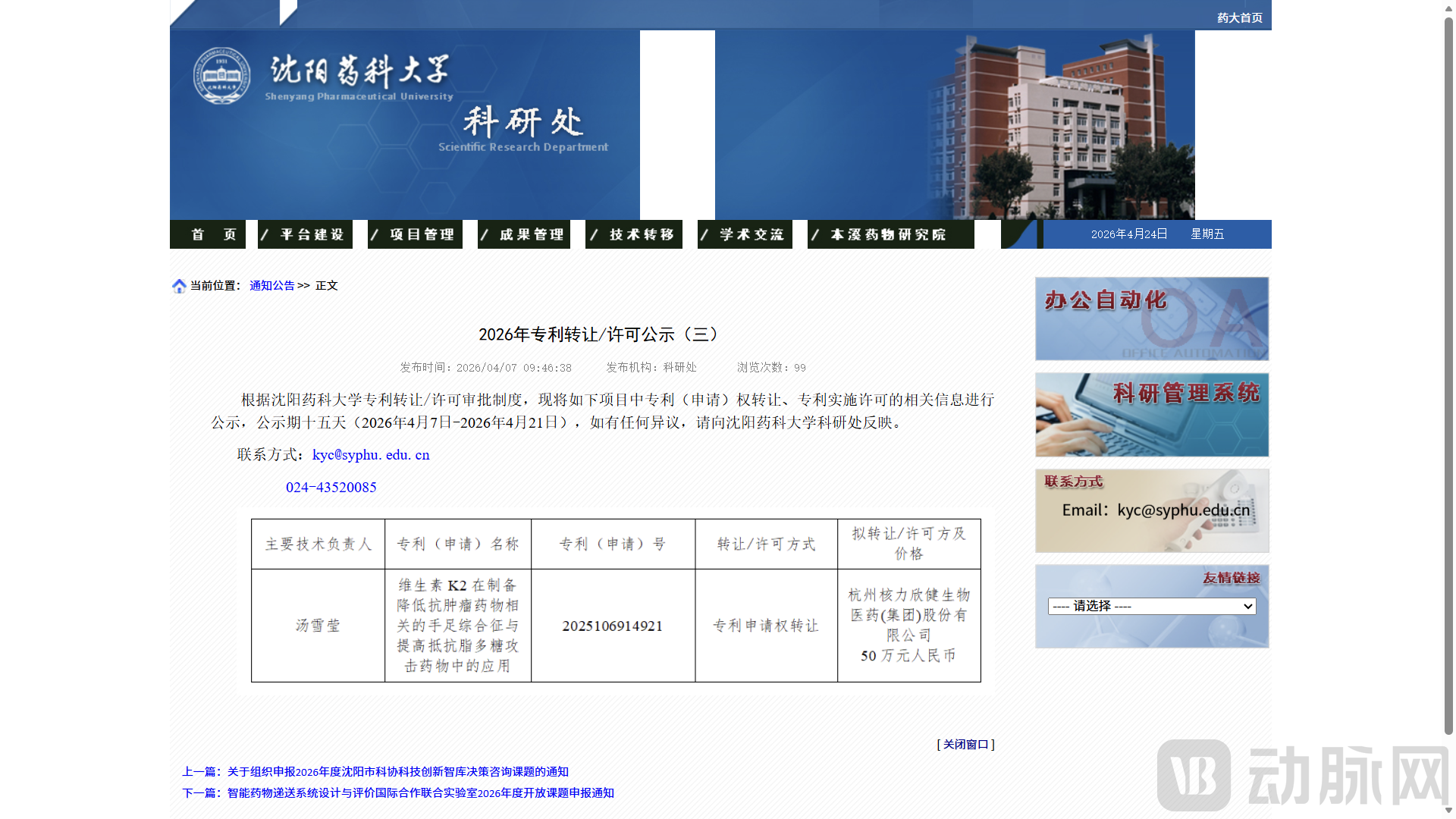
Image from the official website of Shenyang Pharmaceutical University
This patent is held by Shenyang Pharmaceutical University.Tang Xueying TeamR&D efforts have overcome the traditional limitations of vitamin K2 applications, marking the first discovery of its efficacy in preventing and treating hand-foot syndrome induced by antineoplastic agents. Furthermore, vitamin K2 can be formulated into PEGylated compound liposomes with chemotherapy drugs such as doxorubicin. This approach significantly reduces drug toxicity and side effects while enhancing the body’s anti-inflammatory and anti-endotoxin capabilities, all without compromising antitumor efficacy, thereby providing a novel technical pathway for attenuating toxicity and enhancing the efficacy of chemotherapeutic agents.
Hand-Foot Syndrome (HFS), also clinically known as erythema with palmar and plantar sensory loss,It is a dose-limiting cutaneous toxicity reaction primarily induced by antineoplastic agents.This condition primarily involves epidermal growth factor receptor (EGFR)-targeted agents (such as gefitinib and cetuximab) and pegylated nanomedicines (such as pegylated liposomal doxorubicin, PLD). Hand-foot syndrome (HFS) is typically dose-dependent, most commonly occurring during the second to third cycles of chemotherapy, with an incidence rate of 30%–40%. Clinical manifestations are predominantly localized to pressure-bearing or warmer areas of the body surface, such as the palms, soles, and perioral region. Initial symptoms include hypoesthesia and paresthesia, which may progress in severe cases to blistering, desquamation, ulceration, and even epidermal necrosis, significantly impairing patients' quality of life and treatment course.
Currently, the clinical management of hemifacial spasm (HFS) primarily adopts symptomatic treatment. There is still a lack of specific etiological treatments, and no unified nursing guidelines have been established.Management typically requires dose reduction or treatment interruption to alleviate symptoms, which directly compromises the continuity and efficacy of antitumor therapy. Furthermore, patients undergoing chemotherapy often experience increased release of endotoxins (such as lipopolysaccharide, LPS) due to impaired intestinal barrier function, triggering systemic inflammatory responses. Existing anti-inflammatory regimens are frequently associated with adverse effects such as immunosuppression and fail to effectively address the compromised host defense mechanisms induced by chemotherapy.
Meanwhile, most existing preclinical screenings use tumor inhibition rate as the gold standard for evaluation, overlooking the extensive damage that drugs inflict on healthy host cells while killing tumor cells, particularly the impairment of the body’s ability to resist external pathogen attacks. Although certain nanomedicines exhibit excellent tumor-inhibitory effects, they can cause a sharp decline in the body’s resistance to lipopolysaccharide (LPS) challenge, even posing an extremely high risk of death upon exposure to minor infections.
Therefore, there is an urgent clinical need forA method for preventing or treating antineoplastic drug-related skin injuries (such as HFS), as well as innovative drugs or adjunctive therapeutic regimens that modulate the coagulation–inflammation balance and enhance the body’s resistance to lipopolysaccharide (LPS) challenge, thereby comprehensively improving patients’ quality of life and safety while ensuring antitumor efficacy.
This patent discloses for the first time the dual therapeutic value of vitamin K2 (particularly menaquinone-4 and menaquinone-7) in anti-tumor treatment.Its core innovation lies not only in the prevention and treatment of severe cutaneous toxicities—specifically hand-foot syndrome (HFS)—induced by antineoplastic agents (such as epidermal growth factor receptor inhibitors and pegylated liposomal doxorubicin), significantly reducing the severity of skin lesions (from Grade 3 to Grade 1); more importantly, it modulates the coagulation-inflammation balance, substantially enhancing the body’s resistance to lipopolysaccharide (LPS) challenge. Experimental evidence confirms that this technology dramatically improves survival rates in subject animals under LPS challenge (from 0% to 100%), effectively addressing the critical issue of immune defense collapse associated with conventional chemotherapy.
Meanwhile, this patent enables the use of vitamin K2 as a separate formulation (such as topical or oral dosage forms like emulsions) in combination with antineoplastic agents for the prevention or treatment of skin injuries. More innovatively, it has developed combination formulations of vitamin K2 and antineoplastic agents (such as PEGylated liposomes and nanoparticles). This combination design incorporates vitamin K2 into the carrier of the antineoplastic drug (e.g., combination liposomes of doxorubicin and menaquinone-7), achieving the desired effect without altering the in vivo circulation time of the drug.“Enhancing Efficacy and Reducing Toxicity”. This combination formulation can significantly alleviate chemotherapy-induced side effects, substantially improve patients' quality of life, and does not require changes to existing clinical administration practices.
In summary, given that hand-foot syndrome is a high-incidence complication of chemotherapy and targeted therapy with no specific therapeutic agents available—a significant unmet clinical need—vitamin K2, as a well-established nutrient, offers distinct advantages in terms of exceptional safety and low cost. Leveraging its high safety profile and dual mechanisms of action, this technology holds promise for effective translation into an essential product for managing chemotherapy-induced skin toxicity, demonstrating substantial potential for clinical application and commercial value.
Currently used in clinical practice forPharmacological Management of Antineoplastic Drug-Associated Hand-Foot Syndrome Primarily Focuses on Symptomatic Treatment, primarily including topical anti-inflammatory and analgesic preparations, neurotrophic agents, skin protectants and repair formulations, as well as traditional Chinese medicine (TCM) topical agents with heat-clearing, detoxifying, swelling-reducing, and pain-relieving properties. The product portfolio is relatively comprehensive, with mature clinical application and high accessibility. Market demand continues to grow steadily, driven by the expanding population of patients undergoing tumor chemotherapy and targeted therapy.
However, overall, most existing drugs focus primarily on alleviating and managing the local cutaneous symptoms of hand-foot syndrome (HFS). Their mechanisms of action are relatively limited, and their functions are rather singular, making it difficult to address other potential systemic injury risks that patients may encounter during cancer treatment. Conversely, drugs capable of enhancing the body’s resistance to lipopolysaccharide (LPS) attack are predominantly utilized in clinical settings for severe infections, endotoxemia, and sepsis. Their clinical use is highly standardized and strictly regulated, with relatively focused indications. These agents also suffer from single-target mechanisms and independent indications, rendering them unable to address common adverse reactions such as HFS that arise during cancer therapy.
Currently, these two classes of drugs are used independently in the market, with no synergistic functionality. To date, no marketed product has been developed that can simultaneously prevent and intervene in hand-foot syndrome while providing protection against lipopolysaccharide-induced injury, leaving a clear clinical gap.
Mecobalamin TabletsThe core component is mecobalamin, the active endogenous coenzyme form of vitamin B12, which can directly participate in neural metabolism and repair processes without requiring hepatic metabolic conversion. Its mechanism of action focuses on nourishing nerves, repairing damaged neural tissue, and improving nerve conduction function. By participating in the one-carbon unit cycle, it promotes neuronal nucleic acid and protein synthesis as well as myelin regeneration, providing targeted intervention for peripheral nerve injury and small fiber neuropathy induced by chemotherapeutic agents.
In the context of antineoplastic therapy, mecobalamin tablets are primarily used to prevent and alleviate chemotherapy-induced hand-foot syndrome (HFS). They improve neurogenic symptoms such as numbness, tingling, paresthesia, and pain in the hands and feet, while also aiding in the reduction of skin inflammation and damage, thereby providing support for nerve repair in the clinical management of HFS. As an oral formulation with convenient administration and a favorable safety profile, this medication can be administered concurrently with chemotherapy or used for symptomatic intervention after symptom onset, meeting the needs of long-term treatment and adverse event management in cancer patients.
Ruyi Jinhuang SanIt is a classic, traditional Chinese proprietary medicine for external use. Its formulation is scientifically rigorous and primarily consists of a combination of multiple Chinese herbal ingredients, including Curcumae Longae Rhizoma (Jianghuang), Rhei Radix et Rhizoma (Dahuang), Phellodendri Chinensis Cortex (Huangbai), and Angelicae Dahuricae Radix (Baizhi). Its core therapeutic effects are clearing heat and detoxifying, reducing swelling and alleviating pain, cooling the blood, and dispersing stasis. The medication has mild properties and a high safety profile for topical application, with no significant systemic adverse reactions. Its pharmacological actions align closely with the pathological characteristics of hand-foot syndrome (HFS) induced by chemotherapy or targeted therapy. Clinically, it can be used as an adjunctive treatment to improve HFS-related symptoms, particularly in cases of HFS characterized by accumulation of heat-toxin. It effectively relieves discomfort such as redness, swelling, burning sensation, and pain in the hands and feet. Furthermore, it is typically applied to the affected areas after being mixed with clear tea or vegetable oil, offering a simple and patient-friendly method of administration.
With its long history of clinical application, mature preparation techniques, and well-defined efficacy, Jinhuang San has established a broad foundation for use in China. It is produced under standardized conditions by multiple reputable manufacturers of proprietary Chinese medicines, ensuring stable product quality. Through extensive distribution across healthcare institutions at all levels and retail channels, as well as the promotion of integrated traditional Chinese and Western medicine treatment models, its application scenarios as an adjunctive intervention for Hand-Foot Syndrome (HFS) continue to expand. Its clinical recognition is steadily increasing, making it one of the commonly used agents in the external treatment of HFS with traditional Chinese medicine.
This patented technology is based on a clear pharmacological mechanism of action and clinical demand orientation, through scientific formulation design and process optimization, whilePossesses the dual core efficacies of alleviating anticancer drug-associated hand-foot syndrome and enhancing the body's resistance to lipopolysaccharide challenge,It precisely fills the critical gap in the current market, where two classes of drugs function independently and fail to provide synergistic protection. Its technical solution aligns with the scope of protection and key innovative aspects outlined in the patent specification, demonstrating prominent differentiated technical advantages and clinical application value.
As the concept of standardized oncology treatment continues to gain traction, there is a growing demand for comprehensive management of complications and multi-dimensional protective measures in cancer patients. Innovative formulations with multiple protective effects have become a significant trend in industry development. This patented product can be widely applied across various scenarios, including medical oncology, hematology, and intensive care units at healthcare institutions of all levels, as well as home-based rehabilitation for patients. With ample room for market penetration, it aims to provide novel solutions in the fields of supportive cancer care and infection prevention, thereby helping to improve treatment adherence and quality of life for cancer patients.