

Flexible and Precise Epidermal Sensors Enabled by Structural Anchoring and Signal Decoupling: A Multimodal Electronic Skin for Continuous Physiological Monitoring
Recently, Sun Yat-sen University released a public notice on the transformation of scientific and technological achievements, indicating that the university intends to“Implementation Methods of Electronic Skin and Physiological Signal Monitoring Systems”This achievement has been transferred to Nanjing Yueyuchen Technology Co., Ltd. through negotiated pricing. The transfer amount is50,000 yuan, the inventor isWu Jin & Luo Yibing。
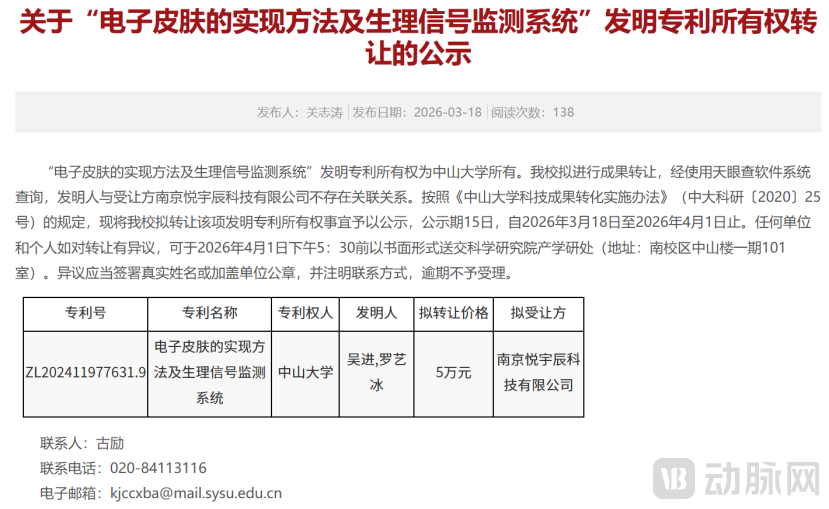
Image from the official website of Sun Yat-sen University
This patent primarily providesA Flexible Multifunctional Electronic Skin with Resistance to Mechanical Deformation and No Signal Crosstalk, by constructing“Polyethylene Terephthalate (PET) Rigid Islands and Polydimethylsiloxane (PDMS) Flexible Bridges”...the underlying structure combined with silanization-based chemical anchoring, along with multilayer hydrogel-sensitive films and signal decoupling algorithms, to achieve high-precision, interference-free continuous monitoring of various physiological signals—including body temperature, skin surface humidity, and transcutaneous partial pressure of oxygen (TcPO2)—during dynamic movement.
In the modern chronic disease management system,Continuous Monitoring of Key Physiological Parameters and Long-Term Data Analysis Are Core to Determining Prognosis. Taking diabetic foot ulcers complicated by lower extremity vascular disease as an example, this is a severe complication that is extremely common and frequently encountered in clinical practice. Due to microangiopathy and neuropathy caused by long-term hyperglycemia, patients are highly susceptible to developing chronic, non-healing wounds and even gangrene in their lower limbs. In the precise assessment and limb-salvage treatment of this condition, macroscopic examination of large vessels alone is often insufficient; there is an urgent clinical need for highly refined, quantitative assessment of the local microcirculatory perfusion status at the affected site.
TcPO2 as a Core Quantitative Indicator for Noninvasively and Objectively Reflecting the Status of Local Tissue Microcirculatory Oxygen Supply, it possesses irreplaceable clinical value in predicting the healing probability of diabetic foot ulcers, assisting in the determination of amputation levels, and evaluating the efficacy of local treatments such as hyperbaric oxygen therapy. Beyond diabetic foot conditions, continuous changes in body temperature, skin surface humidity, and exhaled breath humidity also serve as critical physiological signals for patients with chronic diseases, including severe chronic lower limb ischemia and obstructive sleep apnea-hypopnea syndrome. However, traditional medical monitoring devices mostly adopt rigid structures, are bulky, and must be used within specific medical facilities. They not only fail to enable round-the-clock out-of-hospital disease monitoring but also pose a risk of secondary mechanical injury to the skin surrounding wounds due to their stiff materials.
To overcome the physical form limitations of traditional medical devices, flexible electronic skin that can be attached to the human body surface has emerged.Electronic SkinAs a flexible sensor network that simulates the human tactile and perceptual systems, it can be attached to the skin surface to sense pressure, temperature, humidity, and biochemical signals in real time, representing the cutting-edge form of current wearable medical devices. Among them,Conductive HydrogelIt has become a star candidate material for the fabrication of multifunctional flexible sensors, owing to its excellent ionic conductivity, high transparency, and superior biocompatibility with human tissues.
However, hydrogel materials face fundamental physical and chemical application barriers when advancing toward real-world clinical scenarios. The first isSignal Instability Caused by “Strain Sensitivity”. Due to the high stretchability of hydrogels, their electrical conductivity changes when patients’ daily activities cause mechanical deformation of the skin, which to some extent affects the stability and accuracy of sensor output data under dynamic conditions. Secondly,"Multi-Stimulus Crosstalk" Issue. Due to physical properties such as the water-containing nature of hydrogels, their sensing performance is susceptible to coupled interference from multiple factors, including temperature and ambient humidity. When sensors attempt to simultaneously and continuously measure body temperature, humidity, and transcutaneous partial pressure of oxygen (tcPO2), cross-interference among different stimulus sources makes it highly complex to accurately isolate individual parameters, posing a barrier to the clinical translation of multifunctional hydrogel sensors.
Addressing the application challenges of flexible sensors in tensile strain and signal crosstalk, the R&D team started fromMechanical Structure and Sensing MechanismInnovations were made in two dimensions. To address signal variations caused by mechanical stretching, the team introduced“Island-Bridge Structure” Sensing Platform. The platform is composed of two materials with significantly different elastic moduli:Stretchable PDMSThe "Bridge Zone" as a Connector,Non-stretchable rigid PET filmAs the “island regions” that house the sensing units. When the device undergoes tensile deformation, the length of the bridge regions increases along the stretching direction, while the size of the island regions remains unchanged, thereby shielding the sensing units on the island regions from tensile strain.
However, due to modulus mismatch, direct bonding of the two materials tends to cause delamination in the island regions. To address this,The team enhanced chemical anchoring between materials through surface treatment.. They subjected the PDMS and PET surfaces to air plasma treatment and functionalized the PET using the silane coupling agent APTES. Subsequently, Dragon Skin (DS) prepolymer was used to bond the two materials, forming covalent siloxane bonds that significantly enhanced the adhesion strength. Experimental tests demonstrated that the sensor’s resistance remained stable under dynamic tensile strain of 50%, effectively preventing structural tearing and delamination.
Addressing the issue of crosstalk among multiple signals,This technology achieves self-calibrating sensing by combining physical isolation with differentiated sensing mechanisms.. In terms of material selection,A PAM/Carr-LiBr hydrogel thin film was employed as the core sensing layer.The sensing platform is designed with a three-layer structure:The first and third layers are designed to detect humidity and oxygen in the air and at the skin surface, respectively, while the intermediate second layer is used to measure body temperature. This layered design utilizes PDMS in the first and third layers to physically isolate humidity and oxygen, thereby preventing interference with body temperature detection. Meanwhile, the team applied different electrical signals for different targets: alternating current (AC) with distinct parameters was used for the temperature and humidity sensing units, whereas direct current (DC) signals were employed for the oxygen sensing unit.
Experimental tests demonstrate that, under this mechanism, the temperature sensing unit is insensitive to oxygen and humidity; the humidity sensing unit is resistant to oxygen interference, but its electrical conductivity is affected by temperature; whereas the oxygen sensing unit is influenced by both ambient temperature and humidity.Based on this response pattern, the system has established a decoupling mechanism:First, accurate temperature measurements are obtained using an undisturbed temperature sensing unit. Then, the humidity signal is decoupled and calibrated by combining the temperature results with a temperature-humidity response composite map. Finally, the oxygen sensing unit is further decoupled based on the acquired temperature and humidity data. This self-calibration mechanism effectively eliminates cross-interference among multiple stimulus sources, enabling accurate monitoring of multiple physiological signals.
Looking at the broader global ecosystem of in vitro diagnostics and digital health, flexible electronic skin and wearable medical devices are currently positioned atThe critical transition phase from “sports and wellness consumer products” to “serious medical-grade monitoring devices.”
Early StageSmart Wearable Devices Represented by Apple WatchPrimarily relies on optical and photoplethysmography (PPG) techniques to obtain basic physiological signs such as heart rate and blood oxygen saturation.
With the evolution of materials science, a cohort of highly competitive, professional-grade medical innovation enterprises has emerged in the flexible electronic skin sector. For instance, MC10, a pioneer in the global field of flexible electronics, once leveraged its iconicBioStamp Flexible PatchIt has garnered widespread attention in the global medical community. By integrating an ultra-thin silicone substrate with serpentine metal interconnects, BioStamp conforms closely to the body’s contours, enabling low-burden, continuous monitoring of electrocardiograms (ECG), electromyograms (EMG), and high-precision motion posture.
In the domestic market, companies such as VivaLNK have already launched flexible temperature and ECG patches that have obtained dual medical device certifications from the U.S. FDA and China’s NMPA. Utilizing an encapsulation process featuring a “flexible substrate with rigid microchip islands,” these products have been deployed in continuous vital sign monitoring networks within hospital infectious disease wards and intensive care units.