

Nantong University Affiliated Hospital Licenses SCML2-Based IHC Kit for GEP-NETs Diagnosis to Zhongshan Golden Bridge Biotechnology
Recently, the Affiliated Hospital of Nantong University published a public notice regarding the commercialization of two achievements in the diagnosis of gastroenteropancreatic neuroendocrine tumors (GEP-NETs). The hospital plans to“Ready-to-Use Rapid Enzymatic Immunohistochemistry Kit for SCML2 Detection” and “Application of SCML2 in the Diagnosis of Gastroenteropancreatic Neuroendocrine Tumors”Two invention patents have been assigned to Beijing Zhongshan Jinqiao Biotechnology Co., Ltd., with the inventors beingXiao Mingbing and His Team, total transfer amount¥40,000。
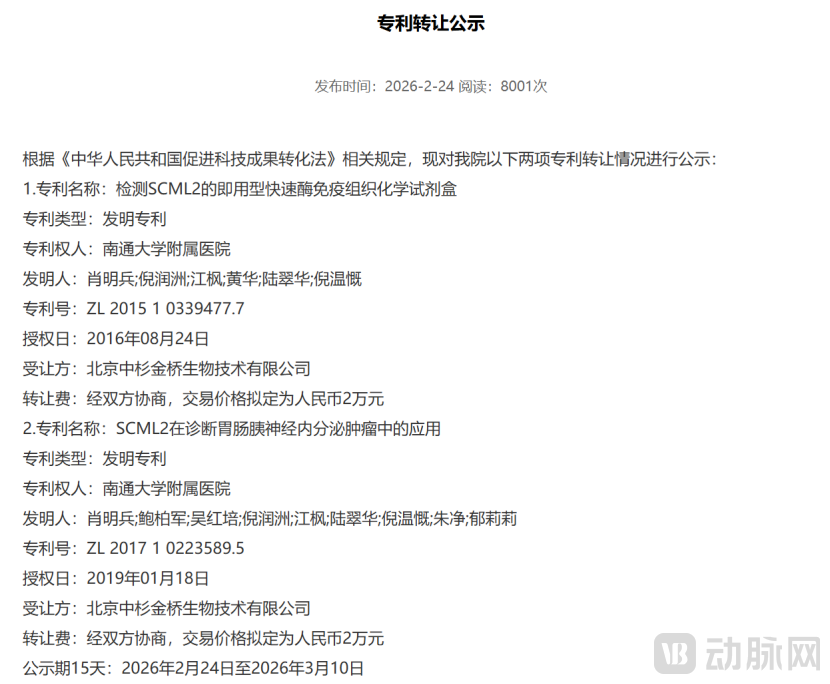
Image from the official website of Affiliated Hospital of Nantong University
This series of patents establishesSCML2As a novel biomarker for gastroenteropancreatic neuroendocrine tumors, and the development ofA ready-to-use immunohistochemistry system comprising high-concentration monoclonal mouse anti-human SCML2 antibody, polymer enhancer, and HRP-labeled polymer, aiming to achieve precise auxiliary diagnosis of GEP-NETs through a dual approach combining quantitative serum ELISA and rapid histological staining.
GEP-NETs are a highly heterogeneous group of tumors originating from peptidergic neurons and neuroendocrine cells.Although historically regarded as a rare disease, the latest clinical epidemiological data indicate that its incidence has now risen to second only to colorectal cancer among all gastrointestinal malignancies.
Such tumors can occur throughout the body, with approximately 70% concentrated in the gastrointestinal tract and some originating from the pancreas. Since more than 80% of patients are completely asymptomatic in the early stages of the disease, it poses significant challenges for early clinical screening. Clinical diagnosis and treatment data indicate that the average time to definitive diagnosis ranges from five to seven years. This severe diagnostic delay often means that distant metastasis has already occurred by the time of final diagnosis, causing patients to miss the optimal window for curative surgical intervention at an early stage, thereby substantially increasing the difficulty of late-stage treatment and the risk to patient survival.
In the current system of pathological diagnosis and in vitro testing, clinicians primarily rely onGeneral secretory protein markers, such as chromogranin A (CgA) and synaptophysin (Syn)for the initial screening and definitive diagnosis of neuroendocrine tumors.
However, as the volume of clinical laboratory samples has expanded, these traditional markers have revealed significant limitations in performance when addressing the high heterogeneity of gastroenteropancreatic neuroendocrine tumors (GEP-NETs). Taking chromogranin A (CgA), the most widely used marker in clinical practice, as an example, its sensitivity varies considerably in actual testing, typically fluctuating dramatically between 32% and 92%. Furthermore, CgA exhibits significant cross-interference issues regarding specificity. In patients with comorbid conditions such as chronic heart failure, autoimmune diseases, or renal insufficiency, serum CgA levels are highly prone to false-positive elevations. This unstable sensitivity, combined with a high false-positive rate in the presence of specific underlying diseases, means that relying solely on CgA or synaptophysin (Syn) for detection can easily lead to misdiagnosis or missed diagnosis in clinical pathology.
Therefore, clinical pathology departments need to introduceA novel tumor target capable of overcoming interference from the aforementioned non-neoplastic underlying conditions and forming an efficient complement to existing traditional biomarkers, to establish a more rigorous and precise diagnostic evaluation system.
To address the aforementioned clinical pain points, the research team at the Affiliated Hospital of Nantong University conducted an in-depth exploration of Polycomb group (PcG) genes,First established SCML2 as a key auxiliary diagnostic marker for gastroenteropancreatic neuroendocrine tumors.As a crucial component of the Polycomb Repressive Complex (PRC), SCML2 participates in the regulation of embryonic development and the cell cycle, and its aberrant expression in certain malignant tumors is closely associated with disordered cellular proliferation.
Patent research, validated through large-scale sample studies, reveals that, SCML2 exhibits significantly specific expression patterns in GEP-NET tissues.Based on this discovery, the team not only established a sensitive direct ELISA protocol for serum detection by constructing a quantitative analysis model using mouse anti-human SCML2 monoclonal antibodies and horseradish peroxidase (HRP)-labeled secondary antibodies, but also developed a ready-to-use rapid enzyme immunohistochemistry kit tailored to clinical pathological needs, thereby transforming complex laboratory assays into standardized clinical tools.
The technical advantages of this ready-to-use kit lie inOptimization of the Underlying Formulation and Introduction of a Signal Amplification SystemThe kit integrates a monoclonal mouse anti-human SCML2 core antibody with a storage concentration of up to 0.2 µg/µl, and is equipped with a specialized “polymer enhancer” and “HRP-labeled anti-mouse IgG polymer.” This polymer-based two-step detection mechanism conjugates multiple HRP enzyme molecules and antibodies onto the same polymer backbone, thereby amplifying the chromogenic signal without increasing background noise. Furthermore, the kit comprehensively includes 3% hydrogen peroxide blocking solution, powder-form antigen retrieval solution based on citrate buffer, and precisely formulated phosphate-buffered saline.
This all-in-one encapsulation design eliminates the need for pathologists to perform tedious antibody gradient dilutions and reagent preparations, ensuring high consistency of test results across different medical laboratories. Clinical trial data have confirmed that when SCML2 is used in combination with traditional markers such as Syn or CgA, it demonstrates significant complementary diagnostic value, effectively capturing positive signals missed by conventional methods, thereby improving the overall detection rate for auxiliary diagnosis.
Currently, the global in vitro diagnostics (IVD) landscape for neuroendocrine tumors features a dual-track competitive pattern characterized by “traditional single-target automation” and “multi-gene liquid biopsy,” with commercialization pathways accelerating toward parallel implementation via IVD registration and Laboratory Developed Tests (LDTs).
In the field of traditional biomarkers,Thermo Fisher Scientific B·R·A·H·M·S CgA II KRYPTORIt is currently the global benchmark for commercialization. As the only CgA automated testing product approved by the U.S. FDA, its indications are strictly limited to patient follow-up and progression monitoring. China’s regulatory system maintains a high degree of alignment on this matter: in its latest classification determination issued in 2024, the National Institutes for Food and Drug Control (NIFDC) explicitly defined the clinical use of CgA chemiluminescence assay kits as “dynamic monitoring and assessment of treatment efficacy,” and clearly stated that they shall not be used as a basis for early diagnosis or definitive diagnosis of malignant tumors.
To address the limitations of single biomarkers, innovative multi-gene liquid biopsy approaches have emerged on the international stage.Wren Labs' NETest 2.0It is a typical representative of such products. By performing parallel detection of 51 NEN-related genes in peripheral blood, the product currently operates overseas under the Laboratory Developed Tests (LDT) model within the CLIA and CAP frameworks. The technology has secured a five-year licensing agreement with KingMed Diagnostics, with plans to implement it in domestic laboratories and pursue approval from the National Medical Products Administration (NMPA). This marks the accelerated penetration of high-barrier, multi-target testing solutions from overseas into China’s high-end diagnostics market, as companies vie for dominance in the field of precision diagnosis.
Focusing on the actual pace of commercialization in China, top-tier tertiary hospitals are rapidly addressing urgent clinical needs through the Laboratory Developed Tests (LDT) model during the interim period before formal in vitro diagnostic (IVD) product approval. For instance, Fudan University Shanghai Cancer Center recently successfully tendered an LDT project for Chromogranin A (CgA) enzyme-linked immunosorbent assay (ELISA) kits. This tender not only specified a maximum price cap of RMB 400 per test and an estimated annual demand of 2,000 tests, but also strictly required production in compliance with IVD quality management systems. This confirms that, under the current regulatory and market environment,“Compliant In-House Testing at Grade 3A Hospitals”Has become a key practical pathway for the diagnosis of neuroendocrine neoplasms (NENs) in China.