

Jilin University Licenses Non-Invasive FFR Technology for RMB 100,000 to Alpha Medical Technology (Jilin)
Recently, Jilin University released a public notice on the transfer of patent rights, proposing to transfer its “Method and System for Calculating Fractional Flow Reserve Based on Real-Time Vascular Images”The invention patent is assigned to Alpha Medical Technology (Jilin) Co., Ltd. The assignment fee is 1010,000 yuan. The inventors of this achievement areLiu Binand his/her team。
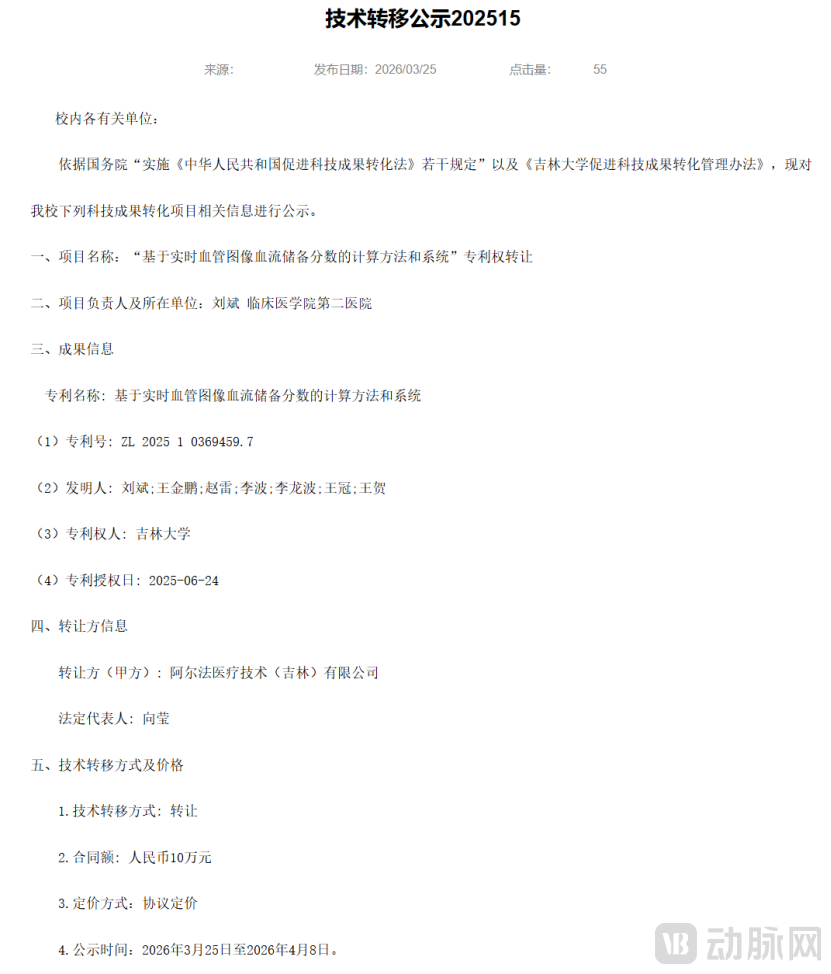
Image source: Official website of the Academy for Advanced Interdisciplinary Studies, Jilin University
“Calculation Method and System for Fractional Flow Reserve Based on Real-Time Vascular Images“An Invention Patent for a Real-Time FFR Intelligent Calculation System for Coronary Interventional Procedures. By precisely registering preoperative vascular imaging with intraoperative real-time angiography, the system synchronously displays stent and lesion locations. It features a dual-mode approach combining proprietary virtual FFR prediction with real-time true FFR calculation, assisting in preoperative stent selection and landing zone assessment, while dynamically monitoring dilation effects and instantly evaluating procedural quality during surgery. The system employs precise modeling based on plaque parameters for more reliable calculations, and its concise, intuitive interface effectively enhances surgical efficiency and safety. This technology addresses the pain points of traditional FFR—namely its invasiveness, latency, and inability to guide stent procedures—and has completed commercialization, representing an innovative Chinese solution for precision coronary intervention.”
In the field of functional assessment for coronary intervention, traditional fractional flow reserve (FFR) technology has long faced application bottlenecks that are difficult to overcome. Both invasive measurement and non-invasive image-based computation exhibit significant limitations in clinical practicality, real-time performance, and procedural compatibility, as detailed in the following three aspects.
Invasive pressure wire measurement is associated with high risks and costs, limiting its clinical adoption.Traditional pressure-wire measurement of fractional flow reserve (FFR) is the gold standard for clinical functional assessment, but it is highly invasive, technically complex, and costly. The procedure requires advancing the wire across the diseased vessel, which can lead to complications such as vascular injury, plaque embolization, and vasospasm. It also necessitates the use of hyperemic agents like adenosine, increasing the risk of adverse reactions in patients. Furthermore, reliance on imported consumables and equipment results in high per-procedure costs and prolonged workflow times, leading to very low clinical adoption in China and limiting its widespread application.
Traditional imaging has significant latency and cannot support real-time intraoperative decision-making.Non-invasive imaging-based FFR technologies, represented by QFR and CT-FFR, eliminate the need for pressure wires but rely on offline post-processing, preventing real-time calculation during stent implantation procedures. These technologies are limited to preoperative assessment or postoperative review and cannot dynamically update data in sync with the surgical process. Consequently, they fail to provide real-time evaluation of stent position, expansion degree, and wall apposition, resulting in significant delays that do not meet the interventionalists’ core needs for immediate intraoperative decision-making and timely adjustments.
Insufficient functional and scenario adaptation; does not support precise guidance throughout the entire stent procedure.Traditional FFR technology lacks stent visualization and lesion modeling capabilities, preventing precise calculations that incorporate key parameters such as stent model, ideal expansion area, plaque characteristics, and balloon pressure. It can neither predict stent implantation outcomes in advance nor guide stent selection and placement, resulting in significant errors in cases of calcified or diffuse lesions. Furthermore, its rudimentary user interface makes it difficult to integrate with catheterization laboratory workflows, failing to provide integrated support for “preoperative prediction–intraoperative navigation–postoperative assessment.”
This patent, based on a method and system for calculating fractional flow reserve from real-time vascular images, addresses critical clinical pain points and achieves a leapfrog breakthrough from “invasive, offline, and experience-based” to “non-invasive, real-time, and precise,” featuring prominent innovations and significant clinical advantages.
First, real-time dual-image registration achieves innovative integration of preoperative and intraoperative information.Precisely align preoperative vascular imaging with intraoperative real-time angiography to establish a unified coordinate mapping, enabling real-time visualization of stent contours and lesion locations on preoperative images. This approach thoroughly resolves the issues of image asynchrony and fragmented information inherent in traditional techniques, making stent placement and lesion coverage immediately apparent.
Second, virtual FFR and real FFR operate in dual-mode parallelism, covering the entire surgical workflow.Pioneering a dual-mode mechanism featuring virtual FFR prediction prior to stent implantation and real-time calculation of actual FFR post-dilation, this approach enables preoperative prediction of ischemia improvement effects and intraoperative dynamic monitoring of value changes, thereby achieving functional guidance across the entire process of “preoperative prediction–intraoperative navigation–postoperative immediate assessment.”
Third, combined modeling of plaque, stent, and balloon significantly improves computational accuracy.By integrating parameters such as plaque characteristics, balloon pressure, and ideal stent area to construct a personalized computational model, accuracy is significantly improved in complex scenarios involving calcified and diffuse lesions, thereby overcoming the limitations of traditional imaging-based FFR, which suffers from substantial errors and incompatibility with stent implantation procedures.
Fourth, non-invasive, real-time, easy to use, and highly efficient, with outstanding clinical value and widespread applicability.. The procedure requires neither pressure wires nor hyperemic agents, enhancing safety; it delivers results in seconds during the intervention, thereby shortening procedural time and reducing radiation exposure. The user-friendly interface is tailored to catheterization laboratory workflows and compatible with various imaging devices, eliminating the need for additional modifications and facilitating widespread adoption across hospitals at all levels.
Currently, multiple mature products and technical solutions have emerged in the global field of coronary functional assessment, achieving technological breakthroughs through different approaches, including CT image-based computation, non-invasive angiography-based computation, and invasive pressure wire measurements.
HeartFlow, a California-based company founded by Stanford University scientists Charles Taylor and Chris Zarins, has its first product asFFRCT。From a technical perspective, HeartFlow FFRCT is a post-processing software used for clinical quantitative and qualitative analysis. By importing CTA data from patients with coronary artery disease into the HeartFlow software, a three-dimensional computational model of the coronary arteries is generated, along with simulated blood flow pressure and velocity. The FFR value is ultimately derived through mathematical formula-based calculations.
PulseFlow Technology's AccuFFR®angioIt is a coronary functional assessment and analysis software based on coronary angiography, pioneering the wire-free era of FFR detection. It enables non-invasive assessment of FFR for coronary stenosis, providing quantitative analysis of myocardial ischemia severity to guide percutaneous coronary intervention (PCI), with an accuracy exceeding 93%.
Philips' OmniWireIt is the world’s first and only pressure guidewire featuring a solid-core design. Its unique structure not only enhances flexibility and trackability, enabling smooth navigation through complex lesions, but also ensures high stability and accuracy of pressure signals, providing a critical basis for the precise diagnosis of coronary stenosis.