

Fujian Medical University Union Hospital Unveils Dedicated Transport Container for Hepatitis B Blood Samples to Enhance Safety and Stability
Recently, the First Affiliated Hospital of Fujian Medical University released a public notice on the transformation of scientific and technological achievements. The hospital intends to transfer its intellectual property through listed trading on an equity exchange.“A Blood Sample Collection, Storage, and Transport Box for Hepatitis B Virus”The relevant patents have been assigned to Fujian Xiangdong Medical Technology Co., Ltd. for use, with a total licensing fee of RMBRMB 499,600. The inventor of this patented technology isChen Wei and Her Team。
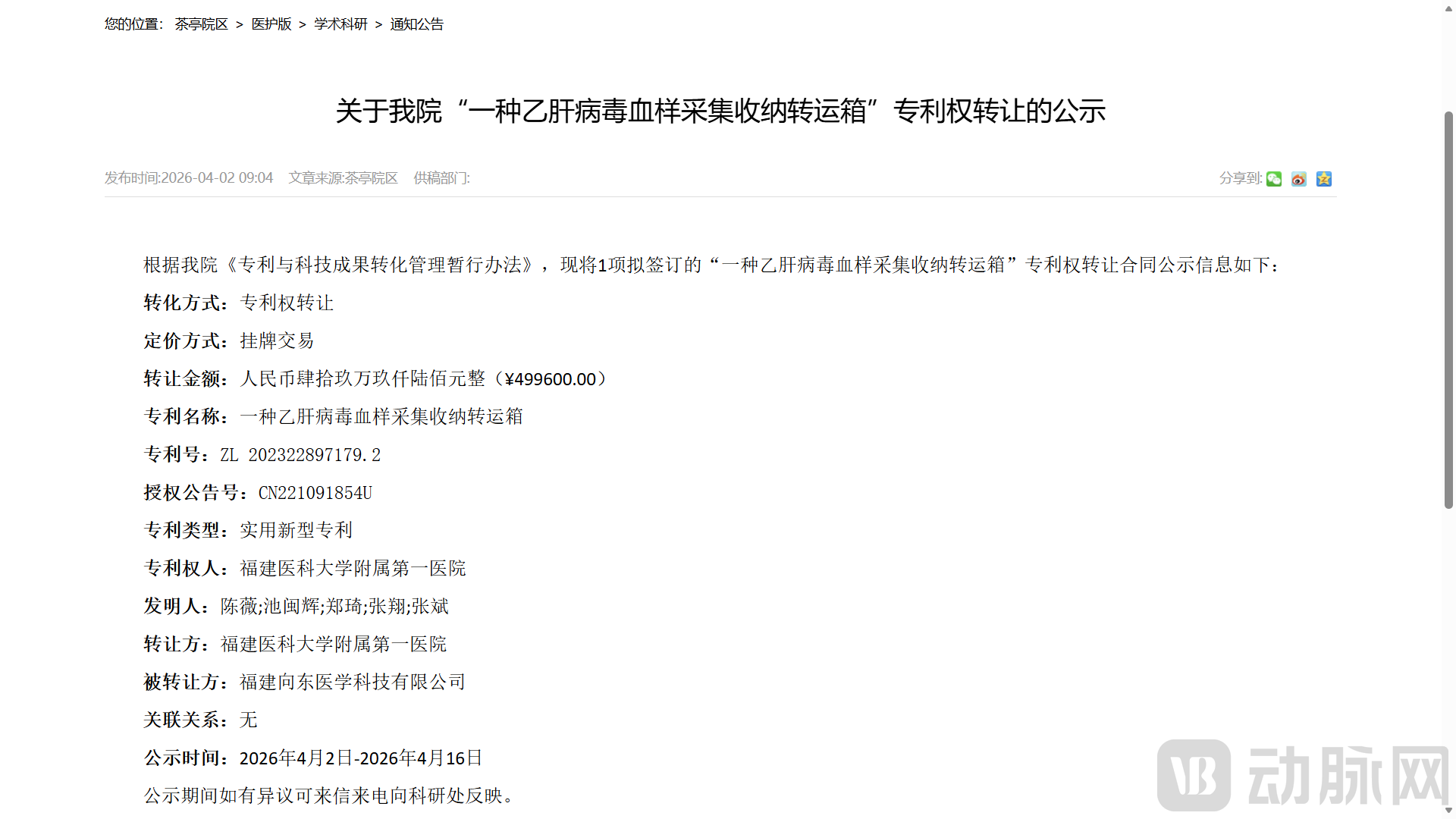
Image from the official website of the First Affiliated Hospital of Fujian Medical University
This technology is specifically designed forMedical-Grade Container Technology for the Collection, Storage, and Safe Transport of Hepatitis B Virus Blood Samples, with the core function beingPrevent blood samples from tipping, collision, or breakage during transport to ensure sample integrity and testing safety.。
Hepatitis B Virus Blood Sample TestingIt is a core component of hepatitis B screening, diagnosis, and treatment efficacy monitoring. The safe transportation of blood samples from collection to delivery for testing directly impacts the accuracy of test results and biosafety. There is an urgent clinical need for specialized transport equipment that is stable, spill-proof, and breakage-resistant.
Currently, general blood collection boxes or simple storage containers are commonly used in clinical practice for the transport of hepatitis B blood samples.No dedicated, standardized transport equipment, has become a persistent operational pain point for both laboratory and clinical departments. Traditional storage containers feature only simple placement holes, lacking any limiting, securing, or protective structures; as a result, blood sample tubes remain loosely placed during transport, making them highly susceptible to shaking, tilting, or even tipping over.
Three Major Pain Points in Clinical Transport:First,Sample Fixation Deficiency, the blood sample tube lacks bottom clamping, mid-section positioning, and top compression; bumps during transport and shaking during handling can easily cause the sample to spill or the tube to break upon impact, resulting in sample contamination, specimen invalidation, delayed testing, and biosafety hazards. Secondly,Insufficient Cushioning Protection, the container lacks shock-absorption design, and there is no cushioning material at the positioning and contact points, making blood sample tubes susceptible to compression and impact damage; the risk of breakage increases significantly, especially during batch transportation. Thirdly,Inconvenience in Operation and Management, the universal container lacks a transparent viewing window, making it impossible to quickly verify sample status; it has no dedicated handle or positioning structure for easy assembly and disassembly, resulting in laborious handling and low efficiency in sample loading and unloading, which makes it difficult to adapt to the high-volume, efficient transport processes required by clinical laboratories.
Furthermore, existing general-purpose storage devices lack specialized designs for the biosafety and transport stability of hepatitis B blood samples, failing to meet the dual requirements of hospital infection prevention and control and sample safety. Their poor stability in complex transport scenarios can lead to sample damage, necessitating repeat blood draws, which increases patient discomfort and the workload of healthcare personnel.
In summary, the current transport of hepatitis B virus blood samples faces core pain points such as the lack of dedicated equipment, unstable fixation, susceptibility to tipping and breakage, inadequate protection, and inconvenient operation, which severely affect the efficiency of the testing process and sample safety.There is an urgent clinical need for a specialized, stable, and safe blood sample collection, storage, and transport device., resolving operational challenges in the transfer process.
The core advantages and advanced nature of this patented technology lie in its fundamental resolution of the industry pain point regarding the lack of specialized equipment for transporting hepatitis B virus blood samples, which are prone to tipping over and breaking. Through“Lateral Constraint + Vertical Penetration + Top Clamping + Bottom Damping”: Synergistic Innovation of the Four-Dimensional Protective Structure, establishing a comprehensive, multi-dimensional system for the stable transport of blood samples, making the entire process of collection, storage, and transportation safer, more standardized, and more efficient.
This solution first overcomes the technical limitation of traditional storage systems, which lack defined positional constraints.
The general-purpose clinical storage box features only simple placement holes, leaving blood sample tubes in an unconstrained state and highly susceptible to displacement and collision during transit. This utility model innovatively adopts a base fixation structure comprising a storage rack and clamping plates: multiple evenly distributed slots allow for the orderly placement of blood samples, while symmetrically arranged clamping plates within each slot provide initial lateral restraint and secure gripping of the sample tube bodies. This design fundamentally prevents lateral swaying and displacement of samples within the container, achieving "instant positioning upon placement" and completely eliminating the safety hazards associated with traditional unrestrained designs.
More critically, there is a breakthrough in the mid-section stable positioning of the “through-type positioning cylinder” and the “slotted positioning plate.”
Conventional devices lack effective constraint on the vertical orientation of samples, causing the upper portion of sample tubes to swing excessively. This patent employs a positioning sleeve structure that vertically penetrates the positioning plate to fully encase and limit the outer wall of the sample tube. Combined with rubber pads on the inner wall of the positioning sleeve, this design provides flexible wrapping protection that is both anti-slip and scratch-resistant, preventing breakage caused by direct impact of glass sample tubes. The slide groove design on both sides of the storage rack allows for smooth installation and removal of the positioning plate, ensuring efficient and convenient sample positioning and handling, thereby achieving "vertical penetration and stable support throughout the process."
On the basis of stable fixation, another major core breakthrough of this protocol lies inFull-Scenario Protection Design with Top Compression and Bottom Shock Absorption.
Traditional transport boxes lack top constraints and cushioning structures, making samples prone to vertical displacement and vibration-induced breakage. This patent features a dedicated pressure block beneath the sealed lid, which automatically clamps the tops of sample tubes upon closure, creating a three-dimensional fixation system characterized by “top compression, middle constraint, and bottom cushioning.” Additionally, shock-absorbing pads installed at the bottom of the box effectively absorb impact forces from bumps and collisions during transit, comprehensively reducing the risk of sample damage and making it particularly suitable for long-distance, multi-scenario transportation needs.
Meanwhile,This technology balances the convenience and standardization of clinical procedures:
A transparent viewing window on the front of the container allows for rapid verification of sample quantity and status without opening the lid, thereby enhancing workflow efficiency in the clinical laboratory. The ergonomically designed dual-side handles enable stable, single-person transport. With its specialized and standardized structure requiring no complex assembly, the device is ready for immediate use by healthcare professionals, significantly optimizing the entire process from collection to delivery of hepatitis B blood samples and filling the gap in dedicated transport equipment for clinical hepatitis B virus blood samples.
The current market for blood sample collection and biosafety transport boxes has formed a competitive landscape comprising international brands, leading domestic players, and small- and medium-sized manufacturers, with products primarilyUniversal Cold Chain/Biosafety Transport BoxFocusing onTemperature Control, Biosafety, and Intelligent TraceabilityThree major directions, but specialized transport equipment designed specifically for hepatitis B virus blood samples, featuring a multi-layer positioning and anti-tip structure, remains a gap in the market.
Haier Bio-Medical's HZY-5B Blood Transport Box, with core features including passive cooling and an internal temperature range of 2–10°C, designed for the transport of blood and critical specimens. It is equipped with thermal insulation and a simple fixation bracket, and supports temperature monitoring and electromagnetic lock security management. It is primarily used for routine blood sample transportation in hospitals, blood centers, and blood collection sites. The product has achieved mature mass production and is widely applied across medical institutions at all levels in China. With cold-chain temperature control as its core advantage, it does not feature a dual-positioning (top and bottom) or clamping plus top-compression structure for individual blood collection tubes.
BIOBASE Group's flagship products: BTB-L Series Biological Safety Transport Boxes (BTB-L5/6/8/12/15, etc.)Compliant with UN2814/UN2900/UN3373 standards, constructed from PP+PE materials with PU insulation, designed for the transport of infectious substances such as pathogenic microorganisms and blood. The interior is equipped with a simple test tube holder and sealed containers. Full-scale mass production has been achieved, covering a range of specifications from 5L to 65L. With a focus on biosafety compliance, the internal fixation primarily utilizes sponge/foam holders, featuring an integrated design without segmented clamping, positioning plates, or pressure blocks.
OLABO (Jinan Jiuxiang Biology) OLB-L12 Biological Safety Transport Box, featuring a 12L dual-canister design suitable for Class A/UN2814 sample transport. It includes built-in 95 kPa safety transport canisters, a digital thermometer, and cold accumulator ice packs, with a capacity for 38 specimen samples. Targeted at hospitals, CDCs, and blood stations, this product is now commercially mature, highlighting large capacity and biosafety as key selling points. Its interior utilizes foam/sponge slots for fixation, lacking the triple-stabilization structure of clamping plates, upper/lower positioning cylinders, and top pressure blocks covered by this patent.
In summary, this patented blood sample collection, storage, and transport box for hepatitis B virus addresses the core pain points in clinical blood sample transportation—namely, the lack of dedicated equipment and the susceptibility to tipping, collision, and breakage—byBottom Clamping, Mid-Section Dual Positioning Cylinder, Top Compression, and Bottom Shock Absorption: A Four-Layer Synergistic Structure, achieving comprehensive, secure fixation and flexible protection of samples, thereby fundamentally resolving issues of sample damage, contamination, and degradation during transportation. The device offers advantages such as precise positioning, ease of operation, and high safety and reliability, filling a market gap for specialized transport equipment for hepatitis B blood samples.
In the future, this technology can further promote the upgrading of clinical laboratory sample transportation towards specialization, standardization, and high safety, providing efficient solutions for the standardized transport of infectious blood samples and hospital infection prevention and control, with broad clinical application and promotion value.