

Yimai Sunshine Launches a Strategic 'Dimensional Upgrade': Building the World's Largest Digital-Intelligent Imaging⁺ Ecosystem

Rimag
Third-Party Chain Medical Imaging Service Provider
Recently, RIMAG (HK: 02522), a leading domestic medical imaging company, plans to undertake a major strategic upgrade.
Shedding the label of “medical imaging service provider,” it aims to become“The Global Leader in the Digital-Intelligent Imaging⁺ Ecosystem”。
At the press conference, RIMAG significantly increased its equity stake in Yinghe Yimai to 25.36%, aiming to leverage the “Scenario–Data–AI” engine to buildDigital-Intelligence Imaging⁺ Ecosystem, leveraging new digital and intelligent infrastructure to unlock new growth drivers.
Concurrently, RIMAG announced partnerships with Tencent Health and United Imaging Healthcare to accelerate the construction of an imaging AI “super factory” and its deployment in overseas markets. The company also plans to collaborate with top-tier Grade 3A hospitals, such as West China Hospital of Sichuan University and Beijing Anzhen Hospital affiliated with Capital Medical University, on agent development, placing physicians at the core of the AI development workflow.
Massively Doubling Down on AI: RIMAG Bets on the New Logic of Medical Imaging in This Era:
As the potential of device physical architecture approaches its limits, based onClinical DataThe outcome of the “software intelligence” competition will determine who achieves victory first.
Across the landscape of existing medical imaging companies involved in AI, RIMAG’s own positioning determines that its approach is inherently differentiated.
Over the past decade, RIMAG has been deeply engaged in the third-party imaging center sector, expanding its offline network to cover 20 provinces across China. It has established 117 imaging service centers and partnered with over 1,100 institutions, securing its position as the industry leader.
Throughout this process, RIMAG has not only acquired equipment and data, but both have reached substantial scales. Based on its business volume, RIMAG adds over 10 million new imaging cases annually, sufficient to meet the demand for clinical data in the era of large language models.
Therefore, while traditional medical imaging AI companies are still focused on training AI models within a limited number of hospitals, RIMAG can achieve cross-regional, cross-device, and cross-modality integration of data spanning the entire lifecycle. The AI developed from this integrated data inherently avoids common pitfalls such as reliance on single-source imaging data, limited application capabilities, and difficulties in deployment at primary care levels.
With access to a vast repository of high-quality clinical data, RIMAG’s strategy for entering the imaging AI sector also differs from previous industry approaches.
Leveraging the algorithmic expertise accumulated in collaboration with Yinghe Yimai, RIMAG has proposed an “Imaging AI Super Factory” model. This approach employs a batch-oriented, systematic strategy for AI development to first transition imaging AI from the 1.0 era of single-disease tools to the 2.0 era driven by foundational large models. Building upon these foundational models, it then initiates scaled-up AI production centered on examination items as units, thereby advancing into the factory-mode AI 3.0 era.
Mass production and large-scale manufacturing here do not mean simply abandoning innovation or neglecting demand orientation in the pursuit of AI-driven manufacturing efficiency.
In contrast, previous single-disease AI solutions failed to accurately address clinicians’ needs, as they could only determine the presence or absence of lesions for a single disease. RIMAG, however, started from the actual diagnostic and treatment needs of physicians, efficiently building clusters that align with their daily clinical workflows, thereby formingSuper Agent。
The flagship product unveiled at the press conference, the “Superintelligent Agent for Cranial CT,” serves as a prime example of this model. This product breaks away from the traditional paradigm of one AI algorithm corresponding to a single disease; it not only identifies 94 common cranial conditions with an accuracy rate of 87.8%, but also automatically generates imaging reports.
Real-world data from Beijing Tiantan Hospital, Capital Medical University, show that over 90% of cases require no modification or only minor adjustments for clinical use, reducing report turnaround time from 15 minutes to just 1 minute.
Before RIMAG entered this sector, the concept of super-intelligent agents existed only as a theoretical possibility. This is because such systems require vast amounts of data, encompass broad modalities, and demand a high degree of standardization, making it difficult for individual hospitals or enterprises to build databases that meet these requirements.
However, superintelligent agents are an inevitable path in the development of AI. Only when AI’s diagnostic capabilities closely approximate those of physicians will radiologists be truly liberated from repetitive tasks, allowing them to devote their time to high-value work and scientific research.
Although the realization of the “Superintelligent Agent for Cranial CT” has transformed the way AI empowers medical imaging, RIMAG still faces two challenges.
First, the application of independent diagnostic modules must be highly integrated into physicians' workflows; second, insights into the most cutting-edge AI needs still originate from top-tier tertiary hospitals equipped with the highest-quality medical devices.
Consequently, after completing the construction of a model for digital and intelligent diagnostic and therapeutic capabilities, RIMAG, on one hand,Promote the deep integration of AI into physicians’ workflows, enabling AI to serve as a capable assistant and truly empower the entire clinical diagnosis and treatment process.On the other hand,Expand mature pilot models and strengthen AI collaboration with top-tier hospitals。
At the press conference, Doctor-buddy, the digital doctor jointly developed by RIMAG and Tencent, is designed to leverageImaging AI Super Factoryproduction paradigm, creating doctors' "exclusive digital twins," deeply integratingAI and Physiciansworkflow, achieving the leap into the AI-Native 3.0 era.
Compared with traditional tools that focus on improving efficiency within a single discipline, the core value of Doctor-buddy is reflected in three major dimensions:
First, the “One Foundation, One Platform” New Architecture: Constructing a dual-layer evolutionary system comprising a “Model Layer + Capability Layer,” powered by a unified AI center to support hospital-wide scaled production.
Second, the new paradigm of “Work as Training”: By breaking away from traditional offline training that relies on costly manual annotation, this approach automatically collects data and implements closed-loop reinforcement feedback through physicians’ routine operations, enabling model evolution at zero additional cost.
3. A New Experience of “Evolution Through Use”: Providing anthropomorphic natural language interaction, the system becomes increasingly attuned to physicians’ professional preferences over time, precisely matching their diagnostic and treatment needs.
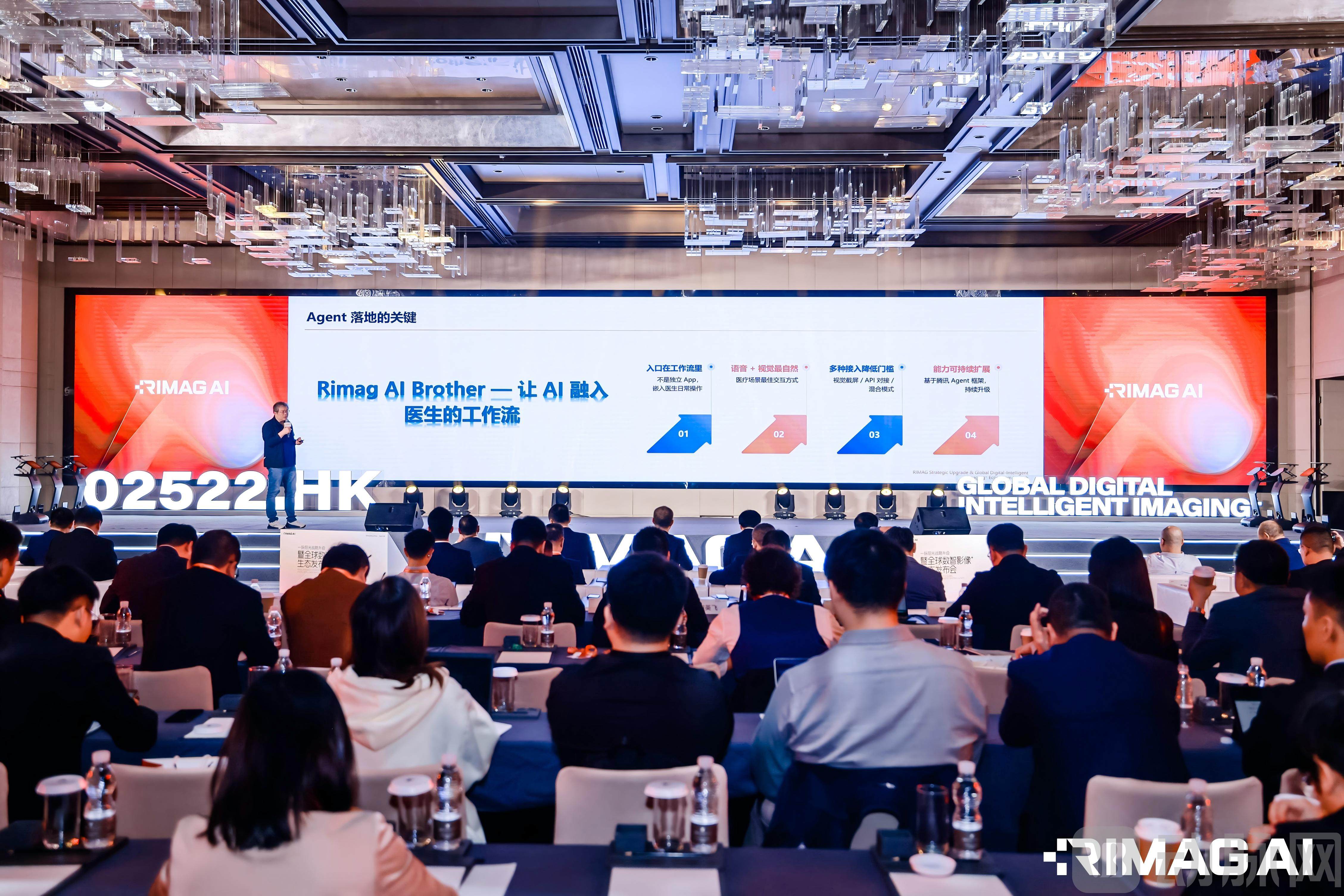
The emergence of Doctor-buddy signifies RIMAG’s transition from single-discipline imaging empowerment to intelligent, end-to-end healthcare processes, transforming medical imaging AGI (Artificial General Intelligence) into a productive force integrated throughout clinical diagnosis and treatment. Currently, this solution is driving the development of a full-chain service system encompassing “precision diagnosis and treatment within hospitals, tiered diagnosis and treatment outside hospitals, and inclusive primary care,” ultimately achieving equitable access to medical AI technologies.
When facing top-tier hospitals, RIMAG’s core strategy is AI “co-creation” based on anatomical regions.
The super-intelligent agent for cranial CT mentioned above is a collaborative achievement between RIMAG and Beijing Tiantan Hospital. Through the “Hetu Initiative,” RIMAG has also engaged in in-depth collaborations with multiple top-tier medical institutions, including West China Hospital of Sichuan University, Beijing Anzhen Hospital affiliated with Capital Medical University, and the First Affiliated Hospital of Nanchang University, to jointly develop AI models for various anatomical regions, such as chest CT, aortic CTA, and knee MRI.
This collaborative model of “co-creation” rather than “buying and selling” with leading hospitals is becoming RIMAG’s primary path to value creation in the era of medical imaging AGI. Hospitals contribute clinical expertise and data, while RIMAG provides the technological foundation and engineering capabilities. Both parties jointly define products and share outcomes, ultimately benefiting the entire industry.
For RIMAG itself, the leap in capabilities and ecosystem has also driven a qualitative transformation of its business model.
In the past, RIMAG’s core business focused on the construction and operation of imaging centers, which was essentially an asset-heavy model. Today, through an integrated closed-loop ecosystem encompassing government, industry, academia, research, commerce, and healthcare, RIMAG has evolved from a mere service provider into a core enabling platform that empowers hospitals, regions, and institutions to achieve digital and intelligent transformation.
At this point, RIMAG’s revenue model will become more diversified. Beyond its traditional business, it can generate income from data asset monetization, AI capability licensing, and ecosystem governance rule-setting, among other avenues. This positions the company to potentially transition from an asset-heavy to an asset-light model once its Digital-Intelligent Imaging⁺ ecosystem takes shape.
The ultimate goal of RIMAG’s strategic upgrade is to build a global digital-intelligent imaging⁺ ecosystem. Currently, RIMAG’s approach is not to undertake everything independently, but rather to use its self-built capabilities as a foundation and progressively open interfaces to various stakeholders across the industry chain.
In previous collaborations, RIMAG has preliminarily integrated four key components: data, algorithms, clinical scenarios, and payment. On the data front, it cooperates with the Beijing Data Pilot Zone and the data exchanges in Beijing and Shanghai to promote compliant circulation and value conversion of medical imaging data. In terms of AI infrastructure, it has incubated the artificial intelligence enterprise Yinghe Yimai and partnered with vendors such as Tencent to build computing power and model infrastructure. Regarding clinical scenarios, it has established a real-world validation network comprising 117 self-operated centers and hundreds of partner hospitals. On the payment side, it is exploring the integration of health and insurance services with institutions such as PICC Life Insurance, aiming to embed commercial payment logic into imaging services.
To fully leverage the value of its ecological closed loop, RIMAG will continue to refine its operations in the domestic market while increasingly focusing its exploration and validation efforts on overseas markets.
The previously delivered Malawi IBCC project has preliminarily validated the feasibility of exporting China’s diagnostic imaging capabilities to overseas oncology diagnosis and treatment scenarios. At the press conference, RIMAG also signed a strategic agreement with United Imaging Healthcare to jointly enter the Turkish market, aiming to further promote the bundled “Chinese equipment + Chinese services” export model and expand into broader overseas markets.
However, the market environment for overseas expansion differs from that in China. How to navigate compliance thresholds in different markets and whether localized operational efficiency can keep pace will all affect the stability of RIMAG’s international service delivery.
Fortunately, RIMAG currently holds a substantial lead, affording it ample room for trial and error.
As the imaging AI ecosystem flourishes and overseas market penetration accelerates, RIMAG, having crossed a critical threshold, may have the opportunity to establish a new model for Chinese medical services going global.