

Fill the Technical Path Gap of Local Similar Products! "RF + Mechanical" Dual-Technology Atrial Septal Puncture System Approved
In the first quarter, Huiyang Medical Technology (Suzhou) Co., Ltd. ("Huiyang Medical" for short) successively obtained registration certificates for two innovative medical devices: Radiofrequency Puncture Generator (Registration No.: 20263010216) and Disposable Radiofrequency Atrial Septal Puncture Needle (Registration No.: 20263010288).
Together, they form Huiyang Medical RF-cross.®Radiofrequency Atrial Septal Puncture System. When used in conjunction, under X-ray guidance and via the femoral vein approach, this system utilizes the thermal effect of radiofrequency current to artificially create an opening in the atrial septum, achieving the purpose of penetrating the atrial septum.
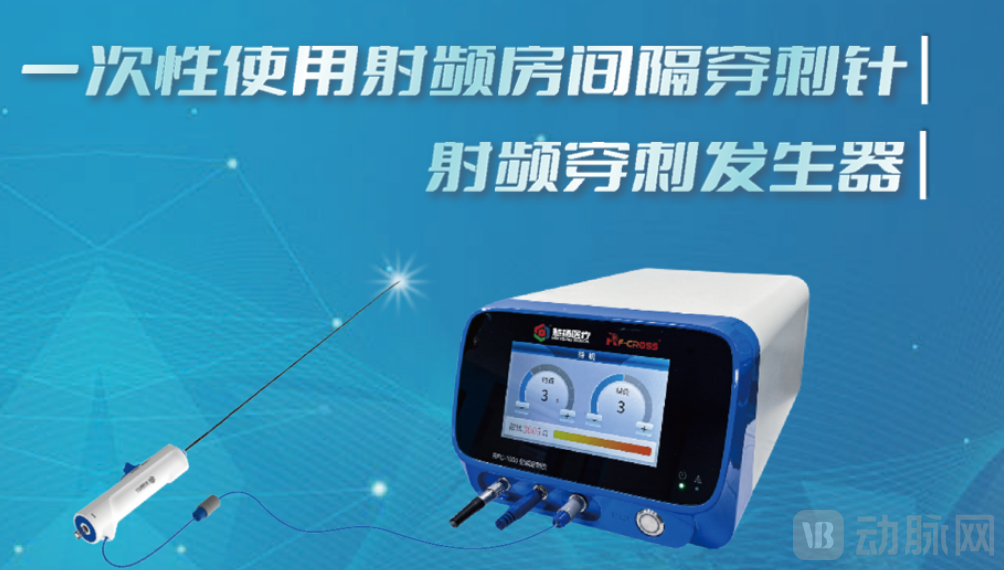
Source: Official WeChat Account of Huiyang Medical
RF-cross®Radiofrequency Atrial Septal Puncture System entered the National "Special Review Channel for Innovative Medical Devices" in 2024.As the first "zero-exchange, mechanical + radiofrequency dual technology, compatible with steerable" atrial septal puncture system in China, with the product approval and official commercialization process initiated, it is expected to provide safer and more controllable domestically produced interventional surgery solutions for cardiac interventional procedures.
Transseptal Puncture (TSP) is one of the most commonly used techniques for left atrial interventional procedures. It involves the use of interventional instruments to cross from the right atrium through the atrial septum into the left atrium, thereby establishing access for left atrial surgery.Procedures including catheter ablation for atrial fibrillation, percutaneous left atrial appendage closure, various mitral valve surgeries, interventional treatment for congenital heart disease, percutaneous placement of left ventricular assist devices, and potential treatments requiring trans-septal access, all rely on trans-septal puncture as a prerequisite.
Taking atrial fibrillation (AF) as an example, according to Open Source Securities, AF patients account for the highest proportion among patients with rapid arrhythmia in China. According to Frost & Sullivan analysis, from 2017 to 2032, the number of AF patients in China is expected to increase from 18.16 million to 28.9 million. Influenced by population aging, the compound annual growth rate from 2025 to 2032 will rise to 3.53%. Currently, radiofrequency ablation is the mainstream paradigm for AF ablation. In 2020 alone, 81,900 AF ablation procedures were performed in China. It is projected that by 2024, this number will exceed 250,000. According to Huayuan Securities, the combined number of AF ablation procedures in the U.S. and Europe exceeded 500,000 in 2022. At present, with the intensification of population aging, increasing accessibility to medical care, a growing number of patients with diseases such as AF, and rising patient awareness, the volume of AF catheter ablation procedures continues to climb.
The growth in demand for all surgeries requiring transseptal access, including atrial fibrillation ablation, has also led to a further increase in the market demand for core devices used in transseptal puncture procedures, such as puncture sheaths and needles.
However, there are still significant shortcomings in the atrial septal puncture technique. The mechanical puncture method commonly used in clinical practice relies on substantial mechanical force to complete the puncture, which results in a high level of operational difficulty, a relatively long learning curve for doctors, and risks of potentially serious complications (e.g., cardiac tamponade, heart rupture). Additionally, it is difficult to accurately predict the puncture site, and the puncture process tends to be time-consuming. For instance, in patients with conditions like aneurysms where the atrial septum is either too tough or too thick, traditional atrial septal puncture needles require greater thrust, posing risks such as an unclear "breakthrough feeling" and loss of control.
The radiofrequency puncture method, utilizing the thermal effect of radiofrequency energy to penetrate the atrial septum, requires less mechanical force and offers better control during the puncture process. The distal end of the radiofrequency puncture needle is often made of flexible, bendable material, which can be used in conjunction with other adjustable instruments to precisely adjust the angle to reach the target tissue, avoiding damage to non-target tissues. Additionally, the device is typically controlled by a handle that switches the energy on and off, which has a shorter response time compared to a foot pedal, thereby improving the success rate and safety of atrial septal puncture procedures.
Driven by technological advantages, some companies are moving towards "transseptal radiofrequency puncture," and Huiyang Medical is one of them.
From the product recently approved for Huiyang Medical, it adopts a dual-technology approach of "radiofrequency + puncture." Based on this technical path and product design, it mainly features "high efficiency, safety, convenience, and strong adaptability."
More efficient.Based on the synergy of mechanical and radiofrequency dual-puncture technology, it can easily overcome complex atrial septal structures, significantly improving the success rate of surgeries. Doctors can switch between mechanical/radiofrequency puncture modes at any time according to clinical conditions, meeting various clinical needs.
Safer.RF + Mechanical Dual Puncture Technology can effectively reduce issues such as atrial septal tearing and cardiac tissue damage caused by improper force in traditional mechanical puncture, lowering the risk of severe complications. Its pre-installed spring-loaded safety needle design limits radial movement to just 7mm during surgery, avoiding the risk of foreign object detachment caused by scraping against the dilator's inner wall when using traditional curved puncture needles. The self-retracting needle tip is exposed only when the doctor pushes the button and automatically retracts into the dilator when the button is released, ensuring surgical safety.
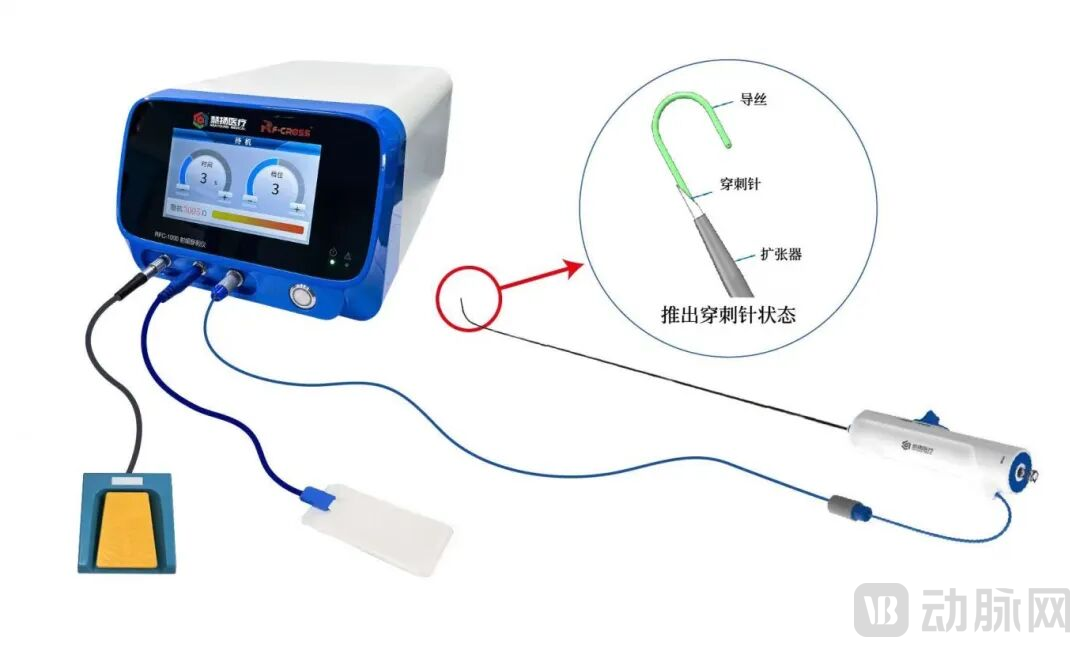 Source: Suzhou Medical Device Industry Association
More convenient.An integrated design of puncture needle, dilator, and guidewire allows for zero exchange of the puncture needle and guidewire. This enables seamless execution from positioning → puncturing → guidewire insertion → sheath passage, saving 50% of procedural steps and significantly reducing operation time.
Stronger adaptability.The radiofrequency atrial septal puncture system approved this time is compatible with a variety of mainstream deflectable guiding sheaths, allowing the guiding sheath to be placed immediately after puncture, further reducing surgical steps.
Currently, the Center for Medical Device Evaluation of the National Medical Products Administration has issued the evaluation reports for Huiyang Medical's radiofrequency puncture generator and disposable radiofrequency transseptal puncture needle.
In the animal experiment, 9 Labrador dogs were used for acute and chronic trials, with 3 for immediate evaluation and 6 for 30-day follow-up evaluation. The results showed that immediate dissection and pathological analysis revealed tissue degeneration around the puncture site, with no observation of tissue carbonization at the puncture site.In the chronic experiment, both the experimental group and the control group were successfully punctured. The experimental animals survived until the end of the 30-day trial. The system showed good operability, and no adverse events occurred. After 30 days, the endocardium at the puncture healing site was intact, and anatomical examination revealed no abnormalities in major organs.
In terms of human clinical trials, a prospective, multi-center, randomized controlled, non-inferiority design was adopted. The control device was a traditional mechanical atrial septal puncture system. A total of 180 subjects were enrolled in the clinical trial, with 90 in the experimental group and 90 in the control group. The results showed that the success rate of atrial septal puncture, the primary evaluation index, was 98.89% in the experimental group and 100% in the control group, with a difference of -1.11%. The lower limit of the 95% confidence interval was -3.28%, which was greater than the non-inferiority margin of -10%. In terms of secondary evaluation indicators,The average time required for successful completion of atrial septal puncture in the experimental group was 7.8±5.44 seconds, while in the control group, it was 144.6±242.34 seconds.It demonstrated a more efficient puncture rate. However, there was no statistical significance between the groups in terms of the crossover rate to the contralateral side after failed atrial septal puncture, system performance evaluation, incidence of complications related to atrial septal puncture, adverse event rate, and severe adverse event rate.
Currently, the global market for atrial septal puncture devices is characterized by a competitive landscape dominated by overseas giants, with domestic companies rapidly catching up.
From the perspective of overseas leading enterprises, the main players currently include Medtronic and Boston Scientific. Among them, Medtronic's integrated transseptal sheath product and Boston Scientific's radiofrequency puncture technology, acquired through the purchase of Baylis, have gained high recognition in clinical applications. These products are technologically mature and offer stable performance but come with a relatively high price, which to some extent limits their widespread adoption in emerging markets.
In China, local companies are rapidly catching up. With the advantages of localization, cost-effectiveness, and product designs that meet domestic clinical needs, these companies are gradually capturing market share. Currently, key players in the radiofrequency atrial septal puncture device market include Nansen Medical, Shanghai Shape Memory Alloy Materials Co., Ltd. (under Lepu Medical), and Huiyang Medical, among others.
Based on the two innovative medical device products that have been approved: RF puncture device + disposable RF puncture needle,Huiyang Medical fills the technical gap in locally produced similar products with a "radio frequency + mechanical" composite technology approach.The approval of Huiyang Medical products further promotes the technological upgrade of domestically produced atrial septal puncture devices, laying the foundation for Chinese enterprises to participate in global competition. While further contributing to the development of cardiac interventional medical devices towards the direction of "independent control, precision, and high efficiency," Huiyang Medical is expected to benefit more patients through the innovation of domestically produced medical devices.