

DeePath's AI Technology Licensing Business Surges 331.7% Year-on-Year, Becoming Primary Growth Engine and Breaking Industry’s 'Hardware Dependency' Trap
Medical imaging, which accounts for approximately 80% of global clinical data, is currently facing a severe supply-demand imbalance. With a vast base of around 5,000 medical imaging examination items worldwide, the surge in diagnostic and treatment needs driven by an aging population, coupled with a shortage of specialists in fields such as ultrasound and pathology, has brought this imbalance to public attention on an unprecedented scale.
Meanwhile, the traditional healthcare supply model has nearly reached its efficiency limit.
Bridging the supply-demand imbalance requires not only enhanced digital efficiency but also a systematic reconstruction of foundational clinical capabilities.As the world’s first publicly listed company specializing in large AI models for medical imaging, Desheng is leveraging its first annual report since its IPO to bridge the gap from technological validation to commercial viability, demonstrating how large AI models can drive a paradigm shift in the industry.
According to the annual report, Deshi’s total revenue in 2025 surged by 133.7% year-on-year, with gross profit exceeding RMB 100 million. Notably, revenue from AI technology licensing based on iMedImage, its foundational large model for medical imaging, skyrocketed by 331.7% year-on-year, emerging as Deshi’s primary growth engine. This growth is not merely a simple accumulation of sales volume; rather, these impressive results highlight Deshi’s commercial and social value. As a global provider of AI healthcare infrastructure, Deshi is transforming current global operational models through a productivity revolution.
As Deshi accelerates its expansion, it is further driving large-model technology out of the laboratory and into clinical practice, generating real revenue and setting a new benchmark for sustainable commercial growth in the industry. In doing so, it is reversing the previous trend among medical AI companies, which intentionally or unintentionally neglected commercial implementation and relied heavily on “hardware” sales for revenue. Deshi’s financial reports demonstrate that AI technology can also achieve rapid monetization—backed by robust double-digit growth in both revenue and gross profit, Deshi is building high-quality, sustainable self-sustaining capabilities.
Overall, in 2025, Deshi achieved revenue of RMB 164 million, a year-on-year increase of 133.7%. Gross profit reached RMB 118 million, significantly higher than RMB 46 million in the same period last year. The continuous optimization of its profitability structure is attributed to the sustained monetization capability driven by the deep integration of Deshi’s AI technology with clinical scenarios.
In terms of core business, Deshi has established its foundation on a large base model for medical imaging, pioneering commercial breakthroughs in the high-growth sector of microscopic imaging. The company has achieved market success with its chromosome karyotyping analysis solution and is poised to expand horizontally into other fields in the future. Meanwhile, Deshi’s large medical imaging model is unlocking new avenues for commercial growth through technology licensing and cloud-based delivery models.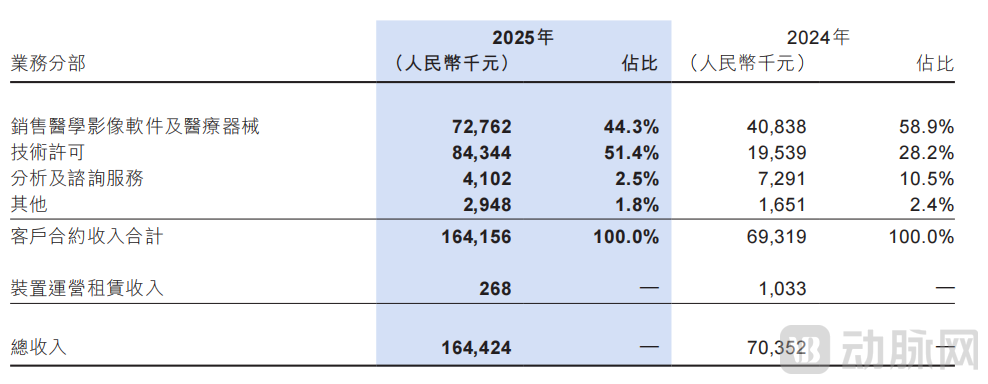
Image source: Deshi 2025 Annual Report
In the fields of chromosome karyotyping analysis, medical imaging software, and medical device consumables, Deshi is achieving steady growth in its clinically integrated “hardware-software” solutions powered by AI.The business generated annual revenue of RMB 72.76 million, representing a year-on-year increase of 78.2%. Desai is optimizing its sales channels and increasing the proportion of direct sales to further boost profitability. As early as 2024, Desai had already captured a 30.6% market share in China’s chromosomal karyotype analysis sector, ranking first nationwide and breaking the long-standing monopoly held by international giants such as Zeiss and Leica. With the expansion of its business scale, Desai is poised to further solidify its leading position in this niche market.
In the technology licensing business based on foundational large models for medical imaging, operations are experiencing explosive growth, becoming Deshi's primary growth engine.In terms of AI large model technology licensing, Deshi achieved annual revenue of RMB 84.34 million, a year-on-year increase of 331.7%. The technology licensing business is replacing chromosome karyotype analysis as the primary growth driver. Leveraging high gross margins, rapid growth, and high certainty, Deshi is breaking away from the hardware dependence typical of traditional AI vendors by adopting a technology licensing model, thereby carving out a unique commercialization path.
Whether it is the rapid growth of overall business revenue, or the swift expansion of chromosome karyotyping analysis and large-model technology licensing businesses, all point to the same underlying fact: the comprehensive release of new-quality productive forces. The intelligence enabled by AI large models in medical imaging has enhanced clinical efficiency and addressed substantive challenges in healthcare supply, with revenue growth being a natural outcome.
While conducting its business, Deshi has undoubtedly recognized the importance of compliance, as well as safeguarding data and privacy. In adherence to national laws and regulations, Deshi continuously strengthens the management and protection of information assets, business data, and user information. Through institutional development, system improvement, technical controls, and standardized processes, it consistently enhances its capabilities in information security and privacy protection. Currently, its core business system, Online AutoVision®Completed Level 3 Cybersecurity Classified Protection Filing for the Official Website and iMed MaaS®The cybersecurity classified protection assessment for the platform is also proceeding in an orderly manner.
It is worth noting that Deshi did not achieve profitability in 2025, with a core reason being its R&D investment in large AI models. In 2025, Deshi made strategic investments totaling RMB 104 million, over 80% of which was allocated to computing power infrastructure to ensure an iterative advantage for its large models. While this expenditure represents a short-term cost, it is expected to attract more high-quality customers in the long run through superior model iterations.
Currently, an increasing number of industry practitioners and clinical medical institutions are choosing to partner with Deshi.
The underlying reason is that the AI industry widely faces practical challenges such as weak model generalization capabilities, high R&D costs, protracted development cycles, and prominent hallucination issues. The development of traditional single-scenario, specialized models often requires more than two years, capital investment exceeding RMB 20 million, and support from tens of thousands of annotated data cases, making it difficult to adapt to the current rapidly expanding and diverse clinical needs.
By leveraging a foundational large model for medical imaging to deliver a “dimensionality-reduction strike” against traditional R&D paradigms, Desheng has mastered the “master key” to the scalable commercial deployment of medical AI through extreme reductions in development costs.As a cross-modal foundation model with hundreds of billions of parameters, iMedImage supports 19 imaging modalities—including CT, MRI, ultrasound, karyotype analysis, and endoscopy—covering over 90% of clinical scenarios. This foundation model can shorten the development cycle for disease-specific AI models to just over two months and reduce costs by more than 90%. It is poised to overcome industry development bottlenecks through its underlying technical architecture, providing healthcare institutions, research institutes, and equipment manufacturers with an efficient, low-cost pathway for AI model development, thereby truly demonstrating the efficiency and disruptive potential of “new quality productive forces.”
Leveraging these capabilities, in the second half of 2025, Deshi partnered with over 65 industry-leading institutions to launch 92 collaborative projects, resulting in the deployment of more than 30 specialized large medical imaging models. This achievement established Deshi as the provider with the most extensive partnerships and the fastest implementation rate for foundational large medical imaging models in China. On a global scale, Deshi also stands at the forefront: according to incomplete statistics, AI companies worldwide developed over 180 AI models in the second half of 2025, meaning Deshi’s jointly developed projects accounted for nearly one-sixth of this total.
Attracting leading institutions for collaboration is certainly important, but what matters more is the ecosystem stickiness demonstrated behind such partnerships.As more ecosystem partners join, it means that more specialized large models will be developed based on Desheng’s foundational large model. Desheng is expected to further define industry entry standards in the field of medical imaging AI based on its own foundational large model. With the establishment of these standards, more clinical institutions, research institutes, and equipment manufacturers are likely to build more exclusive large models based on Desheng’s large model foundation.
Currently, multimodal AI models for multiple diseases, rapidly and cost-effectively developed based on Deshi Medical’s foundational large imaging model, iMedImage, include applications such as preterm birth prediction using cervical ultrasound imaging, multidimensional intelligent tumor assessment based on preoperative contrast-enhanced CT, pathological prediction of prognosis in cancer patients, and PET/CT imaging-based assessment of post-treatment recurrence risk. Most of these models have completed clinical validation at top-tier tertiary hospitals in China. The disease-specific models, co-developed through collaborative efforts, have significantly improved diagnostic accuracy and efficiency, demonstrating substantial clinical value.
Taking the assessment of tumor prognosis risk using PET-CT imaging as an example, this project collaborates with national-level research institutions and key specialized oncology hospitals. Conventional EGFR gene testing requires invasive biopsy, which is costly and technically demanding; thus, there is an urgent clinical need for a non-invasive, rapid, and convenient method for the precise diagnosis of genetic mutations. By developing and validating an AI system based on PET-CT, this project enables non-invasive and precise diagnosis of tumor pathological types and molecular subtypes, thereby optimizing diagnostic and treatment workflows, improving therapeutic efficacy, and reducing healthcare costs. The current study sample covers 10 medical centers and includes 5,500 cases. The developed model achieves high-precision differentiation of tumor pathological types and molecular subtypes, with an AUC exceeding 0.85 in the task of identifying EGFR gene mutations.
Furthermore, Desheng’s chromosome karyotyping solution, built upon its foundational large language model, better aligns with market demands and plays an irreplaceable role in preventing birth defects and supporting the high-quality development of the national population. The National Health Commission’s “Healthy Children Action Improvement Plan (2021–2025)” explicitly called for the implementation of the “Birth Defect Prevention and Control Improvement Initiative.” Traditionally, conventional chromosome karyotyping—a core method including prenatal screening such as the Down syndrome screening—had an industry-average accuracy of only about 50%, with reporting cycles extending up to 30 days. In contrast, empowered by AI technology, Desheng’s AI Auto Vision system has demonstrated outstanding performance: it reduces single-image analysis time to just 2.5 minutes, shortens the reporting cycle to 4–7 days, and achieves an overall accuracy rate of 99.45% to 99.86%, significantly enhancing both clinical efficiency and diagnostic accuracy.
These deployed models have validated the clinical and industrial value of foundational large-model technologies in medical imaging. As a national-level “Little Giant” enterprise specializing in refined, distinctive, and innovative practices, Deshi is clearly emerging as the “first listed company in AI large models for medical imaging,” becoming a typical representative of new-quality productive forces in the medical AI sector and leading the industry from single-point application innovations toward a new phase driven by foundational platforms.
Since its inception, Desheng has targeted the global market, positioning itself as a global provider of AI-powered medical infrastructure. Guided by the globalization strategy of “exporting technology and establishing standards first,” the company has steadily advanced Chinese-originated medical imaging AI technologies and products into mainstream global markets. In this process, Desheng has gradually built a comprehensive business layout encompassing “medical imaging foundation models – intelligent systems – clinical implementation – platform ecosystem,” forming a mature business model driven by “software + devices + reagents + technology licensing.”
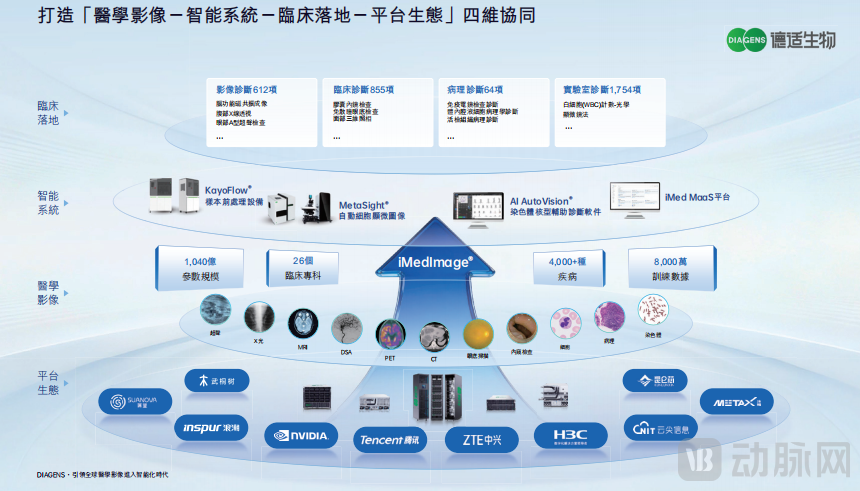
Image source: Deshi's 2025 Annual Report
For Desai, “the competition of the future will no longer be about who can sell more standalone devices, but rather about who can provide global clinical institutions with intelligent infrastructure that supports continuous training, continuous deployment, continuous inference, and ongoing evolution.”
Currently, Desheng is furthering its collaboration with strategic partners, including Tencent. Underpinning this cooperation is Desheng’s macro-strategy targeting the global medical imaging industry—Through collaboration and leveraging digital connectivity platforms such as WeChat and Tencent Health, an innovative business model integrating “devices + services + data” is established to jointly advance standards for AI training in medical imaging and data security. This enables a strategic transformation from mere “equipment supply” to providing “digital new infrastructure.” Ultimately, powered by the Deshi Medical Imaging Foundation Large Model, top-tier global medical capabilities will be delivered worldwide like essential utilities—such as water, electricity, and gas—facilitating equitable access and high-quality development in healthcare, and effectively alleviating the global challenge of uneven distribution of medical resources.
Currently, with rapid business growth, Deshi’s products and technologies have become deeply entrenched in the Chinese market, covering 31 provinces and municipalities and more than 400 hospitals, with a penetration rate of 40% among China’s top ten hospitals. Meanwhile, Deshi is further expanding into the global market. To date, it has successfully served enterprises in more than 70 countries and regions across six continents.
As previously mentioned, Desheng is clearly offering more than just chromosome karyotyping solutions that have obtained or are in the process of obtaining NMPA, FDA, and CE certifications; it is also providing large-scale medical imaging model technology. From a research perspective, Desheng has completed clinical validation studies with top-tier medical and research institutions such as The Chinese University of Hong Kong, The University of Hong Kong, and Prince of Wales Hospital. The related findings were published in the prestigious international journal *Human Genetics*, demonstrating an AI-based karyotype analysis accuracy rate of 97% and a sensitivity of 98%. Furthermore, they jointly developed the world’s first two-stage standardized clinical workflow for AI-assisted karyotype analysis, providing a directly replicable standardized solution for cytogenetics laboratories worldwide. In-depth scientific collaboration with Baylor College of Medicine in the United States has yielded authoritative academic endorsement in areas such as global clinical application, tackling common industry-wide technical challenges, and integrating multiple technological pathways, thereby further enhancing the global influence of China’s medical AI technology.
From a clinical implementation perspective, Great Ormond Street Hospital (GOSH), a top-tier hospital under the UK’s National Health Service (NHS), has expressed clear procurement intent and officially initiated its internal access qualification assessment. This marks Deshi’s successful entry into the “deep-water zone” of global medical imaging. Following its public listing, Deshi is now accelerating its expansion into strategic markets such as Germany, Spain, and Brazil, further transforming its China-originated AI solutions for medical imaging into new global healthcare infrastructure.
With the continuous improvement in revenue scale and quality, and further consolidation of industry barriers, Deshi delivered a high-quality performance in its 2025 annual report. AndAs a benchmark for realizing the value of large medical models and a global provider of AI medical imaging infrastructure, Deshi is steadily leading the AI healthcare sector by pursuing high-quality development through deep cultivation in China alongside expansion into global markets. It is accelerating the industry’s transition from technological concepts to tangible value realization, injecting Chinese strength into the intelligent upgrading of healthcare worldwide.