

Zhongshan University Develops a Novel 3-Day Animal Model for Retinal Vascular Diseases Using cGAMP
Recently, the Zhongshan Ophthalmic Center of Sun Yat-sen University released a public notice on the transfer of invention patents, proposing to“Application of cGAMP in the Construction of Animal Models for Retinal Vascular Diseases”transfer of the invention patent rights. The transferor in this transaction is the Zhongshan Ophthalmic Center of Sun Yat-sen University, and the proposed transferee is Poxia Biotechnology (Guangzhou) Co., Ltd., with the transfer price being400,000 yuan。
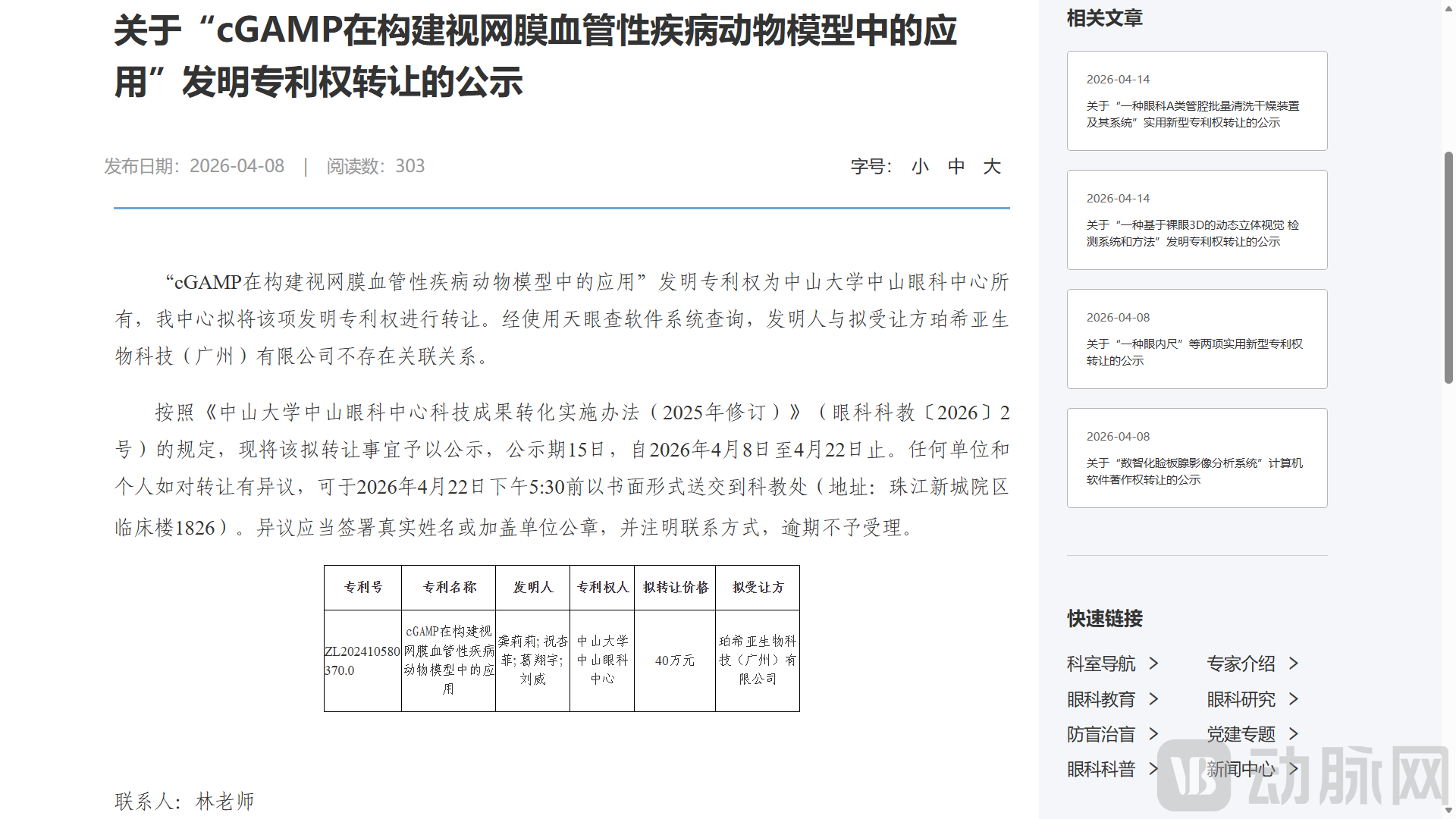
Image from the official website of Zhongshan Ophthalmic Center, Sun Yat-sen University
The core technological innovation of this patent lies inRapid Establishment of an Animal Model of Retinal Vascular Disease via a Single Intravitreal Injection of cGAMP, overcoming the limitations of traditional models, such as prolonged model establishment periods and the inability to simulate mature retinas. By targeting the well-defined cGAS-STING signaling pathway, it can stably recapitulate typical pathological phenotypes—including vascular leakage, neovascularization, and vasculitis—within just three days, thereby providing an efficient and reliable novel tool for mechanistic research on fundus diseases and drug screening.
Retinal Vascular Diseases (RVD)It is a highly prevalent and serious retinal vascular disorder, characterized primarily by retinal vascular exudation, hemorrhage, vasculitis, and structural damage, and represents a major ophthalmic condition leading to severe visual impairment or even blindness in clinical practice.
Current clinical treatment approaches for this category of diseases are primarily based onLaser Therapy, Anti-angiogenic Drug Therapy, and Surgical Treatmentas the main focus,However, its overall application has significant limitations:Laser therapy is prone to causing complications such as visual impairment and color vision abnormalities, with damage that is difficult to reverse. Anti-angiogenic drugs require repeated intravitreal injections, leading to poor patient compliance and significant inter-individual variability in efficacy, making it challenging to achieve stable and controllable therapeutic outcomes. Therefore, identifying key targets in the onset and progression of diseases and developing safer and more effective treatments have become urgent clinical challenges in the field of fundus diseases.
As a core support for disease mechanism research, drug screening, and efficacy evaluation,Standardized Animal Modelsare essential tools for promoting clinical translation, yet current mainstream models have significant limitations: the streptozotocin (STZ)-induced diabetic retinopathy model requires a prolonged induction period of 8–10 weeks, making it time-consuming and inefficient; the hyperoxia-induced retinopathy of prematurity (ROP) model is only applicable to neonatal mice with immature retinal development, failing to recapitulate the true pathological state of adult mature retinas. Furthermore, both models suffer from unclear targets and substantial discrepancies between their pathological phenotypes and the clinical disease course, thus failing to meet the research demands for precision, efficiency, and close alignment with real-world clinical scenarios.
Therefore,The industry urgently requires novel animal model construction technologies with clearly defined targets, rapid modeling capabilities, and applicability to mature retinas.。
This patented technology successfully established an animal model of retinal vascular disease through a single intravitreal injection of cGAMP (2'3'-cGAMP). Its core advantages and innovations are primarily reflected in the following three aspects:
First: The target is well-defined and the mechanism is novel, filling a gap in the field.
This technology in the field of biomedicineFirst proposed a method for establishing a mouse model of retinal vascular diseases based on cGAMP, a key activating molecule of the cGAS-STING immune signaling pathway.Unlike existing models with ill-defined targets, the present application directly targets the cGAS-STING pathway. By directly binding to and activating downstream STING signaling via cGAMP, it mimics the pathological process in which aberrantly activated cGAS-STING signaling triggers the release of inflammatory cytokines and immune cell infiltration. This innovation not only confirms the role of this pathway in retinal vascular diseases but also provides a novel tool with a well-defined molecular mechanism for studying related diseases.
Second: The modeling period is significantly shortened, and the pathological phenotypes are typical and reliable.
Compared with traditional models, this technique significantly shortens the time required for model establishment. Experimental data demonstrate that a single intravitreal injection of cGAMP induces evident pathological changes in the animal retina within just three days, including marked blood extravasation, neovascularization, lymphocyte adhesion to blood vessels, and severe vasculitis.
These features closely resemble the pathogenesis and progression of human retinal vascular diseases, such as diabetic retinopathy and age-related macular degeneration, demonstrating that this method offers the advantages of a short modeling period, procedural simplicity, and highly reliable results.
Third: Broad applicability, overcoming the limitations of developmental stages
This technology overcomes the limitation of existing retinopathy of prematurity (ROP) models, which can only induce disease on postnatal day 7 in mice (when the retina is not fully developed), thereby failing to simulate conditions in a mature retina. The method described in this application can be successfully implemented in both neonatal and adult mice (e.g., 5–8 weeks of age). This means that the model can be used not only to study developmental retinal vascular diseases but also as a powerful tool for investigating vascular diseases of the mature retina, significantly expanding the utility of animal models in ophthalmic disease research and drug screening (particularly for STING inhibitor drugs).
Animal models of retinal diseases are core supporting tools for basic ophthalmic research and preclinical development of new drugs,With the rapid development of innovative drugs for fundus diseases, gene therapy, and cell therapy, market demand continues to grow steadily. Currently, the industry offers a diverse range of models with mature application scenarios, covering mainstream indications such as diabetic retinopathy, neovascular age-related macular degeneration, and retinal vasculitis. These models are widely used in mechanism research, target validation, drug screening, and efficacy evaluation. The overall market is trending toward standardization, specialization, and scenario-specific applications, while research institutions, CRO platforms, and pharmaceutical companies are increasingly demanding efficient, stable, and highly clinically relevant models.
DL-AAA-Induced Rabbit Model of Retinal Neovascularization, constructed by administering specific inducers into the vitreous cavity, can stably induce retinal neovascularization and persistent vascular leakage. Its pathological manifestations bear a high degree of similarity to those of common clinical neovascular fundus diseases. Leveraging the anatomical advantages of the rabbit eye, this model is compatible with routine clinical imaging assessments, including fundus photography, fluorescein angiography, and optical coherence tomography (OCT). It enables long-term, stable maintenance of pathological phenotypes, making it suitable for observing chronic lesions and evaluating the duration of drug effects. This model exhibits prominent features in terms of stability, clinical relevance, and observational convenience.
In terms of market application, this model has become a mature and standardized tool in the field of ophthalmic preclinical research. It is primarily targeted at indications such as wet age-related macular degeneration (wAMD) and diabetic macular edema (DME), and is widely used for evaluating the efficacy, validating mechanisms of action, and optimizing dosing regimens of anti-angiogenic agents, anti-inflammatory drugs, and novel fundus medications. Leveraging its well-established operational protocols and robust drug response characteristics, this model has been adopted by numerous preclinical CROs and innovative pharmaceutical companies. It serves as a critical preclinical model system supporting new drug development and regulatory submissions, maintaining a stable and pivotal role in the R&D pipeline for therapies targeting retinal neovascularization.
STZ-Induced Rat Model of Diabetic Retinopathy, which specifically damages pancreatic islet β-cells via streptozotocin, inducing persistent hyperglycemia and subsequently triggering pathological changes such as retinal vascular leakage, pericyte loss, thinning of retinal layers, and inflammatory responses. This model effectively mimics the onset and progression of early diabetic retinopathy in humans. With a well-established protocol and clear clinical-pathological correlation, it is compatible with various conventional assessment methods, including optical coherence tomography (OCT), fluorescein angiography, and retinal electrophysiology, demonstrating good experimental operability and data reproducibility.
In terms of market applications, this model is a classic one with a long history and wide range of use in preclinical research on diabetic retinopathy. It is extensively applied to explore disease mechanisms, evaluate the early efficacy of anti-hyperglycemic agents, retinal protective agents, anti-inflammatory drugs, and anti-angiogenic drugs, as well as verify their action pathways. Adopted by numerous domestic and international research institutions, CRO platforms, and pharmaceutical companies, it has long occupied a foundational and standardized core position in basic research and new drug development for diabetes-related fundus diseases.
This patent relies on clearMechanism of Action of the cGAS-STING Signaling PathwayBy adopting a construction method that is easy to operate and can be completed with a single administration, this approach enables the rapid preparation of animal models for retinal vascular diseases that exhibit typical pathological phenotypes, strong stability, and high clinical relevance. It precisely meets the core demand in the field of fundus diseases for efficient, reliable, and mechanistically well-defined preclinical model tools.
This model is not only applicable to elucidating the pathological mechanisms of retinal vascular diseases and studying the interplay between inflammation and vascular abnormalities, but also provides a stable platform for screening and evaluating the efficacy of innovative therapies, such as STING-targeted drugs, anti-inflammatory agents, and anti-angiogenic drugs. It boasts broad application potential across the entire spectrum from basic research and drug development to clinical translation.
Amid the industry trend of continuous advancement in innovative therapies for fundus diseases and the escalating demands for model quality and efficiency in preclinical research, this patented technology, leveraging its unique technical advantages and practical value, boasts strong prospects for market adoption and potential for outcome translation. It is poised to become a standardized and universal core model tool within the preclinical research framework for retinal vascular diseases.