

Million-Dollar TCM Patent Licensed: Innovative Herbal Health Wine Offers Breakthrough Solution for Atherosclerosis Management
Recently, Hunan University of Chinese Medicine plans to transfer its patentsA Health-Preserving Wine for the Prevention and Treatment of AtherosclerosisConduct technology transfer by means of patent licensing and complete the transfer through negotiated pricing, with a proposed transaction price1 million yuan, this patent is held byDu Jianfang, Yan Mengfan, Liu LiR&D.
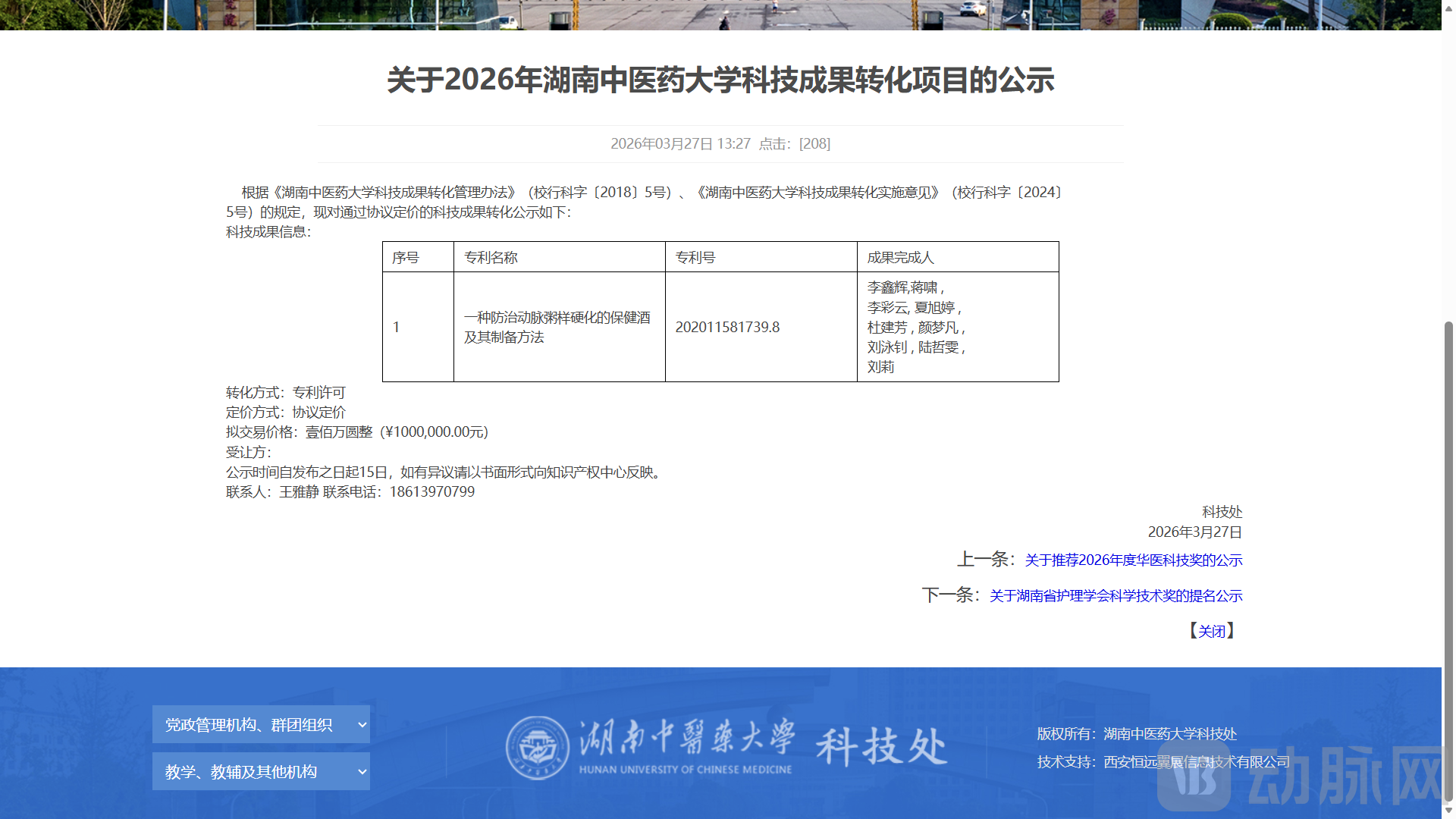
Image from the official website of Hunan University of Chinese Medicine
The patent core provides traditional Chinese medicine healthcare solutions for high-risk populations of atherosclerosis.This patent overcomes the limitations of traditional Chinese herbal decoctions, which are inconvenient to administer, and Western medicines, which often cause significant side effects with long-term use. Centered on a core formulation of pine needles, Gynostemma pentaphyllum, Trichosanthes kirilowii fruit, turmeric, processed Polygonum multiflorum, and black goji berries, it employs a standardized manufacturing process involving cold maceration, blending and aging, and volumetric filtration to produce a health-promoting wine. This product offers the benefits of replenishing qi and strengthening the spleen, nourishing the liver and kidneys, and resolving phlegm and removing blood stasis. It demonstrates clear anti-atherosclerotic, lipid-lowering, antioxidant, and anti-inflammatory effects. By achieving an innovative integration of Traditional Chinese Medicine theory with a medicinal wine dosage form, it provides a safe, convenient, and suitable long-term regimen for the prevention and adjunctive management of atherosclerosis.
Atherosclerosis (AS)It is one of the common and frequently occurring diseases that seriously endanger human health. In Western countries, atherosclerotic cardiovascular disease is known as the “number one killer.” With the improvement of living standards and changes in dietary habits among the Chinese population, this disease has also become a leading cause of death in China.
Atherosclerosis (AS) refers to the deposition of lipids (primarily cholesterol and cholesterol esters) in the intima and subintimal layers of arterial walls and their branches. This process is accompanied by the migration and proliferation of medial smooth muscle cells into the subintimal space, leading to intimal thickening and plaque formation. Subsequent degeneration, necrosis, and disintegration of plaque tissue combine with deposited lipids to form a gruel-like substance. These changes cause arterial wall thickening, hardening, and loss of elasticity, ultimately resulting in luminal narrowing. This can lead to ischemia or thrombosis in local tissues and organs, or even vessel wall rupture and hemorrhage, causing functional impairment. AS constitutes the pathological basis and primary etiology of many ischemic cardiovascular and cerebrovascular diseases.
Studies suggest that risk factors for atherosclerosis include age, unhealthy lifestyle habits (such as smoking, alcohol consumption, and a diet high in fatty foods), dyslipidemia, hypertension, and genetic factors. Clinically, the primary approach isStatin Therapy for Hyperlipidemiaas the mainstay, requiring long-term medication and associated with numerous side effects. The prevention and treatment of atherosclerosis using Traditional Chinese Medicine (TCM) is a distinctive feature and advantage of China’s healthcare system. As public awareness of TCM’s role in disease prevention and management grows, its application will become increasingly widespread.
Although traditional Chinese medicine (TCM) possesses dual theoretical and clinical advantages in the prevention and treatment of atherosclerosis, traditional TCM decoctions present challenges such as complex preparation, inconvenient administration, and difficulty in portability. These issues lead to low patient compliance, thereby restricting the full realization of the distinctive advantages of TCM.
Meanwhile, as public health awareness continues to strengthen, the market demand for health-promoting alcoholic beverages—characterized by their rich historical and cultural heritage, abundant raw material resources, strong policy support, and convenience of consumption—is steadily expanding. Based on the Traditional Chinese Medicine (TCM) principles of disease and syndrome differentiation, and integrating the clinical pathogenesis and population characteristics of atherosclerosis, we aim to develop a formulation of health-promoting alcoholic beverage suitable for long-term use.It effectively addresses the limitations of existing clinical interventions, providing patients with safer, more convenient, and sustainable long-term intervention options, thereby holding significant value for the prevention of cardiovascular and cerebrovascular diseases and the improvement of quality of life.
This patented technology for a health-promoting liquor designed to prevent and treat atherosclerosis is grounded in Traditional Chinese Medicine (TCM) theory and modern pharmacological research, focusing on the core pathogenesis of the disease and addressing pain points in clinical application.Formulation Compatibility, Dosage Form Selection, Preparation Process, Efficacy Characteristics, and Application ScenariosAchieved comprehensive innovation.
This technologyAccurately Grasp the Fundamental Pathogenesis of Atherosclerosis: Deficiency of Liver, Spleen, and Kidney; Interplay of Phlegm and Blood Stasis; and Complex Intermingling of Deficiency and Excess, adhering to the principle of equally emphasizing the reinforcement of vital energy and the elimination of pathogenic factors, it employs a scientifically formulated combination of six medicinal ingredients: Masson pine needles, Gynostemma pentaphyllum, Trichosanthes fruit, turmeric, processed Polygonum multiflorum, and black goji berries. With clear roles assigned according to the traditional Chinese medicine principles of "monarch, minister, assistant, and envoy," these ingredients work synergistically to achieve holistic regulation by replenishing qi and strengthening the spleen, nourishing the liver and kidneys, and resolving phlegm and removing blood stasis. This approach fundamentally improves abnormalities in lipid metabolism and blood stasis, distinguishing itself from traditional therapies that focus solely on lipid-lowering or blood-activating effects.
In terms of dosage form innovation, this technology deeply integrates the active ingredients of traditional Chinese medicine with health-oriented medicinal liquor formulations., thoroughly addressing practical issues associated with traditional Chinese herbal decoctions, such as cumbersome preparation, inconvenient administration, poor palatability, difficulty in transportation, and low long-term adherence. Meanwhile, it offers prominent advantages including simple administration, lower cost, high utilization rate of medicinal materials, and ease of consistent daily use, making it more suitable for long-term management of chronic diseases and general health maintenance needs.
In terms of manufacturing process, the project adopts a standardized procedure comprising raw material preparation and crushing, cold maceration extraction, blending with refined honey followed by aging, volume adjustment and filtration, and aseptic filling., clearly defining key parameters such as raw material particle size, baijiu (Chinese liquor) concentration, extraction time, stirring frequency, refined honey temperature, and aging period. The entire process can be completed under Class 100,000 clean production conditions, featuring a stable, controllable, and highly reproducible process that meets the requirements for industrialized, large-scale production and ensures consistent and stable product quality across different batches.
In terms of efficacy and safety, this health wine has been verified through animal experiments to possess multiple effects, including anti-atherosclerosis, lipid-lowering, antioxidant, anti-inflammatory, anticoagulant, and free radical scavenging properties., it can significantly improve atherosclerosis-related symptoms such as dizziness, headache, limb numbness, palpitations, chest tightness, shortness of breath, and precordial discomfort, while also enhancing immunity and assisting in the regulation of blood pressure and blood glucose, thereby achieving holistic conditioning through multi-target and multi-pathway mechanisms.
Moreover, the medicinal liquor is formulated using commonly employed herbs that fall within the category of substances recognized as both food and medicine. Its composition is mild, utilizing low-alcohol baijiu as the extraction medium. This approach avoids the adverse effects associated with long-term use of statin-based Western medications, offering enhanced safety and broader applicability. It can be used for prevention in high-risk populations as well as serving as a long-term adjunctive regimen for patients in the clinically stable phase.
Overall, this technology organically integrates Traditional Chinese Medicine (TCM) theories, modern pharmaceutical manufacturing processes, and public health needs. It not only preserves the advantages of TCM in disease prevention and treatment but also aligns with modern lifestyles and consumer habits, representing a typical innovation in transforming TCM scientific and technological achievements into health products.
At the current stage, traditional Chinese medicine (TCM) specialty medicinal wines and herbal conditioning products are gradually being integrated into public daily health management systems, leveraging their characteristics of gentle nourishment and gradual, step-by-step regulation. This has fostered a development pattern in which clinical interventions and home-based care complement each other.
Against the backdrop of upgrading health consumption, the general public is no longer limited to single-disease treatment but places greater emphasis on early prevention, postoperative recovery, and long-term vascular care. Consequently, conditioning products that are suitable for long-term use, mild in nature, rationally formulated, and clearly targeted in their mechanism of action are garnering increasing attention.
Overall, as the broader industry development environment continues to improve and support for the traditional Chinese medicine (TCM) health industry intensifies, medicinal liquor products for health regulation are advancing toward standardization and diversification. In this context, therapeutic and regulatory products related to atherosclerosis not only boast a stable consumer base and room for growth, but the market as a whole also maintains a steady and positive trajectory. This lays a solid foundation for the research and development, translation, practical application, and commercial promotion of similar pharmaceuticals and specialty medicinal liquors.
Jing Brand - Maopu Black Buckwheat Liquor is the core product of the Maopu Herbal Liquor series under Jing Brand Co., Ltd.Positioned as a herbal-infused baijiu for quality-conscious consumers and light business occasions, this product uses aged base spirits from three renowned aromatic styles—strong, light, and sauce—as its foundation. After years of aging and scientific blending, the spirit exhibits a faint yellow hue, a smooth and mildly sweet palate, and well-balanced flavor layers. The product features a stable production process for the ratio of base spirit to herbal ingredients, incorporating botanicals such as tartary buckwheat, kudzu root, goji berries, and monk fruit. Produced through standardized extraction and formulation methods, it benefits from a robust quality control system and mature industrial-scale manufacturing capabilities. Its processes and health-related aspects are supported by national invention patents, emphasizing the integration of drinking experience with herbal essence. Leveraging herbal ingredients and scientifically optimized ratios, the product aims to provide a gentler drinking experience, focusing on wellness benefits associated with herbal care, including auxiliary support for blood lipid regulation, reduced physiological burden, and enhanced drinking comfort.
In terms of market application, Maopu Black Buckwheat Liquor has established a mature distribution network covering the entire country. It is widely used in diverse consumption scenarios such as family gatherings, daily personal consumption, light business banquets, and holiday gifting, catering to the mass demand for healthier drinking habits. As a representative commercialized product in the herbal liquor category, it leverages stable channel layout and brand operations to continuously target consumer groups that prioritize drinking comfort and health benefits. The product maintains a stable customer base and market vitality in the mid-range herbal liquor segment. Meanwhile, the company continually aligns with current market trends toward rational consumption, green consumption, and high cost-performance by optimizing liquor quality and streamlining packaging. Overall, the product is in a mature and stable stage of market application, providing a proven model for the scaled operation of herbal health-oriented baijiu products within the industry.
Ginkgo Biloba Leaf Tincture is a prescription Chinese proprietary tincture produced by Beijing China Resources High-Tech Natural Pharmaceutical Co., Ltd., with Ginkgo biloba leaf extract as the main ingredient. It appears as a clear, brownish-red liquid with a fragrant aroma and a pungent, bitter taste. This product has the efficacy of promoting blood circulation, removing blood stasis, and unblocking collaterals. It is clinically used for the adjunctive treatment of chest bi (obstruction) and heart pain, stroke, hemiplegia, stiff tongue and slurred speech caused by blood stasis obstructing the collaterals, as well as stable angina pectoris due to coronary heart disease and cerebral infarction. Its application in improving blood circulation and protecting vascular collateral channels is well-established. The dosage form is an oral tincture, offering convenient administration. The product quality standards are standardized, and the production and quality control systems are mature, demonstrating good safety and tolerability in clinical applications.
In terms of market application, Ginkgo Biloba Tincture, as a commonly used Ginkgo biloba preparation in the cardiovascular and cerebrovascular field, leverages China Resources Sanjiu’s brand strength and channel distribution to maintain stable adoption across medical institutions at all levels, community health service centers, and chronic disease management settings. The product primarily targets patients with cardiovascular and cerebrovascular conditions associated with coronary heart disease, cerebral infarction, and atherosclerosis. It is widely utilized for standardized clinical treatment and rehabilitation-phase care, serving as one of the staple adjunctive therapies for chronic cardiovascular and cerebrovascular diseases in medical institutions. Its overall application scenarios are predominantly centered on in-hospital prescriptions, specialized diagnosis and treatment, and long-term chronic disease management. With a clear market positioning and standardized usage contexts, it maintains consistent clinical recognition and broad application coverage among traditional Chinese medicine preparations designed to promote blood circulation, remove stasis, unblock collaterals, and protect blood vessels.
This patented productLeveraging a proprietary formulation aligned with pathogenesis and a mature, standardized production process, it precisely meets the core needs of long-term care and adjunctive conditioning for individuals with atherosclerosis.The product is formulated in accordance with the compatibility principles of traditional Chinese medicine theory. With its mild and soothing nature, it is highly suitable for long-term, continuous use in health maintenance regimens.
Meanwhile, this patent focuses on vascular care and the regulation of lipid metabolism, offering a clearer functional positioning. It precisely addresses the daily health needs of middle-aged and elderly individuals, those with suboptimal metabolic health, and populations at high risk for chronic cardiovascular and cerebrovascular diseases. The product can be gradually commercialized through a diversified channel system, covering various scenarios such as daily household wellness, health maintenance for the middle-aged and elderly, and adjunctive rehabilitation management for chronic diseases.
It can serve as a daily wellness product for the general population to prevent vascular damage and maintain cardiovascular health, while also providing a gentle Traditional Chinese Medicine (TCM) adjunctive solution for chronic disease management in medical institutions and health interventions in wellness care facilities. In line with current health consumption trends, future efforts will focus on continuously optimizing product formulation and user experience across different scenarios, thereby expanding its applications and reaching a broader audience.