

West China Hospital Licenses Innovative Gastrointestinal Retention Clearance Device to Chengdu Yizhao Medical
Recently, West China Hospital of Sichuan University released a public notice on a patent implementation licensing transaction, proposing to license its independently developed“Device for Clearing Retained Material in the Digestive Tract”Licensing of the relevant patented technologies, with a proposed transfer amount ofRMB 200,000RMB plus 5% commission on sales revenue, the licensee is Chengdu Yizhao Medical Device Co., Ltd.
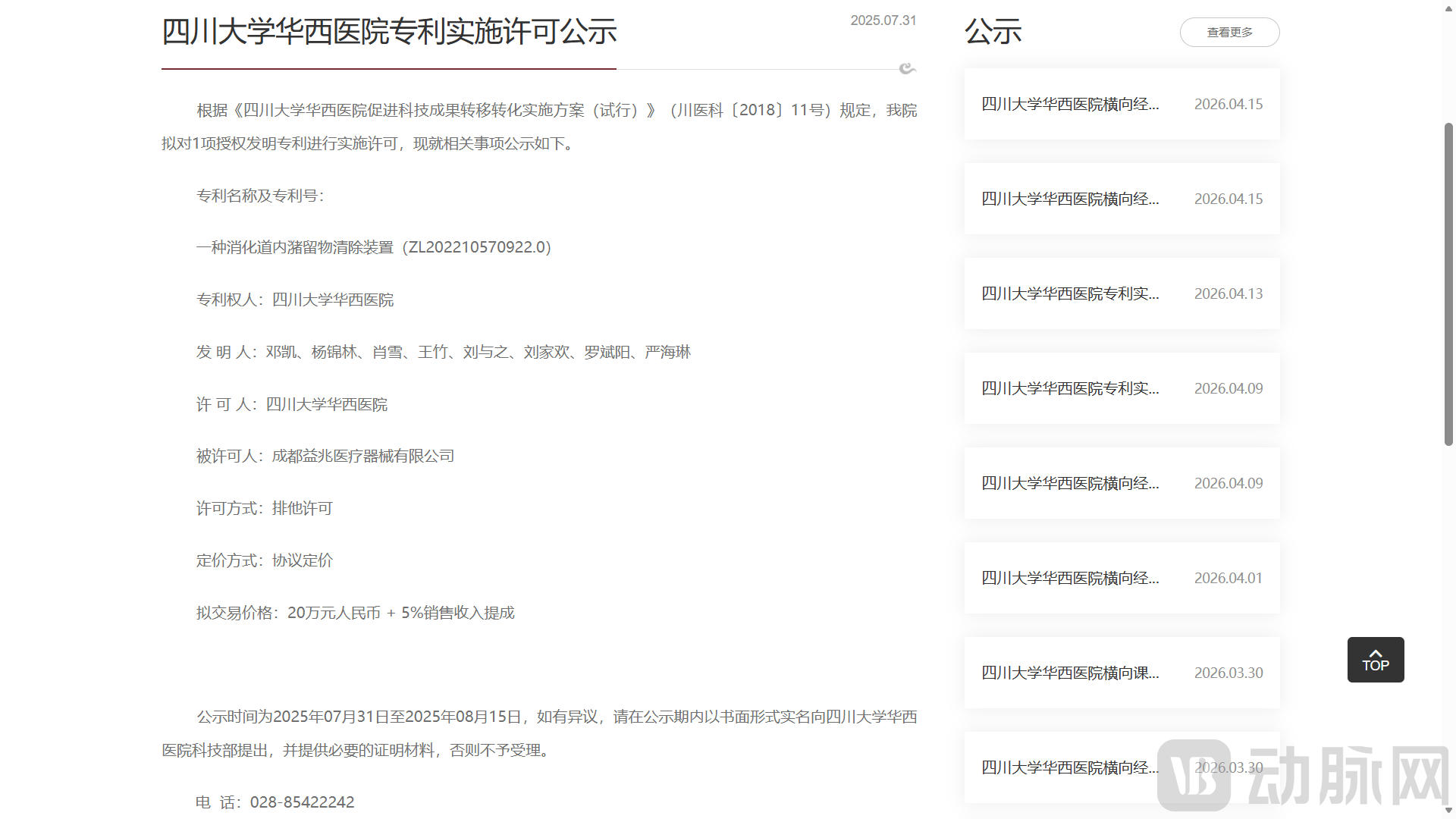
Image from the official website of Sichuan University
This patented technology focuses on clinical pain points such as emergency endoscopic diagnosis and treatment of acute gastrointestinal bleeding, and endoscopic examination in patients with inadequate bowel preparation. It overcomes the limitations of traditional clearance methods—including prokinetic agents, gastric lavage, and enemas—which are characterized by low efficiency, significant visual field interference, and the presence of contraindications and adverse reactions.Innovatively adopts a combined structure of "movable cannula with negative pressure suction inner tube", achieves shearing and crushing of retained matter through relative motion of the tube body. Combined with a bendable and adjustable tip and side-wall aperture design, it enables rapid, efficient, and safe clearance of accumulated blood, blood clots, food residues, and fecal matter from the gastrointestinal tract. This significantly improves endoscopic visualization and diagnostic accuracy in emergency settings, offering both clinical utility and public health value, representing a significant technological innovation in the field of auxiliary devices for digestive endoscopy diagnosis and treatment.
Acute Gastrointestinal BleedingIt is one of the most common critical and life-threatening emergencies in internal medicine, characterized byAcute Onset, Rapid Progression, High Riskcharacteristics, with relevant clinical data indicating that patient mortality rates can reach 3%–14%, imposing extremely high demands on the efficiency of emergency care and the precision of diagnosis and treatment. Currently,Emergency Endoscopy and Interventional TherapyIt has become the preferred intervention for acute gastrointestinal bleeding, enabling direct visualization to localize bleeding sites and perform hemostasis, thereby significantly improving treatment success rates.
However, in actual clinical practice, this critical diagnostic and therapeutic step still presents unavoidable pain points:The gastrointestinal lumen often contains substantial amounts of retained blood, blood clots, food residues, fecal debris, and fecalomas. These retained materials directly obstruct the endoscopic field of view, resulting in unclear visualization of lesions and difficulty in locating bleeding sites. This significantly interferes with the proper execution of endoscopic diagnostic and therapeutic procedures, potentially leading to missed diagnoses of treatable cases and delays in optimal resuscitation, thereby further increasing the risk of patient mortality.
To improve the endoscopic field of view, current routine clinical measures mainly include traditional methods such as the use of gastrointestinal prokinetic agents, gastric lavage, bowel cleansing, and enemas prior to endoscopy. However, these methods have significant limitations in emergency settings:
First, the time cost is high., failing to meet the core requirement of "rapid response" in emergency resuscitation;
2. Suboptimal clearance efficacy, making it difficult to thoroughly clear viscous blood clots and solid retained material, with limited improvement in the visual field;
3. Prone to causing adverse reactions, posing a risk of irritation to the gastrointestinal mucosa in patients;
4. Presence of clear contraindications, some critically ill, elderly, or patients with comorbidities are not suitable candidates. Constrained by these multiple limitations, traditional measures for improving visual fields are difficult to apply widely and efficiently in clinical practice.
In light of this practical dilemma, there is an urgent and rigid clinical demand in the field of endoscopic diagnosis and treatment of the digestive tract:There is an urgent need to develop a dedicated clearance device that can rapidly access the gastrointestinal tract, efficiently remove various types of retained material, ensure safe and simple operation, minimize patient discomfort, and have no significant contraindications., fundamentally resolving the issue of obstructed endoscopic visualization in emergency settings, ensuring precise localization of bleeding sites and smooth execution of diagnostic and therapeutic procedures. It also provides a reliable “secondary bowel preparation” option for patients with inadequate bowel cleansing, thereby improving the detection rate of lesions such as polyps and adenomas, while reducing healthcare resource consumption and patient treatment burden.
To address the aforementioned clinical pain points, the gastrointestinal retention clearance device provided by this patent,Comprehensive innovation from structural design and working principles to clinical applications, effectively addressing the limitations of traditional solutions and offering significant technical advantages. The device is based onNegative Pressure Suction Inner Tube + Movable CannulaCentered on a core structure, it overcomes the limitations of traditional medications and irrigation methods by adopting an integrated design combining mechanical shearing with negative pressure aspiration. This system can directly shear, crush, and simultaneously aspirate solid retained materials such as blood clots, food residues, and fecal matter, ensuring more thorough clearance and faster efficacy.
The device features a rounded blunt tip and smooth tube wall at the front end., minimizing damage to the gastrointestinal mucosa, ensuring greater safety and improved patient tolerance. The cannula is equipped with side-wall apertures, which not only enhance shearing and fragmentation efficiency but also facilitate the smooth entry of debris into the suction channel, further improving clearance efficacy.
Meanwhile,Innovative Bending Adjustment System Integrating “Knob Structure + Tension Wire + Directional Micro-Holes”, enabling 0°–90° angular adjustment at the distal end. Combined with directional markers, it can easily reach blind spots that are difficult to access with conventional instruments, significantly enhancing the comprehensiveness of visual field clearance. In addition, the inner suction tube is equipped with depth markings and a negative pressure control valve, allowing physicians to precisely control insertion depth and the activation/deactivation of negative pressure, thereby making the operation more intuitive and controllable.
Overall,This technique does not rely on medication, has no significant contraindications, allows for rapid operation, and involves minimal stimulation., it can rapidly clear accumulated blood and clots under emergency endoscopy to improve the success rate of hemostasis, and also serve as a tool for secondary bowel preparation in patients with inadequate initial preparation, thereby enhancing lesion detection rates. Combining high efficiency, safety, and versatility, it significantly reduces the risk of clinical missed diagnoses and the consumption of public health resources, representing a significant upgrade in auxiliary equipment for digestive endoscopic diagnosis and treatment.
Current devices for clearing gastrointestinal tract retention and improving endoscopic visualization have established a stable clinical application landscape, with the market dominated byEndoscopy-compatible irrigation and suction systems, dedicated aspiration instruments, colonic hydrotherapy equipment, and general-purpose negative pressure suction devices are the mainstream categories., covering multiple scenarios including emergency treatment, routine endoscopy, and preoperative bowel preparation.
Imported brands dominate the high-end hospital and emergency endoscopy sectors by leveraging the overall advantages of their endoscopic systems. In contrast, domestic brands have achieved widespread adoption in primary healthcare institutions, health examination centers, and rehabilitation and nursing facilities, driven by their cost-effectiveness and extensive channel coverage. While overall market demand continues to grow, existing products offer relatively limited functionality, primarily focusing on irrigation, simple suction, or external lavage. There is a lack of integrated, specialized devices designed for fragmenting solid retained matter, protecting mucosa, cleaning blind spots, and enabling rapid emergency intervention. Consequently, significant technological gaps remain in high-end emergency care and complex clinical scenarios.
Kangbei (TCOMB) SM-3000 Colon Hydrotherapy SystemIt is a specialized medical device dedicated to bowel cleansing and preoperative preparation, utilizing pulsed water irrigation technology with constant temperature, constant pressure, and controllable flow rate. Equipped with multiple safety protections and real-time monitoring systems, it ensures safe and controlled colonic lumen cleansing. The device features standardized operations and procedures, making it primarily suitable for scenarios such as bowel preparation prior to colonoscopy, intestinal cleansing before anorectal surgery, and management of chronic intestinal functional disorders. Its mode of operation focuses on non-invasive external irrigation, targeting routine cleaning and maintenance of the colon.
This product is widely adopted in China’s medical market, having been deployed in numerous secondary and tertiary hospitals, gastroenterology specialty departments, proctology diagnostic and treatment centers, health management centers, and rehabilitation and nursing institutions. It is one of the more commonly used devices for routine clinical bowel preparation, characterized by mature market application and high user recognition. The device primarily serves non-emergency, non-critical bowel cleansing needs, with clearly defined boundaries distinguishing it from emergency clinical scenarios such as the management of acute gastrointestinal bleeding or the clearance of upper gastrointestinal retention.
US Endoscopy BioVac High-Efficiency Suction CannulaIt is a specialized suction device designed for endoscopic diagnosis and treatment of the gastrointestinal tract. Leveraging an optimized tubing structure and suction channel design, it can be used in conjunction with conventional digestive endoscopes. It is primarily employed to clear intraluminal accumulated blood, secretions, semi-solid debris, and other substances during endoscopic procedures, thereby improving the operative field of view and ensuring the smooth progression of diagnosis and treatment. The product features strong overall compatibility and can interface with mainstream endoscopy platforms. Its design emphasizes rapid intraoperative suction and channel patency, meeting the basic clinical need for immediate cleaning under endoscopy.
This product is widely used in the international endoscopic device market. Owing to its mature design and stable clinical performance, it has been adopted by gastroenterology endoscopy centers in numerous medical institutions. It is primarily employed in scenarios requiring rapid visualization clearance, such as emergency management of gastrointestinal bleeding and cases with suboptimal bowel preparation. As a representative product among endoscopy-compatible suction devices, it demonstrates a high level of market maturity. Positioned mainly for intraoperative auxiliary cleaning during endoscopic procedures, it maintains a stable scope of application and promotion within the global field of digestive endoscopy diagnosis and treatment.
This patented device for clearing gastrointestinal retention precisely addresses dual gaps in clinical practice and the market, combining technical originality, essential clinical utility, and broad scenario applicability, with promising prospects for commercialization.
The device is designed toMechanical Shearing + Negative Pressure Suction + Adjustable Tip Deflection + Mucosal Protection as Core Innovations, while also being compatible withEmergency Resuscitation for Acute Gastrointestinal Bleeding, Repeat Bowel Cleansing for Inadequate Preparation, and Optimization of Routine Endoscopic VisualizationThree High-Demand Scenarios: Compatible with Mainstream Endoscopy Systems or Operable as a Standalone Unit, Offering Broad Departmental Applicability, Low Procurement Threshold, and Significant Market Expansion Potential.
Driven by multiple favorable factors, including enhanced emergency care capabilities, a sustained rise in the volume of endoscopic procedures, and the accelerated substitution of imported high-end medical devices with domestically produced alternatives, this patent is poised to become a landmark innovative product in the field of digestive endoscopy auxiliary devices. It not only significantly improves the success rate of emergency treatment and the detection rate of lesions but also helps hospitals reduce costs and increase efficiency. With strong clinical, economic, and social value, it demonstrates outstanding market competitiveness and commercialization potential.