

Tongji Hospital of Huazhong University of Science and Technology Announces Transfer of a Novel CCNB2-Targeting Anticancer Drug Patent
Recently, in accordance with the relevant provisions of the “Tongji Hospital Measures for the Administration of Transformation of Scientific and Technological Achievements,” Tongji Hospital Affiliated to Tongji Medical College of Huazhong University of Science and Technology has“Antitumor Drugs Capable of Inhibiting CCNB2 Expression and Their Applications”Public Notice on the Commercialization of Invention Patent Achievements. The patent is proposed to be priced through negotiation.210,000 yuanthe price in RMB, transferred to Wuhan Jinbian Testing Technology Service Co., Ltd., with the inventor beingLi Guodong and His Team。
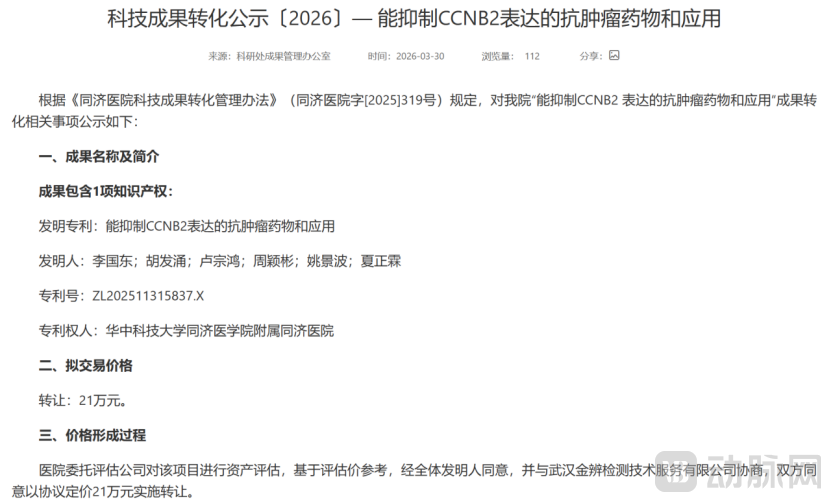
This patented technology primarily relates toAn Antitumor Drug Formulation Composed of Natural Casein and the Classic Chemotherapeutic Agent Camptothecin in a Specific Ratio, aiming to achieve inhibition of breast cancer cells and protection of normal cells in in vitro models by suppressing the expression of cyclin B2 (CCNB2).
Breast CancerBreast cancer is a malignant tumor originating from breast tissue. According to the 2022 global cancer statistics, there were approximately 2.31 million new cases of breast cancer, accounting for 11.6% of all new cancer cases, ranking it as the most common malignancy among women. In China, there were approximately 357,000 new cases of breast cancer in 2022. In terms of pathological classification, over 95% of cases are invasive carcinomas, with invasive ductal carcinoma being the most common type.
For such patients,Systemic Antineoplastic Drug TherapyThis is the standard clinical pathway. However, the tumor microenvironment plays a complex role in the development of breast cancer, capable of impairing immune surveillance and inducing drug resistance in tumors. Relevant studies have indicated that CCNB2 is highly expressed in breast cancer tissues, and this aberrant expression is typically associated with poor patient prognosis.
Within the existing pharmacotherapy system,Camptothecin and Its Derivatives as Topoisomerase Inhibitors, are important drugs in anti-tumor therapy. However, pure chemotherapy drugs generally suffer from non-specific cytotoxicity in clinical applications. While these agents kill tumor cells, they also cause varying degrees of toxic side effects on normal human tissues and cells. This to some extent limits the clinically administrable dosage, compromising patient tolerance and subsequent therapeutic outcomes.
Therefore,Reduce Toxic Side Effects on Normal Tissues While Preserving the Antitumor Activity of Drugs, remains a topic of sustained interest in the field of anticancer drug development.
To address the limitations of camptothecin-based drugs in terms of cytotoxicity, the research and development team from Tongji Hospital, affiliated with Tongji Medical College of Huazhong University of Science and Technology, throughBioinformatics ApproachesAn in-depth exploration of core targets was conducted. By analyzing data from the TCGA-BRCA cohort, the research team confirmed thatCCNB2The expression level in breast cancer tumor tissues was significantly higher than that in the healthy control group, and CCNB2 expression showed significant correlations with various tumor-infiltrating immune cells. The research team found thatα-S2-casein derived from milk can effectively inhibit the expression of CCNB2.Based on this mechanism of action, the team established a technical approach to intervene in the progression of breast cancer by inhibiting CCNB2 expression.
In terms of preparation process and formulation selection, this technical solution has conducted refined validation on the ratio of core active ingredients.The research team mixed α-S2 casein with deionized water and homogenized the mixture to form a casein solution with a mass concentration of 0.3%–0.5%, and mixed camptothecin with dimethyl sulfoxide to form a camptothecin solution with a mass concentration of 0.05%–0.15%. Depending on specific clinical application requirements, sodium chloride may be optionally added to the formulation at a mass concentration of 0.01%–0.05% as an osmotic pressure regulator, or disodium ethylenediaminetetraacetate (EDTA-2Na) may be added at a mass concentration of 0.01%–0.1% as a chelating agent. Experimental results demonstrated that when casein and camptothecin were mixed and homogenized at a mass ratio of 1:10 to 1:15 (preferably 1:12), the resulting combination drug exhibited a significant synergistic effect in antitumor efficacy.
In vitro cytology results further quantified the significant advantages of this combination regimen in enhancing efficacy and reducing toxicity.In the safety assessment using normal human mammary epithelial cells (Hs 578Bst), treatment with 0.05% camptothecin solution alone reduced cell viability to 87.3% ± 0.6%, whereas formulation with casein maintained the viability of normal cells above 91%. In cytotoxicity assays against breast cancer cells, camptothecin alone limited the viability of the human breast cancer cell lines MDA-MB-231 and MCF-7 to 63.3% ± 0.6% and 64.0% ± 1.7%, respectively.
In contrast, in the experimental group using a 1:12 combination ratio, the viability of MDA-MB-231 cells significantly decreased to 30.0% ± 0.0%, and that of MCF-7 cells also dropped to 35.0% ± 0.0%. Furthermore, experimental data indicated that even in the group where casein was used as the sole active ingredient, breast cancer cells exhibited a certain degree of inhibition, and the relative expression levels of CCNB2 in all experimental groups were significantly lower than those in the control group. These findings demonstrate that casein not only possesses inherent tumor-suppressive activity but also enhances the efficacy of camptothecin while reducing its toxicity to normal cells.
Observing the current breast cancer drug market,The Development of Antineoplastic Agents Is Evolving Toward Molecular Subtyping and Precision TargetingAccording to the breast cancer diagnosis and treatment guidelines, antibody-drug conjugates (ADCs) such as T-DXd have demonstrated corresponding clinical value in salvage therapy, making them a key pipeline focus for numerous pharmaceutical companies both domestically and internationally. Many drugs select topoisomerase I inhibitors (i.e., camptothecin and its derivatives) as their underlying toxin payloads. In the Chinese market, several companies are advancing ADC products targeting TROP2 and armed with topoisomerase I inhibitors. For example:
SKB264:The TROP2 ADC developed by Kelun Pharmaceutical (Kelun-Biotech) incorporates a recombinant humanized anti-TROP2 monoclonal antibody and the novel topoisomerase I inhibitor KL610023 in its drug structure.
SHR-A1921:TROP2-targeted ADC developed by Hengrui Medicine, with its payload being the self-designed DNA topoisomerase I inhibitor SHR9265, is currently in the clinical stage.
BAT8008:An ADC drug developed by Bio-Thera Solutions, composed of a recombinant humanized anti-TROP2 monoclonal antibody conjugated to a topoisomerase I inhibitor via a proprietary cleavable linker.
The aforementioned companies, through the development of complexAntibody-Linker Technology, thereby enabling targeted delivery of camptothecin-based toxins into the tumor interior, with the aim of overcoming the nonspecific toxicity of conventional chemotherapeutic agents to normal systemic tissues.
In contrast, the patent titled “Anti-tumor Drug Capable of Inhibiting CCNB2 Expression and Its Application,” which is proposed for transfer in this transaction, offers a differentiated technological pathway based on the improvement of conventional pharmaceutical excipients. This technologyUses naturally extracted casein as an excipient, achieving detoxification and sensitization of camptothecin in in vitro experiments through conventional physical compounding methods. This R&D approach bypasses the preparation of antibody macromolecules, with relatively mature formulations and processes as well as clearly defined costs. This achievement can not only be translated into basic reagent formulations for in vitro cell experiments and drug sensitivity testing, but also provides a cost-effective underlying technical reserve for subsequent exploration of improved new drugs based on classic chemotherapeutic agents.