

Zhejiang University Unveils Piezoelectric Internally-Driven Rotational Thrombectomy Technology for Enhanced Stroke and Arterial Occlusion Treatment
Recently, Zhejiang University released a public notice on the transformation of scientific and technological achievements, proposing to transfer"An Internally Driven Rotary Cutting Negative Pressure Thrombectomy Device and Its Application Method"Transfer of relevant patents, with the transfer fee denominated in RMB1 million yuan. The inventor of this patented technology isChen Zhicai and His Team。
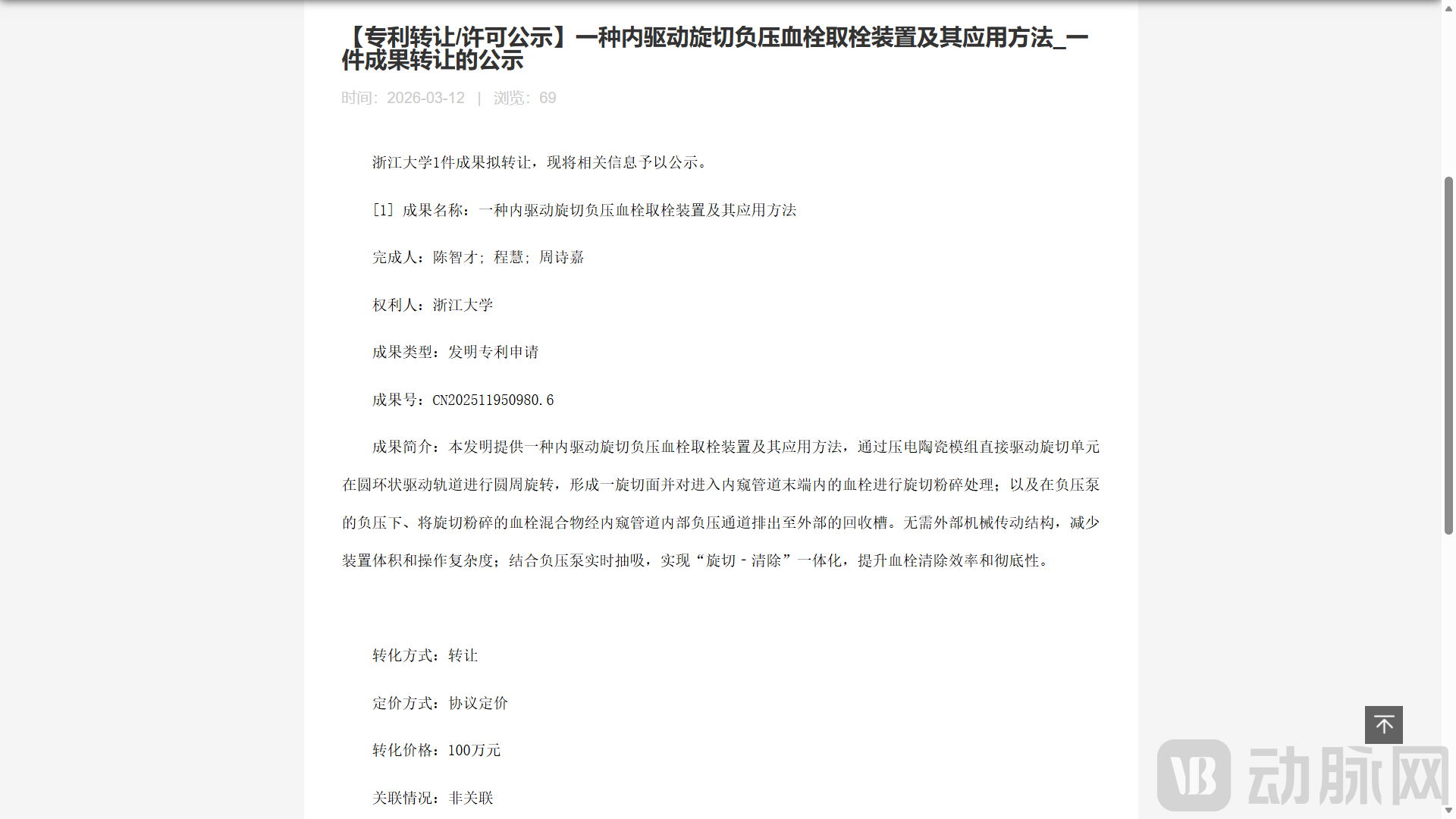
Image from the official website of Zhejiang University
This technology was developed by Zhejiang University.An Endovascular Thrombectomy Medical Technology, the core isUtilizing piezoelectric ceramic internal drive, rotational cutting and fragmentation, and synchronized negative-pressure aspiration to integrally, minimally invasively, and safely fragment and extract intravascular thrombi.. Specifically designed for endovascular thrombectomy procedures to address thrombotic occlusions in conditions such as cerebral infarction and lower extremity arterial embolism.
Minimally Invasive Endovascular Thrombectomy for Thromboembolic Diseases (Cerebral Infarction, Lower Extremity Arterial Embolism, etc.)This represents a core and critical scenario in current endovascular interventions. However, the removal of large-volume, hard-consistency thrombi (such as cardioembolic thrombi) remains technically challenging and carries a high risk of vascular injury, constituting a persistent clinical challenge and a key bottleneck restricting the efficiency and safety of thrombectomy. Meanwhile, existing thrombectomy devices and technical solutions exhibit multiple shortcomings in terms of recanalization efficacy, vascular protection, and procedural controllability, failing to meet the clinical demands for efficient, safe, and standardized thrombectomy.
From the perspective of clinical application, traditional thrombectomy protocols primarily rely on standalone aspiration thrombectomy and stent retriever thrombectomy.Significant technical deficiencies exist:First, the lack of an active rotational cutting and maceration mechanism results in insufficient capability to remove hard, large-volume thrombi, leading to catheter tip occlusion and distal embolization of thrombus fragments, thereby requiring multiple maneuvers to achieve vascular recanalization. Second, certain thrombectomy components (such as blades and stents) are exposed or flush with the catheter tip, directly contacting the vessel wall, which can easily cause intimal injury, hemorrhage, or even perforation. Third, the drive structure relies on external mechanical transmission systems such as gears and belts, resulting in a bulky design and poor stability; this predisposes the device to vibration and jamming during rotational cutting, further increasing surgical risks.
At the level of commercially available thrombectomy devices, even those integrating rotational atherectomy and aspiration functions remain caught in a dilemma where it is difficult to balance efficiency and safety.Current devices generally fail to achieve precise synchronization between rotational atherectomy and negative pressure aspiration, resulting in incomplete thrombus fragmentation, delayed aspiration, and high residual rates. Meanwhile, the unreasonable design of the rotational cutting component’s position and coarse drive control prevent dynamic adjustment of rotational speed based on thrombus hardness, making operations highly dependent on physicians’ experience. Furthermore, the device tubing is prone to thrombus adhesion with a high risk of occlusion, while complex post-procedural cleaning and disposal processes increase the clinical burden and infection risk.
Although novel thrombectomy technologies have seen improvements in negative-pressure drive and rotational cutting structures, they have yet to overcome the triple bottlenecks of safety design, drive mechanisms, and procedural standardization.Most technologies lack the protective design of "in-plane retraction during rotational cutting," resulting in a persistently high risk of vascular injury. They continue to rely on external mechanical transmission, which hinders miniaturization and adaptation to narrow vessels such as those in the intracranial region. The absence of standardized preoperative examinations, precise intraoperative parameter control, and regulated postoperative shutdown sequences makes these systems prone to operational errors that can lead to residual or embolizing thrombi. Consequently, their overall fault tolerance is low, limiting scalable application in emergency and complex vascular scenarios.
Addressing key pain points in the field of endovascular thrombectomy, such as low clearance efficiency, high risk of vascular injury, and complex operational procedures, Zhejiang University’s patented technology employsPiezoelectric Ceramic Internal Drive + Rotational Cutting–Negative Pressure Synergyas the core,Developed a safer, more efficient, and controllable minimally invasive thrombectomy protocol, comprehensively overcoming the technical bottlenecks of traditional thrombectomy devices.
This technology pioneers precise internal-drive rotational cutting without external transmission, fundamentally enhancing stability and controllability.Traditional devices rely on external mechanical transmissions such as gears and belts, resulting in bulky size, significant vibration, and susceptibility to jamming, making them ill-suited for narrow intracranial vessels. This solution employs a circular arrangement of piezoelectric ceramic modules to form an annular drive track, leveraging the inverse piezoelectric effect to directly drive the rotation of the rotational atherectomy unit. By eliminating external transmission structures, the device volume is reduced by 30%, enabling compatibility with intracranial vessels as small as 2 mm in diameter. Integrated with an MCU and PID algorithm, the system precisely regulates rotational speed via piezoelectric voltage control, maintaining an error margin within ±1 rpm. This ensures effective fragmentation of hard thrombi while preventing vascular wall damage from excessive speeds, significantly enhancing both drive stability and miniaturization.
The core breakthrough of the solution lies in the synchronized integration of mechanical thrombectomy and aspiration, significantly enhancing thrombus removal efficiency while reducing the risk of embolic escape.Most existing devices operate on a “aspiration-first, thrombectomy-later” principle or feature unsynchronized rotational atherectomy and aspiration, which can lead to issues such as thrombus occlusion at the catheter tip and distal embolization of fragments. This patent enables synchronized activation of rotational atherectomy and the negative pressure pump, with a delay of ≤10 ms. Thrombus is immediately fragmented by rotational atherectomy upon being drawn into the distal end of the catheter by negative pressure, and the resulting mixture is promptly evacuated through the negative pressure channel without any retention. When combined with spoke-type hollow blades or nitinol rotational atherectomy guidewires, fragmentation efficiency is increased by 25%, thrombus clearance rate reaches 95%, and the probability of occlusion is reduced to 0.1%, truly achieving “simultaneous cutting and aspiration for complete removal.”
The clinical safety design achieves a breakthrough in zero vascular injury, significantly reducing surgical complications.Traditional thrombectomy devices feature exposed cutting components or cutting edges flush with the catheter tip, which can easily scratch the vascular intima, resulting in a high risk of perforation and hemorrhage. This technology recesses the cutting surface 1–3 mm within the catheter tip, ensuring that the cutting unit operates entirely inside the lumen without direct contact with the vessel wall. Animal studies have demonstrated a 0% incidence of vascular injury. Furthermore, the cutting components are made from medical-grade materials with excellent biocompatibility, combined with a low-vibration drive design, which further reduces vascular irritation and stress-related injury, significantly enhancing safety compared to traditional solutions.
The technology also enables standardization and intelligence across the entire workflow, significantly lowering the operational barrier and enhancing fault tolerance.Traditional thrombectomy relies heavily on physician experience, and the lack of standardized preoperative checks combined with incorrect shutdown sequences postoperatively can easily lead to residual thrombus. This solution features a touchscreen visual control interface that allows for presetting parameters such as voltage and duration, with automatic data storage. It performs an automatic self-check within 30 seconds prior to surgery, displays real-time status indicators including rotational speed, negative pressure, and temperature during the procedure, and triggers automatic alerts for any anomalies. Postoperatively, it employs a controlled shutdown sequence of “stopping rotational cutting first, then stopping negative pressure,” reducing the residual thrombus rate to as low as 0.1%. By standardizing the entire workflow from preoperative preparation and intraoperative adjustment to postoperative processing, this system lowers operational complexity, making it suitable for rapid deployment in emergency settings and primary care clinical environments.
Furthermore, the solution features strong adaptability and ease of maintenance, meeting the needs of diverse clinical scenarios.The dimensions and materials of the rotational cutting structure can be flexibly selected based on vessel diameter. It is compatible with standard 0.014-inch guidewires and suitable for thrombectomy in multiple regions, including intracranial, cervical, and lower extremity vessels. The piezoelectric ceramic module features a threaded connection with a wear-resistant coating, enabling convenient installation and removal and tripling maintenance efficiency. The entire system supports portable power sources with a battery life of ≥4 hours, meeting the requirements for diverse scenarios such as catheterization labs, emergency departments, and ambulances, thereby demonstrating significant value for widespread clinical adoption.
Driven by the rapidly growing clinical demand in acute ischemic stroke and peripheral arterial thrombosis,Integrated Rotational Aspiration ThrombectomyIt has become the mainstream technological direction for vascular interventional debulking. Leading global enterprises and innovative domestic manufacturers are iterating their products around core aspects such as transmission structure, atherectomy method, synchronized aspiration, and vessel protection, forming a competitive landscape dominated by imports with accelerated catch-up by domestically produced devices, while technical routes are concentrated inMechanical transmission rotary cutting, magnetic coupling drive, piezoelectric/ultrasound-assisted rotary cuttingThree Major Directions: Overall Transitioning from Mature Clinical Application to Technological Iteration and Upgrading
Boston Scientific’s Core Products: Peripheral Atherectomy System + Integrated Aspiration Platform, rotational atherectomy combined with active synchronized aspiration enables real-time removal of plaque/thrombus fragments, thereby reducing the risk of distal embolization; it is used for pretreatment of peripheral vascular lesions such as those in the femoropopliteal arteries. Approved for market launch by the NMPA in August 2024, it boasts comprehensive global multicenter clinical data and holds a mainstream share of the high-end peripheral atherectomy market.
Penumbra's core products: Indigo System, CAT6/8/10 Aspiration and Mechanical Thrombectomy Systems, featuring large-bore aspiration combined with proximal mechanical thrombus fragmentation, it primarily utilizes high-negative-pressure aspiration supplemented by fragmentation, addressing both acute stroke and peripheral thrombosis. As a global leader in neurointerventional and peripheral thrombectomy aspiration devices, it has received approval from both the FDA and NMPA and holds a high recommendation level in clinical guidelines.
Jiangsu Jintai Medical's TideSpin® Thrombectomy System, Disposable Peripheral Vascular Rotational Atherectomy Catheter, with key features including magnetic coupling transmission and physical separation between the catheter and the main unit; a dual-cutting-head configuration integrating rotational atherectomy, spiral aspiration, and secondary fragmentation. Approved for market launch by the NMPA as an innovative medical device in January 2026, it is the first domestically approved peripheral thrombectomy product, with technology benchmarking international leading standards.
In summary, the piezoelectric ceramic internally driven rotational thrombectomy with integrated negative pressure technology disclosed in this patent addresses the pain points of traditional thrombectomy devices, such as low clearance efficiency, high risk of vascular injury, and operational complexity, by featuring core innovations in internal piezoelectric ceramic drive and integrated rotational cutting–negative pressure functionality.An integrated solution enabling precise thrombus fragmentation, simultaneous aspiration, safe minimally invasive procedures, and intelligent controllability. By leveraging a miniaturized design with no external transmission, inward-retracted rotary cutting protection, precise PID speed control, and standardized full-process operation, this technology significantly enhances thrombus removal rates and vascular safety, making it suitable for minimally invasive thrombectomy in various scenarios, including intracranial and peripheral applications.
Looking ahead to the future of the industry, miniaturization, transmission-free design, and intelligent coordination will become the mainstream development directions for vascular interventional thrombectomy devices. Leveraging their structural advantages and clinical value, these technologies are poised to fill the domestic gap in the high-end minimally invasive rotational atherectomy and thrombectomy sector, thereby driving the treatment of acute thrombosis toward greater safety, efficiency, and standardization.