

Tongji Team Invents Specialized Immobilization Blanket That Halves Pediatric Facial Suturing Time
Recently, Tongji Hospital Affiliated to Tongji Medical College of Huazhong University of Science and Technology released a public notice on the transformation of scientific and technological achievements, proposing to transfer two utility model patents in their entirety to Hubei Ruikang Trading Co., Ltd., with a proposed transfer amount ofRMB 205,000. The two patents involved in this transfer are respectively“A Maternal Examination and Emergency Trolley” and “A Maxillofacial Suturing and Fixation Device”, all byLiu Xiangping, Zheng Jin, Wu Hui, and Li Zheying TeamR&D. This section primarily introduces“A Maxillofacial Suture Fixation Device”related patents.
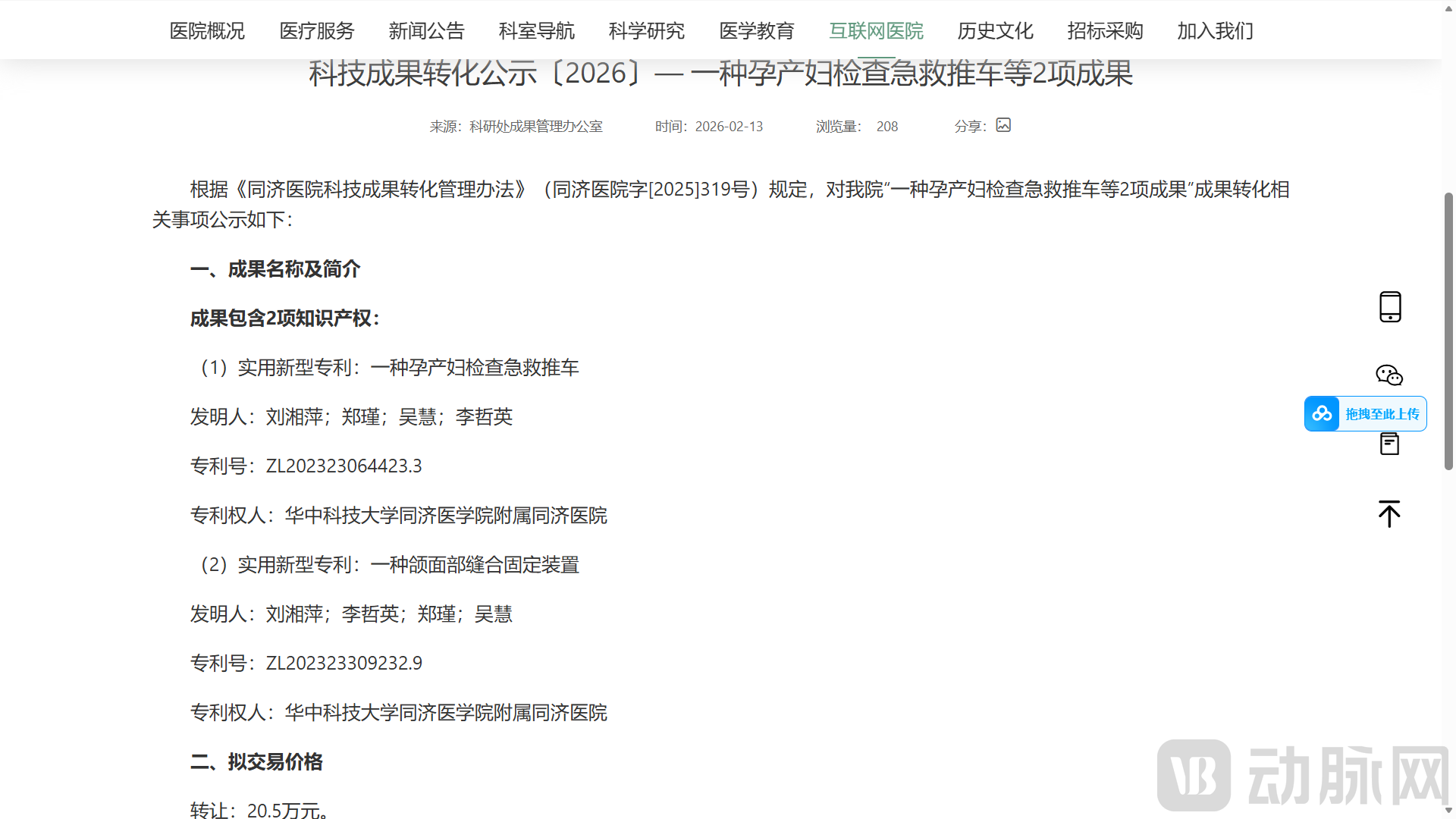
Image from the official website of Tongji Hospital, Tongji Medical College, Huazhong University of Science and Technology
The core innovation of this patent lies in addressing clinical challenges such as poor cooperation, difficulty in immobilization, and inadequate wound exposure during pediatric maxillofacial suturing. Through an integrated design featuring head restraint, torso wrapping, adjustable adhesion, and neck elevation, it achieves stable immobilization of pediatric patients and optimizes the surgical field, thereby significantly enhancing the safety and operational efficiency of suturing for pediatric maxillofacial trauma.
Maxillofacial TraumaIt is a relatively common type of injury in pediatric emergency departments, with skin lacerations being the most prevalent. Due to their young age and limited self-control, children often exhibit intense stress reactions—such as severe crying, limb thrashing, and head shaking—following lacerations to the head, face, and maxillofacial regions. These reactions are typically triggered by wound pain, unfamiliar environments, and stimulation from medical procedures. Consequently, overall treatment compliance is extremely low, which not only interferes with standardized procedures such as debridement, anesthesia, disinfection, and suturing, but also directly compromises wound alignment, suturing precision, and subsequent healing outcomes.
Currently, there is no standardized or specialized fixation solution for suture management of pediatric maxillofacial lacerations in clinical practice in China. The mainstream approach remains manual assistance by family members, whereby caregivers manually restrain the child’s head, torso, arms, and legs to passively limit movement.
This traditional model suffers from numerous insurmountable shortcomings:
First, as family members are non-professionals, their immobilization techniques are often non-standard and uneven in force, making it highly likely that the immobilization will be insecure. This leads to continuous shaking of the child’s head and torso, significantly increasing the difficulty for physicians during suturing procedures and directly prolonging the overall treatment duration;
Second, the child is prone to touching the sterile field and contaminating surgical instruments and the wound during struggling, significantly increasing the risk of postoperative complications such as infection and poor wound healing;
Third, in clinical practice, it is common for only one family member to accompany the child during medical visits. A single individual struggles to simultaneously stabilize the child’s head and entire body, leading to further reduced immobilization efficacy and posing significant safety risks.
Fourth, for wounds in special locations such as the mandibular region, traditional manual fixation fails to effectively adjust the head and neck position of pediatric patients, making it difficult to fully expose the wound within the optimal surgical field, thereby further increasing operational difficulty and the risk of traumatic repair.
In the face of growing demand for the treatment of pediatric maxillofacial trauma and increasingly stringent medical safety standards, existing fixation methods can no longer meet the clinical requirements for standardized, comfortable, and safe care, creating an urgent need within the industry forA Dedicated Maxillofacial Suturing and Fixation Device Capable of Stabilizing Pediatric Patients, Precisely Exposing Wounds, Adapting to Various Ages and Body Types, and Offering Simple Operation, to address the clinical staffing shortfall and enhance the level of trauma care in pediatrics.
The “maxillofacial suture fixation device” described in this patent revolves aroundFull-Process Requirements for Suturing Pediatric Maxillofacial TraumaConduct systemic innovation toIntegrated, Adjustable, and Human-Centered DesignCompletely replaces traditional manual fixation methods, establishing multiple core technological advantages and application values.
The device uses a fixed plate as its base carrier., with a dedicated head placement area and T-shaped detachable elastic straps at the upper part, providing stable and gentle restraint of the pediatric patient’s forehead and vertex to effectively prevent intraoperative head movement from interfering with the procedure;Equipped with adjustable sliding arm supports on both sides of the head., which can standardize the supporting posture of auxiliary personnel, thereby enhancing fixation effectiveness and preventing hand tremors from family members from compromising sterile technique;The middle section features a large-sized hook-and-loop fastener adhesive structure., it can be flexibly connected to body restraints and neck pillows, adapting to the installation positions for pediatric patients of different heights and body types, significantly enhancing the device's versatility.
The physical restraint system consists of a waterproof, easy-to-clean wraparound blanket combined with multiple strap assemblies., it can provide full-circumference wrapping and restraint for the child's torso, addressing the clinical challenge of being unable to achieve whole-body immobilization when accompanied by a single caregiver. The restraint pressure is evenly distributed with high comfort, significantly reducing the child's struggling and stress responses.
Matching Inflatable Neck Pillow, featuring a height-adjustable design achieved through the combination of an outer layer of high-density foam and an inner airbag, which precisely elevates the pediatric patient's mandibular region to fully expose wounds in the lower jaw area. This effectively addresses the common limitation of inadequate surgical field exposure associated with traditional fixation methods, thereby providing clinicians with clear and stable operating conditions.
The entire device is easy to assemble and disassemble, offers flexible adjustment, and is made of safe materials that are easy to sterilize. It effectively reduces the risk of contamination in sterile areas and cross-infection, significantly shortens the total time required for debridement, anesthesia, and suturing, and improves operational precision and wound healing quality. Balancing safety, practicality, and comfort, it comprehensively addresses all limitations of existing clinical solutions.
In summary, with the continuous improvement of standardized and comfort-oriented treatment requirements in China’s healthcare sector, the commercialization of this achievement will effectively fill the domestic market gap for pediatric maxillofacial suture fixation devices, demonstrating strong potential for clinical adoption and market commercialization.
The demand for pediatric emergency trauma diagnosis and treatment in China is steadily increasing, with the popularization and application of specialized medical devices continuously advancing. Medical institutions at all levels have a clear demand for devices that are adapted to children's physiological characteristics and meet the requirements of specialized procedures.
Laerdal’s Head Immobilizer is an internationally renowned head restraint device specifically designed for emergency transport., featuring a multi-directional adjustable fixation plate with a handle locking mechanism, paired with replaceable cushions and head-chin straps. It is suitable for patients aged 2 years and older. The device is made of durable materials that are easy to clean and disinfect, and it is compatible with imaging examinations such as X-ray, CT, and MRI. With a streamlined operational workflow, it demonstrates mature performance in terms of stability and safety for head immobilization.
This product is designed for pre-hospital emergency care, spinal trauma transport, and emergency department settings, primarily used in conjunction with spine boards and stretchers. Its core value lies in maintaining the head in a neutral position throughout trauma care to prevent secondary injury. With its reliable quality and international recognition, it has been widely adopted by emergency departments, emergency centers, and ICUs in China’s Grade A tertiary hospitals, establishing itself as a classic imported product in the field of head immobilization.
Montai APN Magnetic Control Restraint Strap is a medical device under Montai Nursing, specializing in specialized protective restraints., featuring a core design based on magnetic lock technology, combined with skin-friendly, durable materials and an adjustable structure, it offers anti-escape functionality, ease of operation, and comfortable wear. The product line includes various specifications for wrist, ankle, and supine positioning. Its core positioning is as a protective restraint for specialized clinical scenarios, designed to meet the safety restraint needs of specific patient populations while balancing safety and human-centered design. Unlike general-purpose restraints, it demonstrates clear specialization and adaptability for targeted medical applications.
It is widely used in clinical settings across China, primarily suited for psychiatric specialty hospitals, intensive care units (ICUs) in general hospitals, geriatrics departments, and emergency departments. It is a commonly used product in the field of specialized protective restraint. Leveraging its well-established brand presence, the product has been adopted by medical institutions at all levels. With its specialized design and reliable quality, it has gained widespread recognition from clinical institutions, becoming one of the mainstream choices for specialized restraint scenarios.
This patented maxillofacial suturing and fixation device focuses on the specialized fixation needs of pediatric maxillofacial suturing. With its exclusive, integrated, and adjustable design, it provides a dedicated solution that better aligns with clinical operational scenarios. The device is suitable for diverse settings such as pediatric emergency departments, stomatology departments, and maternal and child health hospitals. It complements existing general-purpose restraint products and emergency fixation instruments, thereby enhancing the overall supply system of clinical fixation devices. As the concepts of standardized and comfortable medical procedures gain wider acceptance, this patented technology demonstrates strong clinical adaptability and promotional value. Upon successful commercialization, it will effectively enrich the selection of specialized medical devices, offering broad prospects for practical application and market development.