

Zhongshan Ophthalmic Center's Innovative Adhesive-Free, Hypoallergenic Eye Patch Patent Licensed to VisionEcon Medical for Commercialization
Recently, the Zhongshan Ophthalmic Center of Sun Yat-sen University released“An Eye Patch”Public Notice of Assignment of Utility Model Patent Rights: Intended Conversion and Transaction of the Outcomes of This Ophthalmic Medical Device Patent. This transaction involves the full assignment of utility model patent rights. The assignor is the Zhongshan Ophthalmic Center, Sun Yat-sen University, and the proposed assignee is Vision Aikangte (Guangdong) Medical Technology Co., Ltd. The transaction consideration is proposed to be adoptedRMB 100,000 fixed transfer fee + 2% commission on annual salespattern.
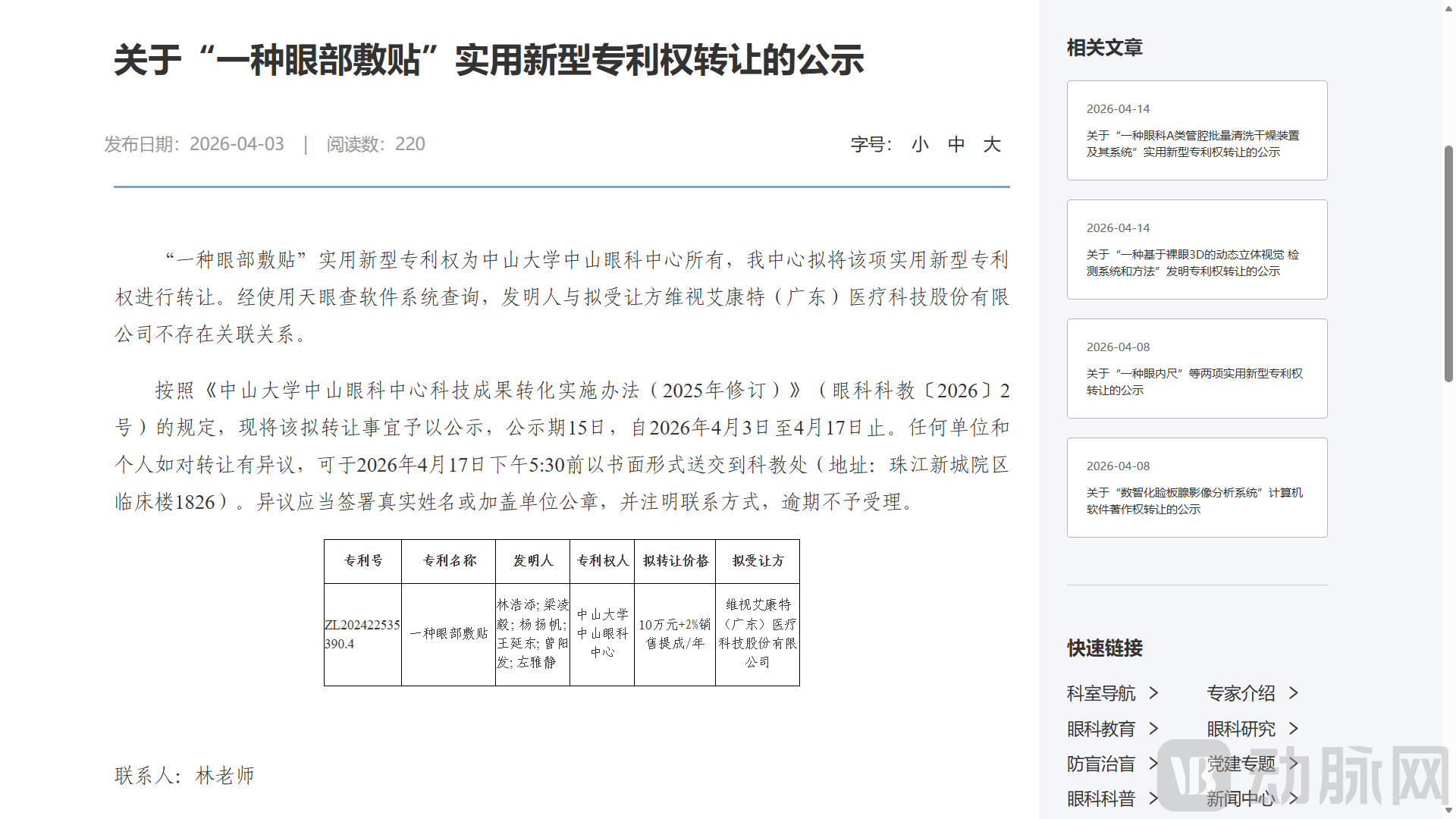
Image from the official website of Zhongshan Ophthalmic Center, Sun Yat-sen University
This innovative patent focuses onOcular Wound Care Scenarios, with its core innovation lying in the abandonment of traditional adhesive fixation methods,Adopts a paper-based ear-loop support structure combined with a layered water-resistant moisturizing design, offering advantages such as comfortable wear, hypoallergenic and non-irritating properties, ease of use, environmental friendliness, and low cost. It precisely provides a stable microenvironment for the healing of ocular wounds, effectively addressing the pain points of traditional dressings, including skin irritation, cumbersome fixation, and the risk of accidental eye injury.
Ocular Wound CareIt is a specialized clinical intervention for various traumas and wounds of the ocular surface and periocular region. Its core functions are to isolate external stimuli, prevent pathogenic microbial invasion and subsequent infection, accelerate tissue healing, and effectively alleviate wound pain and discomfort.
As one of the most delicate structures and physiologically sensitive organs in the human body, the eye is not only a high-risk area for infection—where bacteria can easily invade and trigger severe complications—but also features a dense distribution of nerve endings, resulting in more intense pain and lower tolerance after trauma. Consequently, ocular wound care is subject to far more stringent standards than general cutaneous wound care, particularly in terms of infection prevention and control, functional preservation, wearing safety, and patient comfort.
In current clinical practice,The use of dressing products for wound care remains the most common approach., traditional eye patches generally use adhesive materials as the primary fixation method. While this design can maintain the patch's position stability for a short period and meet basic coverage requirements, it presents several insurmountable drawbacks in practical applications:
First, the adhesive layer comes into direct contact with the delicate periocular skin, easily causing chemical and physical irritation. Long-term wear is highly likely to trigger adverse reactions such as erythema, pruritus, and allergies, significantly reducing patient compliance;
Secondly, the fixation and removal procedures for traditional dressings are cumbersome and demand a high level of operational skill from users or caregivers; during these processes, there are safety risks such as skin traction, dressing displacement, and even accidental injury to the eyeball.
Furthermore, most traditional dressings lack a rational design for water barrier and moisture retention, leading to rapid water evaporation and easy infiltration of external fluids. This failure to provide a stable, moist microenvironment for wound healing directly compromises repair efficacy and recovery speed.
Addressing the Limitations of Current Clinical Protocols: Urgent Needs in Ophthalmic Clinical Practice and Patient CareA Novel Ocular Care Patch: Non-Adhesive, Easy to Apply and Remove, Excellent Water-Resistant Moisturizing Performance, Anatomically Contoured for the Eye Area, Safe and Comfortable, to address the limitations of current clinical nursing tools and enhance the quality of care and rehabilitation experience in scenarios such as ocular trauma and post-ocular surgery.
The eye patch described in this patent systematically improves and structurally reconfigures around the core defects of traditional products,A comprehensive technical solution that integrates safety, comfort, practicality, and industrialization value, with prominent innovations and advantages.
This technology completely abandons traditional adhesive fixation methods, opting instead forLightweight paper support with ear-loop openings for non-invasive fixation, fundamentally eliminating the risk of irritation and allergic reactions to the sensitive skin around the eyes caused by the adhesive layer; its simple and quick application and removal effectively prevent skin pulling and accidental eye injury, significantly enhancing safety and patient compliance;The main body of the patch adopts a layered integrated design comprising a dressing layer, a permeable layer, a water-proof layer, and a water-proof border., strictly controlling water vapor transmission rate and liquid permeability, which not only locks in moisture for an extended period to maintain the moist microenvironment required for wound healing, but also effectively blocks the intrusion of external contaminants, thereby providing stable and reliable care conditions for ocular surface repair.
MeanwhileAdopts a separable dressing layer and fluid reservoir bag structure, enabling independent production of the main component and the dressing section, which facilitates flexible adjustment of the production process, improves efficiency, and reduces costs. It also allows for the replacement of dressing types based on clinical needs, thereby expanding applicable scenarios. The design featuring separate application of the dressing and connection part combined with straps better accommodates facial contours across diverse populations, ensuring more secure fixation and resistance to displacement. Its compact folded size facilitates packaging, storage, and clinical use.
This product is overall designed withNon-woven Fabrics and Eco-friendly Paper MaterialsCentered on a soft texture, stable structure, and excellent breathability, it combines low cost with biodegradability. It not only meets the safety standards for medical consumables but also aligns with the industry trend toward environmental sustainability, comprehensively addressing the core requirements of ocular wound care in terms of protective efficacy, wearing comfort, ease of use, and scalability for industrial adoption.
The current domestic market for medical eye wound dressings generally presentsSteady Expansion of Demand, Upgrading of Product Structure, and Enhanced Focus on Clinical Valuedevelopment trends. With the deepening aging of the population, a continuous increase in the volume of ophthalmic surgeries, and the incidence of ocular trauma and ocular surface diseases remaining at high levels, the demand for professional medical dressings in scenarios such as postoperative eye care, wound healing, and ocular surface protection is continuously expanding, driving steady overall market growth.
From the perspective of the product landscape, the current market is still dominated by traditional adhesive dressings, standard sterile eye pads, and integrated hydrogel dressings. International brands occupy the mid-to-high-end market with their mature technologies and channel advantages, while domestic brands have achieved extensive penetration in primary healthcare institutions and routine care scenarios through high cost-performance ratios and localized services, resulting in a highly competitive industry overall.
Xingzhicheng Polyvinyl Alcohol Hydrogel Eye Patch (Huarenkang)This is a Class II medical eye-care dressing under Shandong Xingzhicheng Biotechnology Co., Ltd. The product features a polyvinyl alcohol (PVA) hydrogel as its core functional layer, combined with a non-woven fabric base and an elastic ear-loop structure. It boasts high transparency, high water content, and excellent adhesion. Sterilized by irradiation, the product demonstrates stable biocompatibility, contains no irritating small-molecule additives, and offers a high level of safety for use.
This product is primarily designed for scenarios such as general anesthesia surgery, deep coma, and intensive care unit (ICU) critical care. By providing a relatively sealed and moist environment for the ocular surface, it mitigates issues like corneal desiccation and epithelial shedding, thereby reducing the risk of exposure keratitis. Its visible design allows medical staff to monitor ocular status without removing the dressing, while the ear-loop fixation structure enhances wearing stability. Adopting an ready-to-use format, the product effectively streamlines clinical workflows, meeting the high-efficiency nursing demands of operating rooms and intensive care units.
Leveraging a standardized production system and established distribution channels for medical dressings, this product has built a stable foundation for clinical use in operating rooms, anesthesiology departments, and intensive care units (ICUs) across hospitals of all tiers. With clearly defined indications, compliant medical device certifications, and a design that aligns seamlessly with clinical workflows, it has become a preferred choice for healthcare institutions implementing protective eye care. The product holds a steady market share in the specialized sector of medical-grade eye protection, continuously contributing to perioperative safety and the preservation of ocular health in critically ill patients.
Suzhou Kanglida Ophthalmic Self-Adhesive Wound DressingThis wound care product is developed and manufactured in accordance with Class II medical device standards. It primarily consists of a non-woven fabric base, medical-grade pressure-sensitive adhesive, an absorbent dressing core, and a release liner. Sterilized with ethylene oxide, it is supplied as a single-use sterile item. Its overall structure balances conformability, absorbency, and fixation stability, meeting the basic protective needs for superficial periorbital wounds, postoperative sutured incisions, and similar scenarios.
This dressing features a contour-adaptive design tailored to the periorbital region. The absorbent core demonstrates effective exudate absorption capacity, while the base material is soft and breathable. Its adhesive fixation method is easy to operate, enabling rapid wound coverage and securement. During use, it provides an effective barrier against external contamination and irritation, thereby offering stable and safe basic care for postoperative and traumatic ocular wounds. It complies with general clinical standards and safety requirements for wound dressings.
In the field of clinical wound care in China, Suzhou Kanglida’s ophthalmic-specific self-adhesive wound dressing has been widely used in settings such as ophthalmology outpatient clinics, operating rooms, and ward dressing changes, owing to its consistent product quality, standardized medical device certifications, and ease of use. It has become one of the preferred choices for managing superficial periorbital wounds and postoperative incisions.
This patent“An Eye Patch”WithNon-invasive ear-hanging fixation, layered water-resistant moisturizing, split-fit structure, eco-friendly low-cost materialsThese core innovations precisely align with the current upgrade trends in the ocular wound dressing market and address critical unmet clinical needs, offering significant competitive advantages and broad prospects for commercial translation.
This technology fundamentally eliminates the risks of skin irritation, allergic reactions, and operational safety hazards associated with traditional adhesive dressings, while establishing a stable microenvironment for wound healing. It balances wearing comfort, nursing efficacy, and clinical practicality, broadly covering core application scenarios such as ocular trauma management, post-ophthalmic surgery care, and ocular surface wound care. It meets the usage requirements across diverse settings, including hospital operating rooms, ophthalmology wards, outpatient dressing changes, and home-based rehabilitation.
Amid policy incentives for the translation of medical scientific and technological achievements and the innovation and upgrading of domestically produced medical consumables, this patented technology demonstrates clear clinical value, industrialization advantages, and cost competitiveness. It not only fills the current market gap in the supply of non-invasive, fixed-type professional ocular wound dressings but also establishes significant differentiation from traditional dressings, ordinary hydrogel eye patches, and conventional sterile dressings. Upon future commercialization, it is poised to rapidly penetrate healthcare institutions at all levels and the consumer care market, gradually becoming the preferred solution in the field of ocular wound care, with substantial potential for market penetration and sustainable development.