

Ant AI Health App 'Ant Aifu' Launches Free Interpretation for 100 Million Users' Physical Exam Reports
In an era where medical check-ups have become a standard component of health management, many people likely share this experience: approaching their check-up like an exam, anxiously reviewing the report afterward, and responding to abnormal findings with either frantic online searches and panic or a brief period of heightened health consciousness before quickly forgetting about it. Ultimately, most reports end up as dust-covered “exam papers,” rarely serving any further purpose.
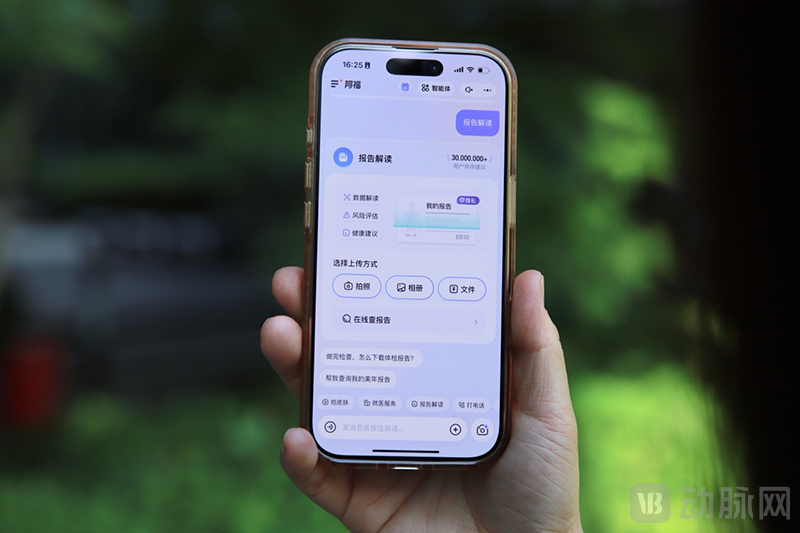
The root cause of these phenomena lies in the long-standing imbalance in health checkup services, which have prioritized testing over interpretation and lacked effective management. Following a strategic partnership with Meinian Onehealth, Ant Fu, China’s largest AI-driven health application, recently launched the “Healthy China Checkup Care Initiative” to provide free interpretation of health checkup reports for 100 million users. Leveraging innovations in AI technology and its service ecosystem, Ant Fu has the potential to address the longstanding gap in post-checkup management, thereby helping to position health checkups as the true starting point for personal health management from both user-service and industry-evolution perspectives.
According to multiple industry reports, the market size of health checkups in China has exceeded RMB 300 billion, with a continuously rising compound annual growth rate. Regular health screenings have become a standard employee benefit for enterprises and public institutions as well as a common health practice among the general public, while demand for checkups among the elderly and children is growing increasingly robust. However, post-examination management remains a weak link; although the industry is paying increasing attention to it, effective implementation has yet to be realized.
The high professional threshold for interpreting health checkup reports is the primary obstacle.Typically, health checkup reports are replete with specialized terminology. Lacking medical knowledge, ordinary users are unable to assess the risk levels associated with abnormal indicators, often swinging between extremes of excessive anxiety and outright neglect, thereby significantly diminishing the warning value of these reports.
Secondly, the level of personalization in health examination services is insufficient.Currently, the market is dominated by health checkup packages for groups or individuals. Even when options are available, the plethora of medical terminology makes it difficult for laypeople to choose appropriate tests. The "one-size-fits-all" model remains prevalent, and over-testing is common, which directly undermines the effectiveness of subsequent precision health management due to a lack of meaningful reference data.
More critically, the fragmentation of health examination data and the disconnection within the service chain make it difficult to provide robust support for long-term health management.A single abnormal indicator does not necessarily provide an accurate assessment of disease risk. Meanwhile, users’ health examination reports are scattered across different institutions and time periods, with inconsistent formats, often leading to their immediate disregard; this makes it difficult to maintain continuous, comprehensive, and easily accessible health records. Furthermore, China’s health examination market is highly fragmented, and there has long been a lack of integrated platforms that consolidate health examination information and services. Most institutions can only offer interpretations of their own reports and limited post-examination guidance, which is insufficient to support sustainable health management.
Ultimately, resources in the health checkup industry are concentrated on short-term revenue-generating segments, such as service packages and examination equipment, while insufficient investment is made in long-term value-added services, resulting in the failure to effectively implement post-examination management.
Addressing industry challenges, Ant Afu leverages a specialized large medical language model and a multi-scenario service ecosystem. By using health checkup report interpretation as an entry point, it strengthens the pre- and post-examination service systems for the industry.
During its evaluation of the Aifu service, VCBeat uploaded three health examination reports spanning a three-year period from different medical institutions. Aifu promptly completed the interpretation by first distilling core conclusions and highlighting year-over-year changes in key indicators. It then categorized items requiring close attention versus routine monitoring, analyzed the causes of indicator fluctuations and the necessity for intervention, and ultimately generated a personalized action plan. This plan specified a follow-up timeline at one month, six months, and one year, complemented by targeted recommendations on diet, nutrition, exercise, and daily routines. Notably, Aifu “commended” indicators that had shown improvement, lending the interpretation a more human-like emotional warmth.
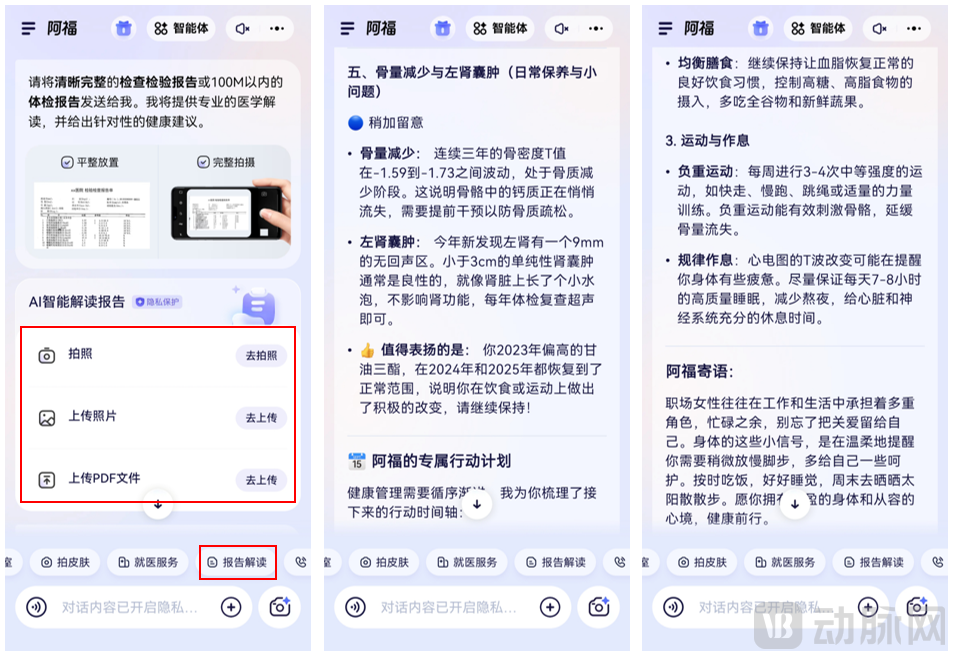
Afu's Physical Examination Report Interpretation and Partial Health Recommendations
When considered alongside the other features of Afu’s health checkup report interpretation, its advantages are primarily reflected in four aspects:
First, translate professional content into layman's terms.Results are color-coded in red, yellow, green, and blue to lower the comprehension barrier for the general public: red indicates immediate intervention is required, yellow warrants re-examination, blue calls for attention, and green signifies no abnormalities.
Second, it supports trend analysis and dynamic profiling.After users upload their medical examination reports from multiple years, Afu can compare and analyze the trends of key indicators, provide early warnings for the risk of chronic disease progression, and offer an intuitive view of health changes even across examinations conducted at different institutions, thereby constructing a dynamic health profile. Meanwhile, users can store these reports in their personal health records for easy access at any time and to receive subsequent personalized health recommendations.
Third, it covers the two key stages of pre-examination and post-examination.In addition to the above post-examination report interpretation, Afu can recommend more personalized health checkup items and eliminate those that do not require frequent monitoring by integrating users’ basic information and previous reports during the pre-examination phase. Accordingly, it provides reminders on pre-examination precautions, such as fasting, medication suspension, and dietary restrictions.
Fourth, action recommendations and report interpretation form a closed loop.Afu generates a personalized action plan for users based on the interpretation results, with clear timelines and priorities that enhance the practicality of the recommendations, addressing the challenge users face in managing their post-examination care.
While Afu’s interpretation results appear simple, they are in fact built upon rigorous and professional technical capabilities. As the technological foundation of Afu, the Ant Medical Large Language Model has consistently ranked among the leaders on both domestic and international professional benchmarks. It collaborates with authoritative institutions such as the Chinese Medical Association, top universities, and leading hospitals to conduct joint AI research, continuously enhancing its professionalism. Meanwhile, Afu connects with more than 5,000 hospitals across China and supports online consultations with 300,000 licensed physicians, thereby establishing a multi-dimensional healthcare service ecosystem. This provides users with tangible resource support for post-examination health management as well as both online and offline medical care.
Currently, the industry has reached a consensus that “health check-ups are not just about screening, but more importantly, about management.”The widespread renaming of physical examination centers across various regions to “Health Management Centers” serves as direct evidence. In 2025, the National Health Commission released the “New National Standard” for physical examination items, further clarifying the critical supportive role of physical examinations in subsequent health management and encouraging the full utilization of information technology to support both physical examination and health management services. With the iterative upgrades of large language models, AI is becoming an industry infrastructure, driving the transition from physical examinations to comprehensive health management.

Leveraging its platform’s technological and resource integration capabilities, Ant Afu has assumed the role of an infrastructure builder in the industry’s transformation and upgrading, making physical examinations a true starting point for health management.
In the future,Leveraging the infrastructure built on AI health platforms, the industry is poised to move beyond the traditional model of merely conducting tests and issuing “report cards,” helping the general public understand their health metrics while meeting users’ increasingly personalized and refined health management needs., driving the expansion of the health checkup market into the broader health management market.