

West China Hospital Licenses Innovative Multimodal Non-Invasive Device for Osteoporosis Treatment
Recently, West China Hospital of Sichuan University released a public notice on patent licensing, proposing to license itsA Treatment Head Device for Osteoporosis TherapyAuthorization for the implementation license of the patent, with a proposed transfer amount ofRMB 100,000 + 5% commission on sales revenue. The licensor in this patent license transaction is West China Hospital of Sichuan University, and the licensee is Sichuan Taiyou Technology Co., Ltd.
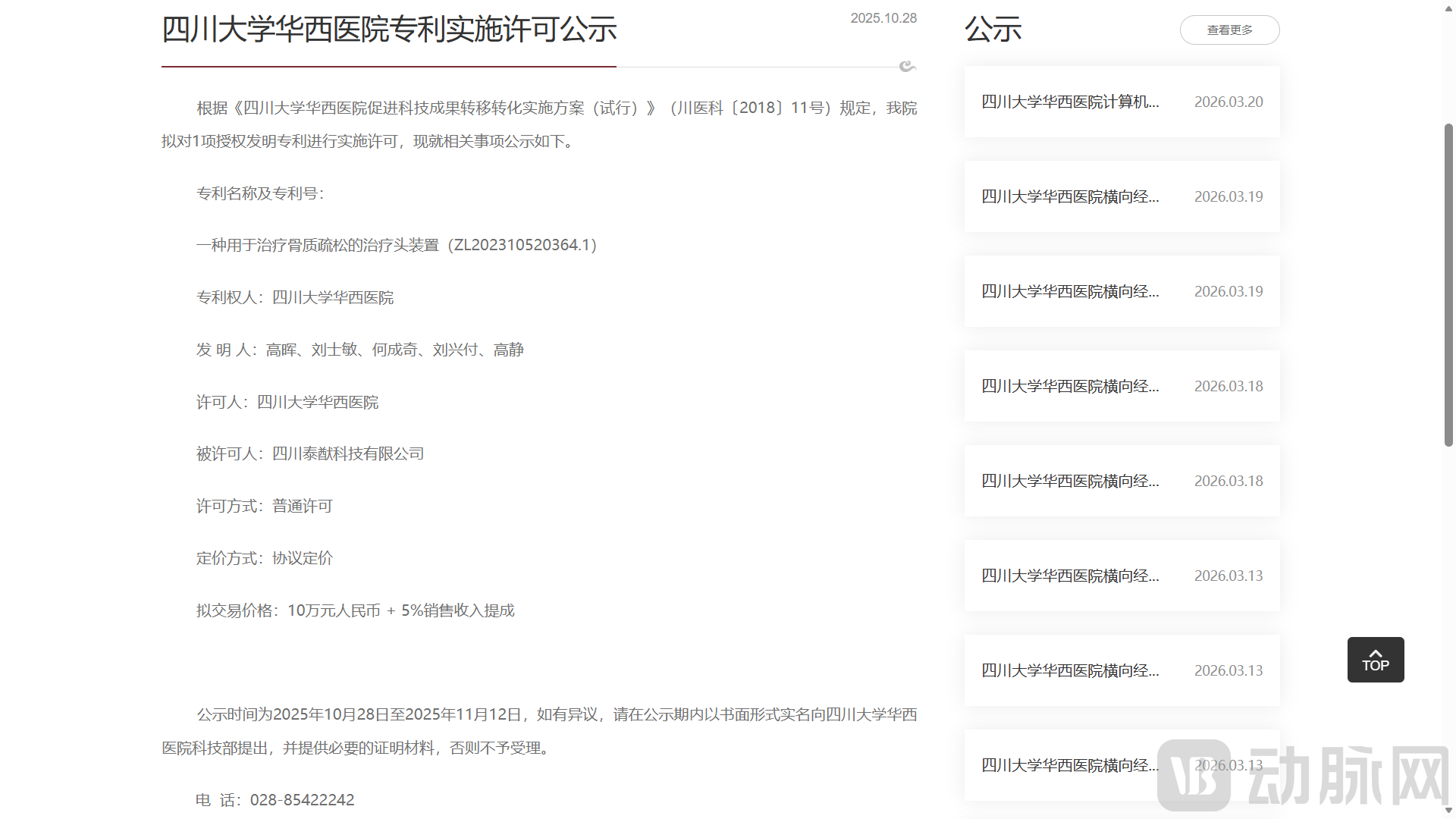
Image from the official website of West China Hospital, Sichuan University
This patent overcomes the technical limitations of traditional osteoporosis treatments that rely on a single physical factor or pharmacological therapy, innovatively integratingLow-Intensity Pulsed Ultrasound, Electrically Controlled Drug Release, Microcurrent StimulationThree therapeutic agents, throughCore technologies including phased-array ultrasonic transducer design, independent electrode phase delay control, and electrically controlled drug release via conductive polymer coupling layers, achieving non-overlapping spatial distribution and synergistic action of three therapeutic factors. This approach not only addresses the limitations of poor efficacy associated with single therapeutic agents and significant systemic side effects of medications, but also substantially enhances the therapeutic efficacy for osteoporosis and shortens the treatment cycle through design features such as ultrasonic dose compensation, expansion of the treatment area, and rapid alleviation of bone pain. Meanwhile, it improves patient treatment experience and compliance, representing a significant achievement in the field of osteoporosis treatment that combines technological innovation with clinical practicality.
OsteoporosisIt is a typical systemic skeletal disease characterized by bone mass loss and deterioration of bone microarchitecture, which significantly reduces the skeleton's resistance to injury and greatly increases the risk of fragility fractures. The vast majority of patients experience pronounced osteoporotic bone pain, which not only severely impairs their daily functional capacity and quality of life but also constitutes a common and challenging clinical dilemma in orthopedics and geriatrics, posing substantial challenges to therapeutic management.
Currently, mainstream clinical treatment regimens for osteoporosis are primarily categorized into two types: one comprises single-modality physical therapy techniques, represented by low-intensity pulsed ultrasound and electromagnetic therapy; the other consists of systemic pharmacological interventions, which dominate clinical practice.
However, both types of solutions have exposed significant defects that are difficult to avoid in practical applications:Single-Modality Physical Therapy TechniquesRelying solely on a single mechanism of action results in low therapeutic efficiency and generally suboptimal overall outcomes; furthermore, it fails to rapidly alleviate osteoporotic bone pain, leading to poor patient-reported treatment experiences; whereasSystemic Pharmacological TherapyAlthough this is a routine clinical approach, the medication must act on skeletal sites via systemic circulation, which not only results in a slow onset of action but also causes significant systemic side effects, making it equally difficult to effectively address the clinical challenge of slow bone pain relief.
The cumulative impact of these issues directly results in poor patient comfort during treatment, leading to low levels of cooperation and adherence. This has become a core obstacle to improving the efficacy of osteoporosis treatment and shortening the treatment cycle in clinical practice. Against this clinical backdrop, there is an urgent need in the medical field for novel osteoporosis treatment technologies and dedicated devices that can break through the limitations of traditional single-modality therapies. These innovations should integrate multiple effective treatment methods, balance therapeutic efficacy with medication safety, rapidly alleviate bone pain symptoms, and significantly enhance patient treatment experience and adherence. Such advancements aim to address the shortcomings of existing clinical treatments and meet the practical clinical demand for efficient, safe, and patient-friendly osteoporosis management.
This osteoporosis treatment head device achieves a comprehensive breakthrough over traditional therapeutic regimens through multi-dimensional technological innovations, offering both significant technical innovation and clinical application advantages. Its core innovations and benefits are reflected in multiple aspects, including technology integration, dose modulation, synergistic efficacy, and enhanced patient experience.
In terms of core technological innovation, the device is pioneering.Integration of Low-Intensity Pulsed Ultrasound (LIPUS), Electrically Controlled Drug Release Technology, and Microcurrent Stimulation Technology, and through precise structural design, it ensures that ultrasound, negatively charged drug ions, and microcurrents do not spatially overlap. This approach not only guarantees the independent efficacy of each of the three therapeutic factors but also achieves a synergistic and cumulative therapeutic effect, fundamentally overcoming the technical limitations of traditional single-factor therapies.
MeanwhileAdopts a phased array ultrasonic transducer design, featuring an independent lower transducer electrode and phase delay control technology, which resolves the issue of reflection attenuation caused by acoustic impedance mismatch when ultrasound is irradiated through the skin to bone. It enables dose compensation for adjacent transducer elements through constructive or destructive interference, thereby positively compensating for insufficient ultrasound dosage and negatively regulating excessive dosage, thus ensuring more precise ultrasound application.
In terms of clinical application advantages,Multifactorial Combination TherapySignificantly accelerates the therapeutic efficacy for osteoporosis, effectively shortens the clinical treatment cycle, and markedly increases the volume of effective treatments delivered per unit time;Electrically Controlled Drug Release TechnologyLocal, precise drug delivery is achieved through a conductive polymer coupling agent layer; negatively charged drug ions reach the lesion directly under the effects of charge repulsion and ultrasonic propulsion, replacing traditional systemic drug therapy and significantly reducing systemic side effects associated with medication.Microcurrent Stimulation TechnologyIt can rapidly alleviate osteoporotic bone pain, and its flexible encapsulation design allows the device to adhere better to the skin, significantly enhancing patients’ treatment comfort and experience, thereby improving treatment adherence and reliance.
In addition,Phased Array TransducerThe design also significantly enlarges the ultrasonic therapy window, enabling broader coverage of skeletal regions affected by osteoporosis and achieving comprehensive treatment of high-risk areas such as human joints. Compared with traditional devices, it offers a wider range of applications, meets diverse clinical treatment needs, provides a superior technical solution for the clinical management of osteoporosis—a challenging medical condition—and holds substantial socioeconomic value and promising prospects for clinical adoption.
Driven by population aging and the expanding prevalence of osteoporosis, the market for physiotherapy devices in osteoporosis treatment is experiencing sustained demand growth and steady industry expansion, with technological upgrades and scenario segmentation emerging as core development directions. The market landscape exhibits distinct tiered characteristics: high-end medical institutions tend to prefer mature, imported professional equipment, while primary care and home-use markets are dominated by cost-effective, domestically produced basic devices. Meanwhile, there is an increasingly urgent demand for the research, development, and application of innovative therapeutic devices featuring multi-factor integration and intelligent control. Policy support for the translation and promotion of innovative medical devices has created a favorable environment for the market adoption of high-end innovative equipment.
Anasys Beijing Yujian RYD-IIE is a domestically produced mid-range medical DC iontophoresis device for thermotherapy., its core mechanism achieves localized transdermal drug delivery and physical analgesia by combining directional iontophoresis with thermal effects. It serves as a foundational rehabilitation device in orthopedics and rehabilitation departments, and is also used for the adjunctive treatment of joint pain associated with osteoporosis. The product’s market strategy focuses on China’s primary healthcare sector, with sales primarily conducted through offline bidding and centralized procurement. It holds a certain share of the primary care market in the niche segment of drug iontophoresis devices combining electrical stimulation with heat, with its core advantages being high cost-effectiveness and suitability for high-volume diagnosis and treatment in primary care settings.
The device supports multi-channel simultaneous therapy with flexible adjustment of treatment parameters, enhancing transdermal drug delivery efficiency and reducing adverse drug reactions, thereby meeting the diagnostic and therapeutic needs of primary healthcare institutions. However, the product lacks design features for ultrasound-mediated deep bone repair, limiting drug penetration to superficial tissues. It also lacks core technologies such as precise dosage control and spatial separation of factors, enabling only basic analgesic and anti-inflammatory effects, and thus failing to meet core therapeutic requirements such as increasing bone mineral density in osteoporosis or promoting fracture healing.
The Xibei Sonopuls 190 is a high-end medical ultrasound therapy device built upon Enraf’s core technology from the Netherlands., with core components imported and precisely assembled domestically, it holds a formal medical device registration certificate, combining import-quality standards with domestic certification. The market application of this device mainly focuses on mid-to-high-end medical institutions in China, core coverage including rehabilitation departments of Grade A tertiary hospitals, professional sports clinics, and high-end physiotherapy institutions, making it a mainstream device for clinical physical therapy of musculoskeletal injuries.
This device is equipped with Low-Intensity Pulsed Ultrasound (LIPUS) technology and features dual applicators: a handheld probe and a suction-mounted head. It supports multi-frequency deep tissue penetration. The suction-mounted design allows for vacuum fixation at the treatment site, freeing the operator’s hands, while intelligently adjusting ultrasound energy output. It is effective in alleviating muscle and joint pain, promoting soft tissue repair, and accelerating fracture healing. As a specialized therapeutic device for orthopedics and rehabilitation departments, it targets sports injuries and osteoarticular disorders. However, it relies solely on ultrasound as a single physical modality, lacking complementary features such as drug delivery or microcurrent stimulation, and thus cannot achieve multi-modal synergistic therapy.
From a market application perspective, this technology can be developed into specialized medical devices suitable for clinical diagnosis and treatment scenarios across healthcare institutions at all levels. It also holds potential for miniaturization and portability, enabling integration into the home physiotherapy equipment market. By addressing multi-dimensional market demands, it demonstrates strong market adaptability.