

Tongji Hospital Licenses Corneal Sensitivity Tester Patent for RMB 216,000
Recently, Tongji Hospital affiliated with Tongji Medical College of Huazhong University of Science and Technology released a public notice on the transformation of scientific and technological achievements, proposing to transfer its “Corneal Sensitivity Meter"The patent for invention has been transferred to Wuhan Tongji Optometry Technology Co., Ltd. The transfer fee is"RMB 216,000. The inventors of this achievement areLi Guigangand his team。
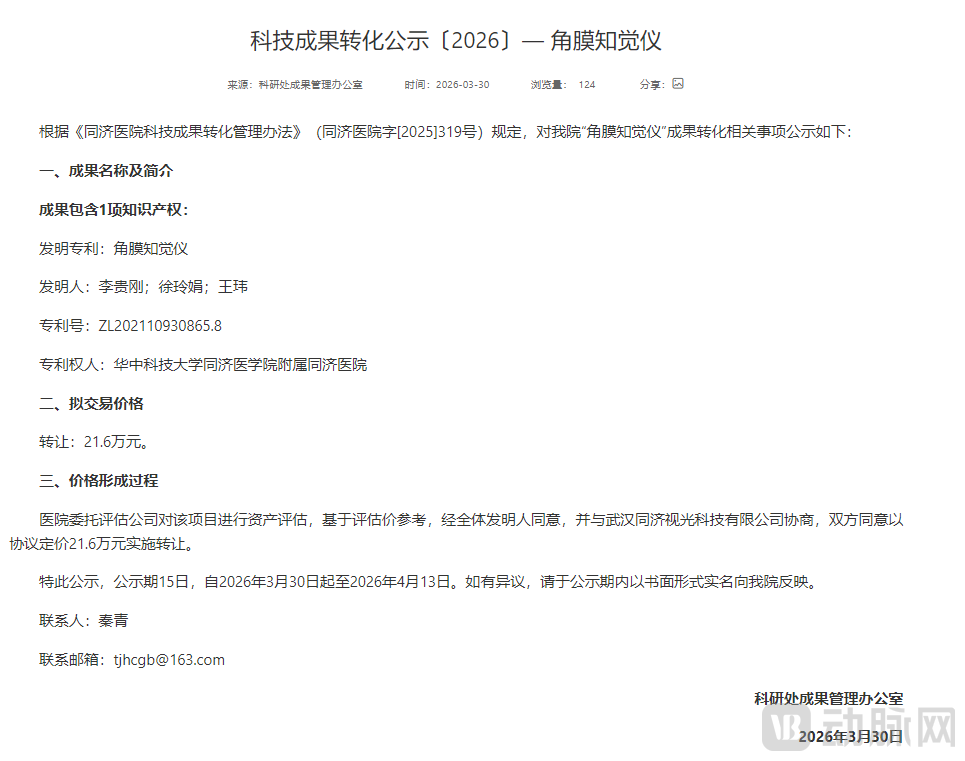
Image from the official website of Tongji Hospital, Tongji Medical College, Huazhong University of Science and Technology
“Corneal Sensitivity Meter"The invention patent addresses the pain points of traditional corneal sensation testing, such as inconsistent procedures, high safety risks, susceptibility to false positives, and difficulty in quantification. It employs a 10°–80° lateral downward pressure measurement technique, combined with precise adjustment of effective filament length and a percentage-based sensation scale, to achieve standardized quantitative assessment. The device features height and angle locking mechanisms and disposable handle kits, which prevent cross-infection and enhance procedural consistency and safety."
Currently, clinical corneal sensation testing still relies on the Cochet-Bonnet aesthesiometer and cotton wisp touch method as mainstream approaches. In practical applications, five major bottlenecks that are difficult to overcome have long existed, severely restricting detection accuracy, clinical safety, and data comparability.
First, poor operational consistency.Detection relies entirely on the operator's visual assessment of minute fiber bends of approximately 5°, lacking a standardized control process. Measurement results vary significantly across different physicians, time points, and patient conditions, leading to substantial subjective error and poor data reproducibility.
Second, the security risk is relatively high.The filament touches the cornea vertically from directly ahead, making it difficult to precisely control the force and angle. This easily scratches the corneal epithelial cells, increasing the potential risk of corneal injury, inflammation, and even secondary microbial infection.
Third, there is a risk of cross-infection.Fibrous filaments are reusable components that cannot be replaced on a single-use, single-patient basis, posing risks of cross-infection between patients and between the left and right eyes. This fails to comply with modern clinical aseptic techniques and healthcare-associated infection prevention and control requirements.
Fourth, the false positive rate is high.When the instrument approaches the eyeball from directly in front, it easily causes visual stimulation and startle to the patient, triggering non-tactile reflex blinking, which leads to false-positive results and fails to accurately reflect the level of corneal sensation.
Fifth, it is difficult to achieve quantitative assessment.Using filament length as the sole recording metric is problematic, given its nonlinear correlation with pressure; this precludes conversion into perceptual percentages or grades, hinders objective assessment of corneal sensory loss, and complicates long-term follow-up, treatment efficacy comparisons, and research statistics.
To address the numerous shortcomings of traditional testing, “Corneal Sensitivity Meter“The invention patent achieves comprehensive innovation across four key dimensions: measurement principles, quantification standards, structural design, and clinical adaptability, with prominent core advantages:”
1. Innovation in Measurement Methods.Lateral Downward Pressure Design: Simultaneous Enhancement of Safety and AccuracyThis patent employs a lateral downward pressure measurement mode, in which the tip of the optical fiber forms an oblique angle of 10°–80° (preferably 20°–40°) with the patient’s horizontal line of sight. The fiber contacts the cornea via an oblique approach, using the tangential contact between the tip and the corneal surface as the criterion for measurement. This design ensures clearly discernible deflection amplitude, fundamentally improving operational consistency and detection accuracy. Furthermore, the oblique contact avoids the risk of corneal epithelial injury associated with vertical poking, significantly reduces visual interference and involuntary blink reflexes, and effectively minimizes false-positive results.
Second, precise quantification.The effective filament length directly corresponds to the perception grade. The standardized instrument is equipped with a high-efficiency filament length adjustment mechanism, utilizing a push-button slider or adjustment rod structure. It features a scale directly marked with percentages of normal corneal sensation, corresponding to five perception levels (Grades 1–5) at 100%, 50%, 25%, 12.5%, and 6.25%, thereby achieving standardized control of testing intensity with intuitive and easily interpretable results. The telescopic rod is fitted with a height adjustment scale and a locking knob, allowing precise control of the depression distance without relying on empirical visual estimation of bending degree, which significantly enhances testing accuracy and reproducibility.
Third, structural design optimization.Modular, Single-Use Design for Comprehensive Cross-Infection ControlThe handle kit features an independent, detachable design that supports single-patient, single-use applications, thereby eliminating the risk of cross-infection between patients and between the two eyes at the source. Its dual-end filament delivery structure enables sequential examination of both eyes using a single fiber optic filament, further enhancing operational efficiency and safety. The instrument can also be equipped with optional pressure sensors and a digital display, which directly capture pressure values and automatically convert them into perceptual thresholds, achieving fully digitalized and quantified output throughout the entire procedure.
Fourth, it demonstrates strong clinical friendliness.Featuring a dual-locking mechanism for angle and height, the device is optimized for high-efficiency outpatient screening workflows. It enables multi-level testing with a single positioning step, eliminating the need for repeated adjustments of either the instrument or the patient’s posture, thereby significantly enhancing detection efficiency. Its streamlined design ensures controllable manufacturing costs, facilitating widespread adoption and bulk deployment in ophthalmology departments at hospitals of all levels, specialized clinics, and optometry centers.
In the clinical application and technological development of corneal sensation testing, various technical solutions have continuously iterated and upgraded, focusing on detection accuracy, operational stability, and clinical safety, ranging from classic traditional devices to novel non-invasive instruments, and further to patented innovations with optimized structures.
Cochet-Bonnet Corneal EsthesiometerIt is the classic gold-standard device for clinical assessment of corneal sensation in ophthalmology worldwide. Since its introduction in the 1950s, it has been extensively used to evaluate conditions such as dry eye disease, corneal nerve injury, and trigeminal nerve dysfunction. During the examination, the patient looks straight ahead while the examiner vertically applies a nylon filament to the central cornea, causing it to bend slightly by approximately 5°. Testing begins with the longest filament (60 mm); if no response is elicited, the filament length is shortened by 5 mm increments until the patient exhibits a blink or tactile response. The filament length at which this response occurs represents the level of corneal sensation.
The world's first device, developed by Professor Chen Wei’s team at the Eye Hospital of Wenzhou Medical University and exclusively patented and commercialized by Yanxiaoyi Biotechnology Co., Ltd.Non-contact Corneal EsthesiometerCentered on “non-invasive, precise, and intelligent” principles, this approach employs controlled airflow stimulation technology to replace traditional contact-based examinations (such as the cotton wisp test), providing a safe, objective, and reproducible solution for corneal nerve function assessment, thereby advancing corneal sensation testing from “vague descriptions” to “precise quantification.”
Zhongshan Ophthalmic Center, Sun Yat-sen University's application for "A Corneal Esthesiometer“Utility Model Patent (Publication No. CN222444076U): To address the shortcomings of traditional corneal esthesiometers, such as unstable handheld operation, significant measurement errors, and the risk of cross-infection due to non-replaceable filaments, we have designed a corneal esthesiometer featuring support structures, motorized advancement, and replaceable filaments. A rubber bracket provides stable support, while a motor-driven automatic filament advancement system minimizes human error. A detachable clamping structure enables filament replacement for each patient. Equipped with sensors and a display screen, the device ensures controllable safety and intuitive data presentation, significantly improving detection consistency and clinical safety.”