NVIDIA Unveils Open Physical AI Models for Medical Robotics at GTC 2026
NVIDIA
Artificial Intelligence Computing Service Provider
Leading surgical robotics companies, including CMR Surgical and Johnson & Johnson MedTech, as well as developers of physical AI platforms for surgery such as PeritasAI and Proximie, have been among the first to adopt NVIDIA’s healthcare-specific physical AI tools unveiled at GTC 2026.
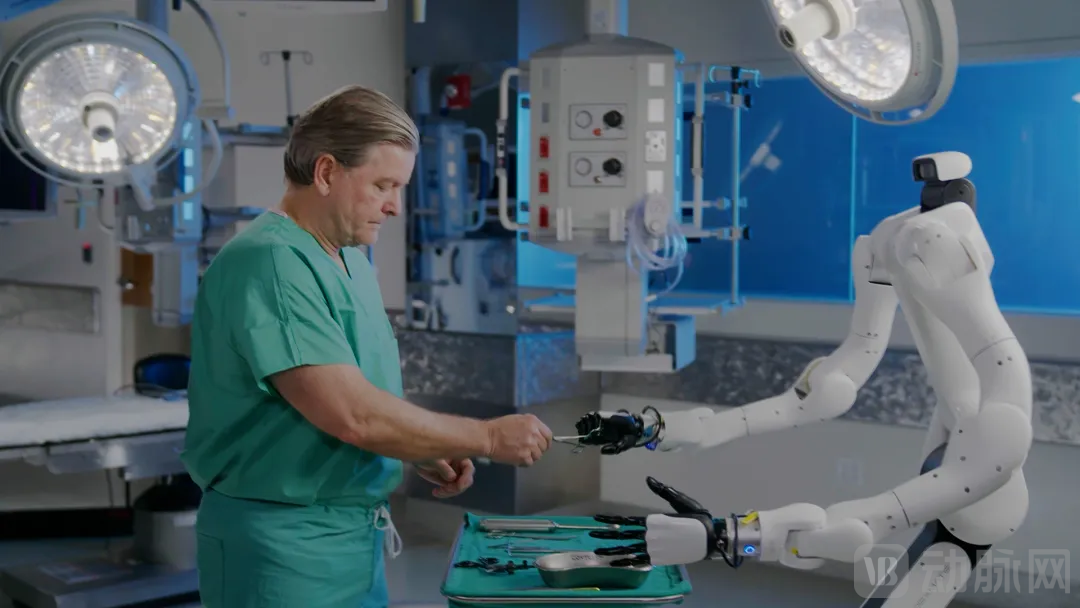
For years, AI in the medical field has been largely confined to screens, tasked with analyzing medical images and monitoring patient prognoses. Now, with NVIDIA’s launch of the first physical AI platform dedicated to the medical robotics sector, AI is moving beyond the screen into the real world.
Leading and innovative surgical robotics companies, including CMR Surgical, Johnson & Johnson MedTech, Moon Surgical, and Rob Surgical, are adopting NVIDIA’s physics-based AI tools designed specifically for the healthcare sector to accelerate workflows such as synthetic data generation, robotic policy evaluation, and digital twin creation.
PeritasAI is integrating these technologies to build a physical AI platform for surgical procedures, enabling real-time perception, collaboration, and action through the integration of robotics and multi-agent intelligence. Proximie, a developer of physical AI platforms, is dedicated to developing vision-language models to support surgical teams.
The following tools released at GTC 2026 provide the robust and open infrastructure that developers need, enabling them to leverage next-generation medical robots to reshape healthcare delivery models. Specific tools include:
Open-H: The world's largest medical robotics dataset, jointly constructed by more than 30 partners, fully demonstrates the diversity and complexity of real-world surgical procedures. This dataset contains over 700 hours of surgical videos, facilitating the development of advanced general-purpose robotic systems.
Cosmos-H: Based on NVIDIA Cosmos, an open model series including Cosmos-H-Surgical, for large-scale generation of domain-specific, physics-based synthetic data. The series comprises three models capable of generating surgical videos from prompts, reference images or videos, and corresponding robot kinematics, enabling developers to augment real-world datasets with realistic simulation environments and evaluate robotic policies by predicting future states of the surgical environment.
GR00T-H: A Vision-Language-Action (VLA) model based on NVIDIA Isaac GR00T N. It is capable of processing text commands describing clinical tasks and generating corresponding motion commands, also known as action tokens. Trained on the Open-H dataset, this model can be used to train and evaluate robots performing complex physical actions in healthcare settings.
Rheo: A developer blueprint provided within the Isaac for Healthcare development framework for AI medical robots, enabling developers to create physically accurate hospital simulation environments. By simulating clinical workflows, medical device interactions, human movements, and hospital logistics, Rheo can be used to develop and test automation strategies at scale and in a safe manner.
The above is the abstract. Click “Read Full Article” or scan the QR code below to read the complete content: