

West China Hospital Licenses AI-Powered Wound Care Decision Support System to Sichuan Guoruan Tech
Recently, West China Hospital of Sichuan University released a public notice on the transformation of scientific and technological achievements, indicating that the hospital intends to transfer its technologies through negotiated pricing.“A Multi-Source Data-Based Decision Support System and Method for Wound Care”The relevant patents have been exclusively licensed to Sichuan Guoruan Technology Group Co., Ltd. for commercialization, with a licensing fee ofRMB 900,000, the inventor of this patent isJiang Yan and Her Team。
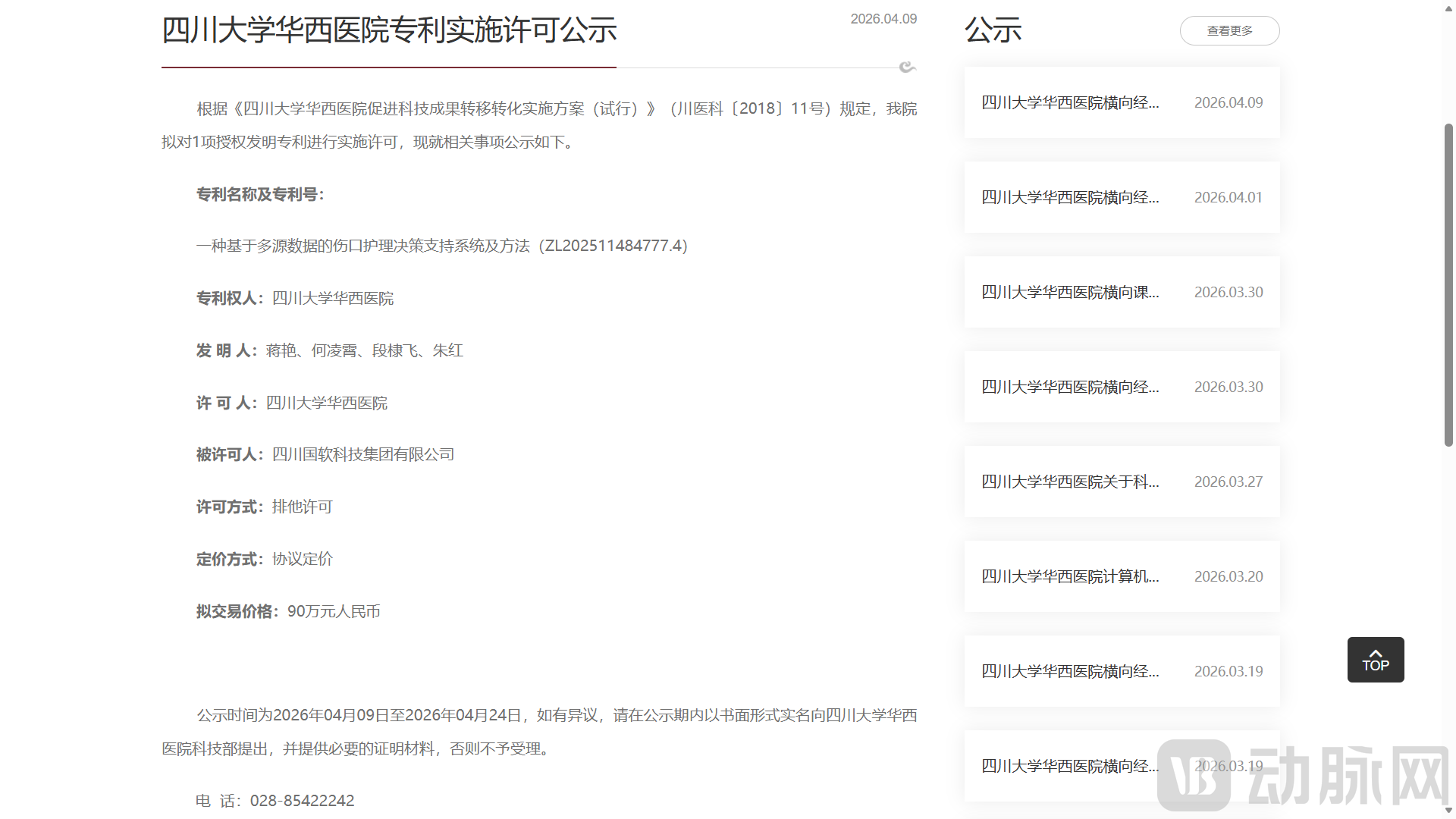
Image from the official website of West China Hospital, Sichuan University
This invention was developed by West China Hospital of Sichuan University.Wound Care Decision Support Technology Based on Multi-Source DataBy integrating multi-source data—including hospital information systems, wound images, consultation audio, and vital signs—and applying standardization and intelligent recognition, this system combines evidence-based guidelines, expert rules, and reinforcement learning algorithms to construct a reward function for intelligently scoring and ranking nursing interventions. It automatically outputs prioritized recommendations, providing end-to-end closed-loop support for the entire workflow of wound assessment, care planning, execution reminders, outcome evaluation, and quality control monitoring. This significantly enhances the efficiency and standardization of wound care decision-making while reducing reliance on clinical experience.
Wound CareAs a fundamental and critical component of clinical diagnosis and treatment, it covers various types of wounds, including pressure ulcers, diabetic foot ulcers, and postoperative wounds. It is characterized by complex disease conditions, cumbersome assessments, and a high degree of dependence on treatment protocols, whereasInsufficient intelligent decision-making and low level of process automationThis has become a core bottleneck constraining the quality and efficiency of wound care. Current clinical practice still relies primarily on nurses' empirical judgment, lacking standardized, data-driven decision support tools, which severely compromises care standardization and patient healing outcomes.
From the perspective of clinical practice, traditional wound care models have significant shortcomings.
On one hand, patient data is scattered across multiple systems, such as Hospital Information Systems (HIS), Electronic Medical Records (EMR), and Picture Archiving and Communication Systems (PACS). Multi-source information, including wound images, consultation audio, and vital signs, cannot be automatically integrated. Nurses are required to manually collect, enter, and verify this data, resulting in a heavy workload, a high risk of omitting key information, and significant consumption of clinical time. Meanwhile, core indicators such as wound area, depth, and tissue classification rely on manual visual estimation, leading to insufficient accuracy and non-standardized documentation, which makes it difficult to precisely track the healing process.
On the other hand, the formulation of nursing care plans relies heavily on individual experience. Evidence-based guidelines and expert consensus have not been translated into actionable computerized decision rules, resulting in significant variations in protocols among different nurses and departments, as well as a low degree of standardization. When faced with complex wounds or challenging cases, there is a lack of rapid recommendations for optimal interventions, leading to low decision-making efficiency and difficulty in balancing comprehensive indicators such as healing outcomes, pain control, and medical costs.
Furthermore, existing systems primarily offer only wound assessment and documentation capabilities, failing to establish a closed-loop management cycle of assessment–planning–implementation–evaluation. They lack essential features such as nursing intervention reminders, automated outcome evaluation, and quality control monitoring. Consequently, nurse feedback and clinical outcomes cannot be leveraged to optimize care protocols, hindering the continuous iteration and upgrading of decision-making models. These pain points directly result in prolonged wound care cycles, inconsistent healing outcomes, and persistently high labor costs. The traditional model can no longer meet the core clinical demands for efficient, precise, and standardized wound care, creating an urgent need for intelligent decision support technologies based on multi-source data to break through industry bottlenecks.
This multi-source data-based wound care decision support technology, through full-process data integration, intelligent matching recommendations, and adaptive learning optimization, thoroughly breaks through the pain points and bottlenecks of traditional wound care models, inData Automation, Decision-Making Precision, Standardization of Nursing Care, and Closed-Loop ManagementAchieving Leapfrog Advancements Across Four Key Dimensions to Provide a Standardized, Intelligent, and Efficient New Solution for Clinical Wound Care.
From the perspective of core technological advantages, the patent leverages multi-source data fusion and intelligent processing to achieve fully automated data acquisition and standardization.
On one hand, the system integrates hospital-wide data sources such as HIS, EMR, LIS, and PACS, automatically synchronizing comprehensive information including outpatient visits, inpatient stays, surgeries, laboratory tests, and medical orders. Meanwhile, it intelligently captures multimodal data—such as wound images, consultation audio, oxygen saturation, local tissue pressure, and vital signs—eliminating the need for manual duplicate entry by nurses and significantly reducing clinical workload. On the other hand, leveraging technologies like image recognition, speech-to-text transcription, keyword extraction, and medical terminology mapping, the system converts heterogeneous data into a standardized database. This enables precise calculation of wound area, depth, and tissue classification, achieving objective and quantitative wound assessment while completely eliminating errors associated with manual estimation.
Furthermore, the patent achieves dual innovation in decision-making logic and recommendation mechanisms, balancing evidence-based scientific rigor with clinical practicality.
On the basis of decision-making, translating international guidelines and expert consensus into computer-readable IF-THEN structured rules, covering 13 major categories and 77 subcategories of wounds, to ensure that every recommendation is supported by high-quality evidence;On the recommendation mechanism, innovatively constructing a multi-dimensional reward function that integrates metrics such as image matching, text matching, vital signs, healing rate, pain improvement, and medical costs, combined with weighted corrections based on historical usage frequency, to automatically output nursing interventions with clear prioritization, achieving personalized strategies and precise recommendations, thereby effectively reducing reliance on empirical experience and variability in care plans.
On the Management Closed Loop, systematically built“Assessment–Planning–Execution–Evaluation–Feedback”Full-process intelligent support provides automated generation of nursing care plans, scheduled execution reminders, automatic evaluation of healing outcomes, and real-time monitoring of quality control data. Meanwhile, the system employs adaptive reinforcement learning based on nursing operations and patient outcomes to continuously optimize recommendation strategies, ensuring increasing accuracy and closer alignment with clinical practice over time.
These advantages directly empower wound care practices:Multi-source automated data collection reduces manual entry by over 80%, significantly enhancing nurses’ work efficiency; intelligent and precise recommendations shorten decision-making time and improve the management of complex wounds; closed-loop management across the entire care process reduces the risk of nursing oversights, thereby increasing healing rates and patient satisfaction; standardized protocols promote homogenization of nursing care throughout the hospital, facilitating quality control and continuous improvement.
In the field of clinical wound care, this patented technology not only fills the gap in intelligent decision support but also achieves a fourfold enhancement in efficiency, precision, standardization, and safety through data-driven approaches and algorithm optimization, providing robust technical support for the standardized and efficient management of chronic and complex wounds.
Currently, global wound care management is transitioning from manual assessment to a model integrating AI, multi-source data, and clinical decision support. Domestic and international enterprises and institutions are intensively deploying solutions in wound measurement, intelligent assessment, treatment recommendation, and closed-loop management, with technological iterations focusing onFull-Process Automation, Evidence-Based Decision-Making, Adaptive LearningThree Major Directions, Forming a Clear Product Pipeline and Research Progress.
Smith & Nephew Wound COMPASS CSA,Based on the TIME principle, it enables wound classification, dressing selection, and referral recommendations; is adaptable to hospital formularies; provides rapid 90-second assessments; offers bedside education and decision support; reduces variations in clinical practice; and has been clinically validated.
Swift Medical Skin & Wound 2AI-powered precise wound imaging with sub-millimeter accuracy, improving documentation efficiency by 79% and accelerating pressure injury healing by 35%. It supports EMR integration, covers hospitals, community centers, and elderly care facilities, and leverages a database of over 32 million wound images.
WoundCorder.ai, LiDAR 3D Imaging AI Platform for Wounds, enabling precise wound volume measurement and long-term dynamic monitoring, targeting chronic disease and home-based wound management, and reducing hospitalizations and complications through quantitative data.
WoundDesk: Mobile Integrated Wound Management Platform, focusing on the closed loop of assessment, documentation, and follow-up, with multi-terminal synchronization to optimize clinical documentation workflows, primarily targeting mobile ward rounds and community nursing scenarios.