

Fujian Medical University Union Hospital Transfers Patented Vacuum Cushion Fixation Device for Radiotherapy Positioning
Recently, the First Affiliated Hospital of Fujian Medical University released a public notice on the transfer of patent rights, proposing to transfer its “A Vacuum Mattress Fixation Device for Treatment Beds"Assignment of Utility Model Patent to Fuzhou Kaidkang Pharmaceutical Technology Co., Ltd. The assignment fee is"301,000 yuan. The inventors of this achievement areSu Li。
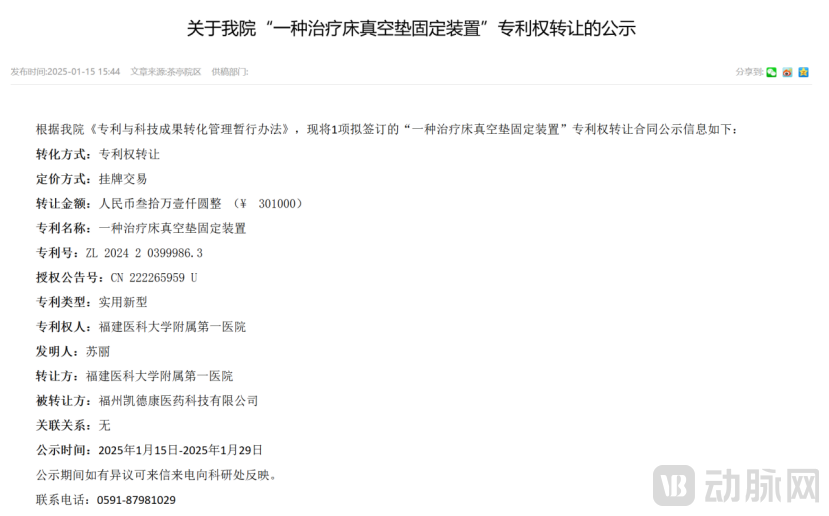
Image source: Official website of the First Affiliated Hospital of Fujian Medical University
“A Vacuum Mattress Fixation Device for Treatment Beds“Based on the treatment couch, this system incorporates multiple sets of flexibly fixable mounting plates. Each mounting plate is equipped with mutually perpendicular, rotatable fixation panels, along with moldable connecting plates. By employing a dual-fixation mode combining lateral wall limitation and bottom contouring, it addresses the pain point of traditional devices that rely solely on groove-based fixation and are prone to displacement. The components of the device are highly adjustable, accommodating vacuum cushions of various sizes and positioning requirements. It offers convenient installation and operation, while enhancing positioning recognition through the shape of the connecting plates, providing a practical solution for patient immobilization in precision medical scenarios such as radiotherapy.”
In medical scenarios requiring precise patient positioning, such as radiation therapy, vacuum cushion fixation devices are critical for ensuring treatment accuracy. However, traditional technologies have long suffered from persistent challenges, primarily in three areas: fixation stability, adaptability, and operational practicality.
Insufficient fixation stability, prone to positional displacement.Traditional vacuum cushion immobilizers rely solely on the interlocking of grooves at the base of the vacuum cushion with the irregular structure of the treatment table for fixation. Due to the light weight of the vacuum cushion itself, adequate conformity depends on compression by the patient’s body weight. When the patient sits up or makes slight positional changes, the removal of external force directly causes displacement of the vacuum cushion, compromising the precision of subsequent treatments. This is particularly problematic in radiotherapy, which demands extremely high positional accuracy, as it can easily lead to targeting deviations.
Monolithic structural design with poor adaptability.The fixation structures of conventional devices are predominantly fixed in design, lacking the flexibility to adjust according to the dimensions and orientation of vacuum cushions as well as the actual operational requirements of treatment tables. Consequently, they struggle to achieve personalized adaptation for patients with varying body types and different anatomical treatment sites, thereby limiting their applicability across diverse clinical scenarios.
Focuses solely on bottom shaping, lacking multi-dimensional restraint.Conventional techniques shape only the bottom of the vacuum cushion using contoured structures, without incorporating effective limiting mechanisms for the side walls. As a result, the vacuum cushion retains mobility in the horizontal plane, failing to ensure stable fixation across multiple dimensions. Furthermore, the shaping structures exhibit low distinguishability, making them prone to orientation errors during patient positioning.
This patent introduces comprehensive innovative design improvements upon traditional technologies. By adopting a design philosophy centered on modular structure, dual fixation, and flexible operation, it fundamentally addresses the pain points of conventional devices. Its advantages are demonstrated across four dimensions: structural design, fixation efficacy, adaptability, and clinical operability.
In terms of structural design, modular assembly enables synergistic interaction among multiple components.The patented device comprises a core module consisting of a treatment bed, multiple sets of parallel-mounted clamping plates, a rotatable fixing plate, and a formable connecting plate. All components are securely engaged via fixing pins and corresponding fixing holes, ensuring a simple yet robust connection. As the foundational support module, the clamping plates can be flexibly secured at various positions on the treatment bed by engaging the first fixing pins with multiple sets of first fixing holes on the bed. Serving as functional modules, the fixing plate and the connecting plate provide lateral containment for the vacuum cushion and shape its base, respectively. This modular design enables each component to perform its specific role, working in concert to achieve precise immobilization.
Fixed Effect: Side Wall Limitation + Bottom Shaping, Dual Protection Against Displacement.This represents the core innovation of the patent, breaking through the traditional single-mode fixation that relies solely on bottom grooves. On one hand, two sets of mutually perpendicular fixing plates arranged vertically on the clamping plate closely abut against the side walls of the vacuum cushion, providing rigid horizontal limitation to directly prevent its movement. On the other hand, the connecting plate protrudes outward from the treatment bed, utilizing its irregular structure to shape the bottom of the vacuum cushion, thereby forming a groove that matches the clamping plate and the connecting plate to achieve snap-fit fixation at the bottom. This dual-fixation mode, combining side-wall limitation and bottom shaping, ensures the stability of the vacuum cushion without relying on patient weight for compression, thereby thoroughly resolving the issue of positional displacement.
In terms of adaptability, it is rotatable and adjustable to meet diverse clinical needs.The patented device significantly enhances adaptability through multiple adjustable designs. One end of the fixing plate, near the hinge axis, is rotatably connected to the clamping plate, while the other end, away from the hinge axis, is hinged to the clamping plate via a first telescopic assembly. This telescopic assembly drives the fixing plate to rotate in the same direction and utilizes an abutment plate to secure the fixing plate in either a parallel or perpendicular position relative to the clamping plate. This allows the fixing plate to flexibly abut against either the transverse or longitudinal side walls, depending on the orientation of the vacuum cushion. The connecting plates are slidably connected to the clamping plate, with adjacent connecting plates hinged to each other. By matching the second fixing pin with different second fixing holes, the shape of the connecting plates can be adjusted to meet the contouring requirements of vacuum cushions of various sizes, thereby satisfying the fixation needs for different treatment areas.
Clinically, it is easy to install and identify, improving positioning efficiency and accuracy.All components of the device are secured via snap-fit connections using fixing pins and holes, enabling easy installation and removal without complex tools. The connecting plate can be adjusted into various shapes to serve as a “marker structure” for vacuum cushion positioning. Medical staff can quickly identify the setup position and orientation of the vacuum cushion based on the shape of the connecting plate, thereby reducing positioning errors and improving clinical operational efficiency. This design is particularly suitable for scenarios requiring rapid and precise positioning, such as radiation therapy.
Currently, vacuum cushion immobilization devices on the market have formed a diversified product landscape, encompassing patented products, commercially available products, and products under development, with innovations focused on enhancing precision and adaptability.
Nanjing Huali Medical Technology Co., Ltd. is preparing to export vacuum negative pressure fixation pads, it can be widely used in scenarios such as medical emergency care and fire rescue, achieving rapid immobilization and support through the principle of negative pressure, while being environmentally friendly and reusable; currently, cooperation has been established with a Japanese company.
Beijing Cancer Hospital’s utility model patent application for “Vacuum Cushion Fixator” (Publication No. CN210078635U), specifically designed to address the issues of unsecured vacuum cushions on treatment tables, significant positioning deviations, and slow setup speeds in radiotherapy. The device features a clamping plate with locking holes installed on the side of the treatment table. Perforated cylindrical blocks and solid cylindrical blocks are assembled via fixing bolts and connected by a connecting plate. A 45° fixed plate is positioned between the cylindrical blocks, forming a triangular protrusion structure in conjunction with the LokBar. During vacuum cushion fabrication, this specialized structure is used for shaping, creating matching grooves on the bottom of the cushion. This allows for precise fixation of the vacuum cushion into the grooves during patient positioning. All components feature detachable connections, ensuring ease of operation and significantly improving positioning speed and reproducibility.
Guangdong Meicen Medical Equipment Co., Ltd.'s Human Body Positioning Bag, the outer nylon coating protects it from tearing and contamination, allowing it to conform closely to the human body. The composite layer design enhances airtightness, preventing deformation under negative pressure throughout the treatment process, thereby ensuring accurate positioning. The body positioning bag is durable, soft and comfortable to the touch, offers excellent airtightness, is easy to clean, and has high radiation penetrability.