

Breakthrough in Pharmaceutical Mixing Technology: Nantong University Affiliated Hospital Licenses Novel Homogenizing Device Patent
Recently, the Affiliated Hospital of Nantong University released a public notice on patent licensing, proposing to license its “A Mixing Device for Pharmaceutical Use“The utility model patent is licensed to Nantong Ruiyan Biotechnology Co., Ltd. on a non-exclusive basis. The licensing fee is”50,000 yuan. The inventors of this achievement areXu Jinqiuand his team。
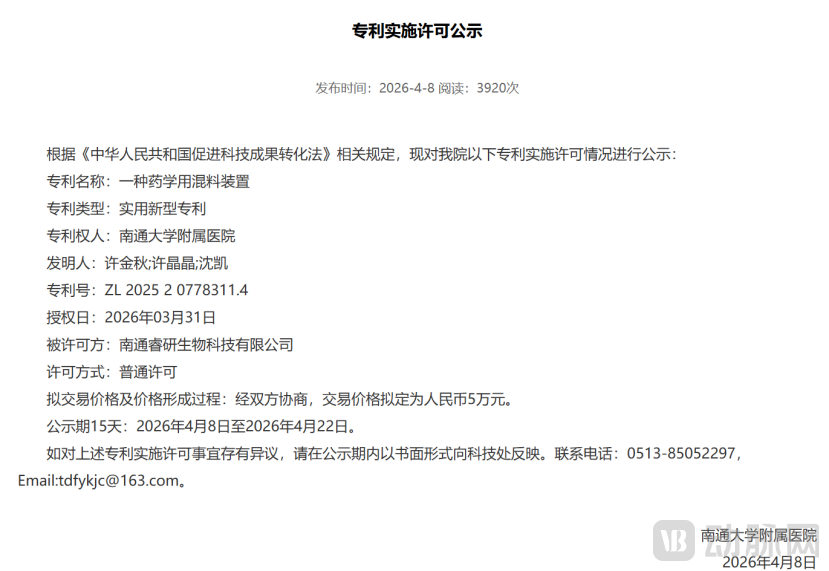
Image from the official website of Affiliated Hospital of Nantong University
“A Pharmaceutical Mixing Device” Utility Model PatentAddressing the pain points of traditional equipment, such as uneven mixing, bottom sedimentation, and cumbersome filter maintenance, this utility model patent features quick-release filtration and dead-zone-free stirring as its core innovations. It innovatively adopts a snap-on quick-release filter structure to facilitate filter media replacement and cleaning maintenance. Equipped with a dual-motor multi-dimensional stirring system, it effectively eliminates blind spots for sedimentation at the bottom of the tank, thereby enhancing the uniformity of pharmaceutical liquid mixing. The device is easy to operate and runs stably, meeting the clean production requirements for pharmaceutical preparations and suitable for scenarios involving hospital preparations and small-batch liquid compounding in pharmaceutical enterprises.
In the formulation and manufacturing of pharmaceutical preparations, traditional mixing equipment has long suffered from numerous technical deficiencies and application limitations, failing to meet the core requirements of modern pharmaceutical production for uniformity, cleanliness, stability, and intelligence. The specific pain points and challenges are reflected in the following aspects.
Blind spots exist in the mixing process, making it difficult to resolve sedimentation at the bottom.In traditional mixing equipment, the stirring paddles and rods are mostly of a fixed structure, resulting in a limited mixing range that fails to cover the bottom and corner areas of the vessel. After standing, the medicinal liquid is highly prone to stratification and sedimentation, leading to uneven distribution of active ingredients and significant concentration deviations. This directly reduces formulation stability and consistency in efficacy, posing a serious threat to the safety of clinical medication.
The filtration maintenance process is cumbersome, with a high risk of contamination.Existing equipment filtration components mostly adopt bolted fastening or monolithic fixed structures, resulting in complex and time-consuming disassembly and assembly procedures, as well as significant difficulties in filter paper replacement and cleaning. Residual drug residues and impurities tend to accumulate on the filter media and within the housing, posing a high risk of cross-contamination and failing to strictly meet the Good Manufacturing Practice (GMP) standards for clean production and quality control in the pharmaceutical industry.
Low mixing efficiency and insufficient batch-to-batch consistency.Equipment commonly adopts a single-direction, single-speed stirring mode, which exhibits poor adaptability to pharmaceutical solutions with high viscosity and significant density differences. This results in prolonged mixing cycles and difficulty in ensuring uniformity, leading to quality fluctuations between batches. Consequently, this not only increases production energy consumption and costs but also intensifies the pressure on quality testing and process control.
Low level of automation and insufficient precision in operational control.Equipment largely relies on manual start-stop operations, on-site observation, and experience-based adjustments, lacking precise parameter control and intelligent interlinkage functions. This results in poor operational standardization and significant human error, making it difficult to meet the modern pharmaceutical compounding requirements for multi-variety, small-batch, and high-precision production. Consequently, the overall level of intelligence and standardization remains low.
In response to the numerous shortcomings of traditional pharmaceutical mixing equipment, this patent introduces innovative optimizations across three core processes—filtration, agitation, and overall equipment operation—thereby establishing technical advantages that combine practicality, safety, and efficiency, as detailed below.
The filtration system features a quick-release snap-fit and secure clamping design, enabling more efficient and convenient maintenance.This patent enables one-touch insertion and removal of the filter cartridge through the coordinated action of a snap-fit plate and a spring, ensuring a simple and rapid assembly and disassembly process. A fixing assembly, comprising four-corner screws, a pressure plate, and guide rods, securely clamps the filter paper to prevent displacement and material leakage, while accommodating filter media of various thicknesses. This design significantly reduces filtration maintenance time, effectively lowers the risks of residue and contamination, and enhances compliance with cleanliness standards.
The stirring system is equipped with dual motors and a multi-dimensional stirring structure to achieve thorough mixing without dead zones.The device employs a dual-motor system to deliver stable power. The primary motor drives the rotating shaft and mixing paddles to achieve thorough mixing of the medicinal solution. The secondary motor adjusts the angle of the stirring rods via transmission gears, precisely agitating bottom sediments to completely eliminate mixing dead zones. This effectively disperses deposits and significantly enhances mixing uniformity, offering superior performance for suspensions and high-viscosity pharmaceutical liquids, thereby ensuring consistent quality across formulation batches.
The overall design balances user-friendly and automated features, ensuring simpler and more reliable operation.The equipment is equipped with a threaded barrel lid, an external observation window, and a bottom discharge valve, ensuring intuitive operation and clear monitoring. The controller synchronizes dual motors to enable one-touch start/stop and parameter adjustment, while a fixed power supply provides stable power for bottom agitation. This design reduces operational complexity and minimizes manual intervention, making it suitable for daily solution preparation in hospitals and pharmaceutical companies, as well as for small-scale R&D trials.
The pharmaceutical industry’s requirements for mixing and liquid preparation equipment in drug formulation and manufacturing are continuously escalating. More uniform mixing performance, simplified maintenance procedures, enhanced cleanliness and safety, and more integrated functional configurations have become the mainstream development trends in the industry. The following patents and commercialized products in the same field have all undergone technical optimizations to address common industry pain points, providing intuitive benchmarks and references for this patent.
“A Pharmaceutical Dissolver Facilitating Slag Filtration and Stirring“Utility Model Patent (Publication No. CN220633876U) discloses a pharmaceutical dissolution device that integrates filtration, stirring, heating, and metering functions. The top of the device features an embedded snap-fit filter basket for rapid filtration and interception of drug residues. The inner wall is equipped with electric heating plates and temperature sensors to achieve constant-temperature dissolution. A ribbon-style agitator works in conjunction with a liftable pressure cover to ensure more thorough mixing. The device also includes an observation window, a metered liquid addition tube, and a discharge valve, making operation intuitive and controllable. This apparatus addresses issues associated with traditional dissolvers, such as inconvenient filtration, uneven stirring, and limited functionality. With its simple structure and ease of use, it is suitable for clinical pharmacy experiments and pharmaceutical dissolution applications.”
“A Three-Dimensional Motion Mixing Device for Pharmaceutical Use“Utility model patent (Publication No. CN224086581U), belonging to pharmaceutical mixing equipment, is an optimized upgrade based on traditional three-dimensional motion mixers. The device adds a rotatable mounting frame and detachable grid plates inside the mixing tank, achieving quick assembly and disassembly of the grid plates through a clamping mechanism. During mixing, it can break up material agglomerates, improving mixing uniformity; the tank body is equipped with an openable flip cover for convenient internal cleaning and accessory replacement, fully meeting GMP clean production requirements. This patent addresses issues such as easy agglomeration, inconvenient cleaning and maintenance, and unstable mixing quality in traditional three-dimensional mixers, making it suitable for mixing powdery and granular materials in industries like pharmaceuticals and chemicals.”
BioHub® Disposable Magnetic Stirring System,A single-use sterile mixing platform designed for biopharmaceuticals, pharmaceutical R&D, and GMP manufacturing. Specifically engineered for solid-liquid mixing, as well as buffer and media preparation, it offers advantages such as stability, cleanliness, low residue, and ease of operation. The equipment is available in various specifications ranging from 50L to 3000L, with customization options to support the entire workflow from laboratory scale to large-scale production. It features precise magnetic stirring with reliable speed control. The tilted bottom design significantly reduces liquid residue, while the use of single-use bags eliminates cross-contamination at the source. With a compact structure, easy mobility, and surfaces that are simple to clean, the unit employs a honeycomb jacket for temperature control without condensation, meeting the requirements of cleanroom environments. It provides a standardized, high-efficiency solution for pharmaceutical solution preparation and bioprocess mixing.