

A Small Invention Licensed for ¥2.007 Million Could Save Millions in Consumable Costs: Novel Catheter and Guidewire Management Device for Neurointerventional Surgery
Recently, Tongji Hospital Affiliated to Tongji Medical College of Huazhong University of Science and Technology plans to"Catheter and Guidewire Fixation and Storage Device for Cerebrovascular Interventional Surgery"Commercialization of scientific and technological achievements, with Hefei Jiazhixin Trading Co., Ltd. as the licensee; the proposed transaction amount isRMB 200,700。
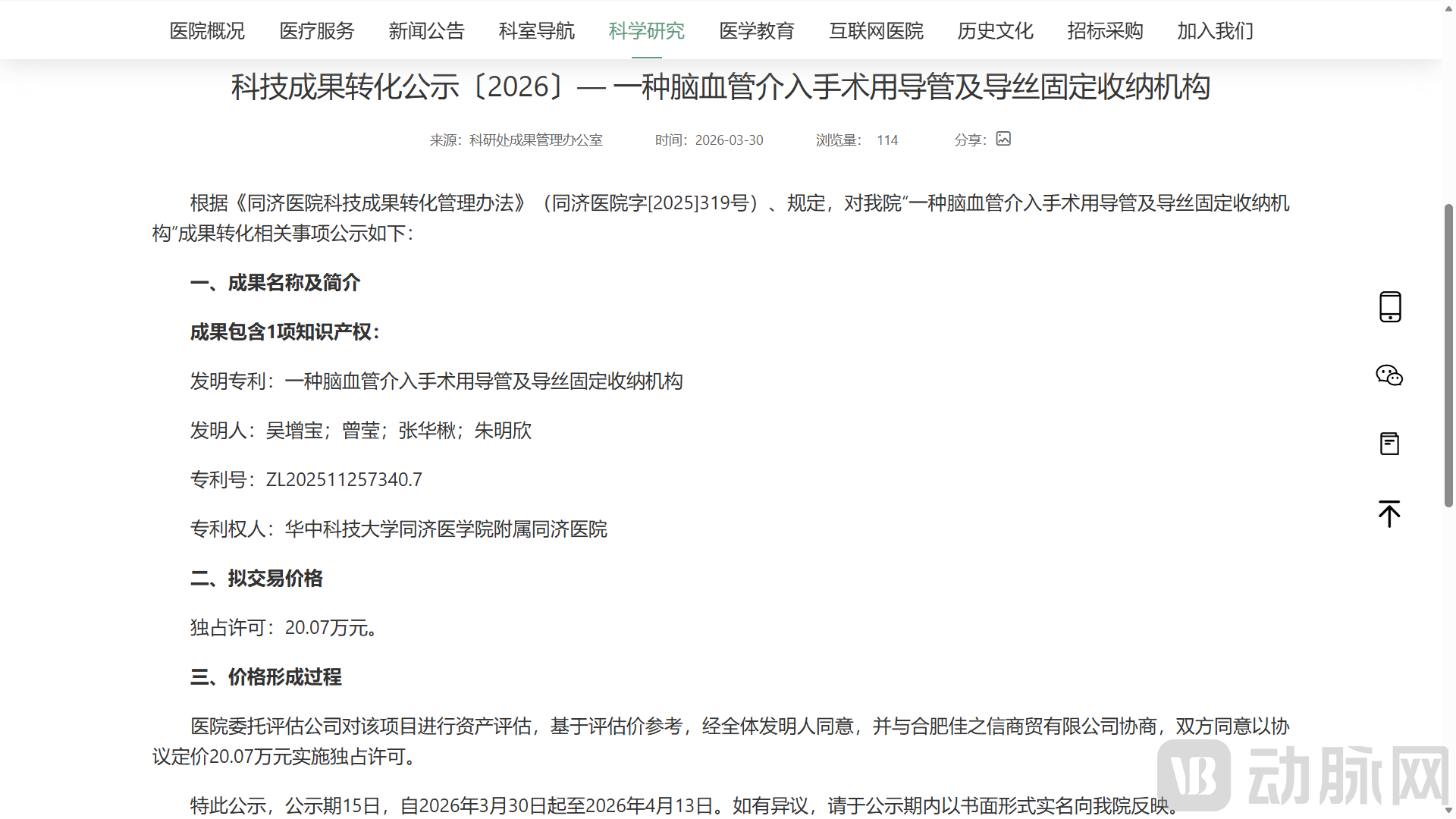
Image from the official website of Tongji Hospital, Tongji Medical College, Huazhong University of Science and Technology
This patented innovation addresses clinical pain points in cerebrovascular interventional procedures, such as excessive length of the external redundant segments of catheters and guidewires, susceptibility to contact with non-sterile areas, high risk of slippage, and occupation of operating table space. It features an integrated structure that combines a spiral guide hole in an inner cylinder for guidewire storage with a rotating ring featuring a spiral guide groove for catheter storage. The device supports two usage modes: arm-wearable and operating table edge-mounted. Through design elements including inflatable balloon fixation, rotational catheter release, and obtuse-angle transitions to prevent jamming, it achieves organized storage of interventional devices, sterile protection, and smooth delivery. This significantly reduces the risk of infection and waste of surgical consumables, thereby enhancing the safety and efficiency of neurointerventional procedures.
Endovascular Procedures for Cerebrovascular Diseasesis the core minimally invasive approach for treating cerebrovascular diseases, with its technical foundation lying in“Access Establishment–Device Delivery–Therapy Implementation”precise coordination. This procedure primarily relies on core devices such as guiding catheters, intermediate catheters, microcatheters, and guidewires. These devices are typically made of polymer materials or nickel-titanium alloys and require coordinated manipulation under real-time guidance from digital subtraction angiography (DSA).
However,Existing clinical practices face significant physical space challenges:Interventional surgical instruments are typically designed to be longer, with guidewire lengths mostly ranging from 180 to 300 cm and catheter lengths between 80 and 150 cm. However, the effective operating space available on the surgical table is limited to the distance from the puncture site to the foot end of the table. This significant discrepancy between instrument length and operational space necessitates managing substantial extracorporeal redundant segments within the confined area of the surgical table.
In existing clinical protocols, due to the limited width of the operating table (typically 60–80 cm) and the lack of barrier structures on both sides, redundant segments of catheters and guidewires exceeding 80 cm in length often have to be placed directly on the operating table.
This extensive management approach has brought about serious safety hazards:On the one hand, excessively long instruments are highly prone to contacting non-sterile areas within confined spaces, significantly increasing the risk of infection; clinical statistics indicate that the incidence of such contact with non-sterile areas is as high as 12–18%. On the other hand, redundant guidewires and catheters are susceptible to slipping out from the proximal end due to gravitational sagging or accidental traction. This not only compromises the sterile field but also forces surgical interruption, with each delay lasting at least 5 minutes, thereby severely impacting the procedural flow and safety.
In light of the aforementioned clinical pain points, there is an urgent need for a fixation and storage device capable of effectively managing the redundant extra-corporeal segments of interventional instruments. The core of this clinical demand lies inHow to Securely Organize and Store Extra-Long Catheters and Guidewires Without Occupying Additional Sterile Space, Preventing Them from Being Scattered on the Operating Table。
Such a device must not only significantly reduce the risk of infection caused by instruments contacting non-sterile areas, but also prevent procedural delays resulting from guidewire slippage, thereby ensuring surgical safety while minimizing waste of expensive consumables and alleviating the financial burden on patients.
The core innovation of the patents transferred in this transaction lies inAdopts a unique “spiral storage and wearable” integrated design, ingeniously solving the storage challenge for ultra-long interventional devices. Its inner cylinder wall features embedded spiral guide holes that utilize a helical structure to coil and store guidewires measuring 180–300 cm in length. In conjunction with spiral guide grooves on the rotating ring for catheter winding, this design transforms redundant equipment—originally requiring extensive flat surface area—from straight to curved configurations, significantly reducing the occupied volume. This design allows the operator to wear the device directly on the forearm, enabling the equipment to move with the user. It fundamentally changes the traditional operational model where instruments must be scattered across the surgical table, thereby physically eliminating the risk of equipment contacting non-sterile areas or dangling.
In terms of operational performance and safety, the device demonstrates highly user-centric and precision-driven innovations.For the guidewire, the device features a guide hole structure with an obtuse-angle transition to ensure smooth, snag-free withdrawal and prevent jamming. For the catheter, a rotating ring and limiting mechanism are innovatively incorporated; by simply pulling one end of the catheter, the operator causes the rotating ring to spin under tension, allowing the catheter to disengage smoothly from the spiral groove and achieving dynamic, on-demand delivery.
Furthermore,The device is equipped with an inflation/deflation control system consisting of an annular air chamber and a rubber expansion balloon., which can flexibly adjust the fixation tightness according to the thickness of the operator's arms, ensuring both the stability of the device during vigorous manipulation and the comfort of wearing as well as the convenience of aseptic operation.
Another major advantage of this technology lies in its versatile application scenarios and robust fixation mechanism.In addition to wearable use, the device is equipped with a docking interface that allows it to be securely mounted on the edge of an operating table using a clamping assembly. Through a multi-angle adjustment mechanism, the exit direction of the catheter and guidewire can be directly aligned with the patient’s puncture site, thereby further shortening the operational path.
This design not only effectively avoids surgical delays (≥5 minutes per incident) caused by instrument slippage but also significantly reduces the risk of costly consumable waste due to contamination. By enhancing the safety and efficiency of cerebrovascular interventional procedures, it substantially alleviates the financial burden on patients, demonstrating high clinical application value.
Currently, domestic products for the fixation and storage of catheters and guidewires used in cerebrovascular interventional procedures are generally atA Market Landscape Dominated by Basic Fixation Functions, with Relatively Scarce Specialized Integrated Storage Devices. As the volume of neurointerventional procedures continues to grow and clinical requirements for intraoperative aseptic management and procedural safety keep rising, the market demand for standardized management of the extracorporeal segments of interventional devices has become increasingly prominent.
Current market products predominantly focus on single-point fixation at the proximal end of catheters or guidewires, primarily to meet basic intraoperative positioning and tubing stability requirements. There is a relatively limited supply of specialized devices that offer integrated functions such as organized storage of long segments of redundant instruments, contamination prevention, anti-slip security, and multi-scenario adaptability. Consequently, the market presents clear opportunities for functional upgrades and product iteration. Both clinical and industrial sectors have high expectations for dedicated fixation and storage solutions that better align with surgical workflows while balancing safety and practicality.
Medtronic’s Navien™ series of intracranial support catheters is a classic access product in Medtronic’s neurointerventional portfolio., its associated fixation-related structures are natively integrated into the catheter system design and are not standalone, separately sold fixation devices. This component primarily consists of a proximal Luer connector, a hemostasis valve, and an adaptive clamping structure. It is mainly used to secure the proximal end of the catheter and establish tubing connections during procedures, ensuring the stability of the access system throughout interventional operations. Additionally, it can work in conjunction with standard surgical table clamps to achieve proximal limit positioning, meeting basic fixation and tubing management requirements. The structural design aligns with the operational workflow and sterile environment requirements of neurointerventional procedures.
In terms of market applications, the Navien™ support catheter and its accompanying fixation system are widely used in domestic and international general hospitals and neuro-interventional centers for routine neuro-interventional procedures, such as stroke thrombectomy, intracranial aneurysm embolization, and flow diverter stent implantation. Leveraging product maturity and robust access support performance, this series is commonly employed in clinical practice to establish stable intracranial access. The accompanying fixation components, characterized by their simplicity and reliability, accommodate varying procedural habits and device combinations across different centers. As a result, the product has achieved high clinical recognition and widespread adoption in both global and domestic neuro-interventional markets, making it one of the preferred fixation solutions for establishing intracranial interventional access.
Terumo Chaperon Guiding Catheter System is a type of access product in the field of neurointervention.The associated fixation structure is an integrated design component of the catheter system, rather than a separately marketed fixation device. Leveraging the design of the proximal hub and connector, this structure ensures stable positioning and secure tubing connections at the catheter’s proximal end. It works in conjunction with standard clinical fixation accessories to constrain catheter position during procedures, thereby meeting the fundamental requirement for access stability in interventional operations. The overall design aligns with the procedural workflow and sterility requirements of neurointerventional surgery, making it suitable for use with conventional devices in endovascular diagnosis and treatment.
In terms of market application, the Chaperon guiding catheter and its associated fixation structures are primarily used in neurointerventional procedures related to the diagnosis and treatment of intracranial vascular conditions. They facilitate the introduction of diagnostic and therapeutic devices and are utilized by medical institutions with neurointerventional capabilities both domestically and internationally. Leveraging its structural design and operational characteristics, the product accommodates varying clinical preferences and device combinations, and is widely employed in clinical scenarios involving the establishment of neurointerventional access. It has established a solid foundation for clinical application and gained significant industry recognition.
This patent involvesCatheter and Guidewire Fixation and Storage Device for Cerebrovascular Interventional Surgery, precisely aligning with the clinical need for refined management of interventional devices. Its integrated structural design enables standardized storage, stable fixation, and smooth operation of catheters and guidewires. Accommodating diverse application scenarios such as wearable use and bedside mounting, it effectively meets multiple requirements including sterile technique in the operating room, efficient space utilization, and optimization of surgical workflows.
Leveraging the continuously expanding market foundation for neurointervention in China, along with the growing emphasis by medical institutions on surgical safety and consumable management quality, this patented technology demonstrates strong clinical applicability and market conversion potential. It is poised to become a practical solution in the field of intraoperative auxiliary devices for neurointerventional procedures, providing robust support for enhancing surgical standardization and safety, with broad prospects for market application.