

Preoperative Prediction of Hepatocellular Carcinoma Recurrence Risk: Fujian Medical University Union Hospital's Li Yueming Team Achieves Clinical Translation of MVI Prediction Model Patent with AUC of 0.939
Recently, the First Affiliated Hospital of Fujian Medical University released a public notice on the transformation of scientific and technological achievements, proposing to transfer its intellectual property through listed trading.“Construction of a Microvascular Invasion Prediction Model for Hepatocellular Carcinoma and Its Probabilistic Prediction Method”The relevant patents have been assigned to Beijing Yizhiying Technology Co., Ltd., with the proposed assignment amount beingRMB 50,800. The inventors of this patent areLi Yueming and His Team。
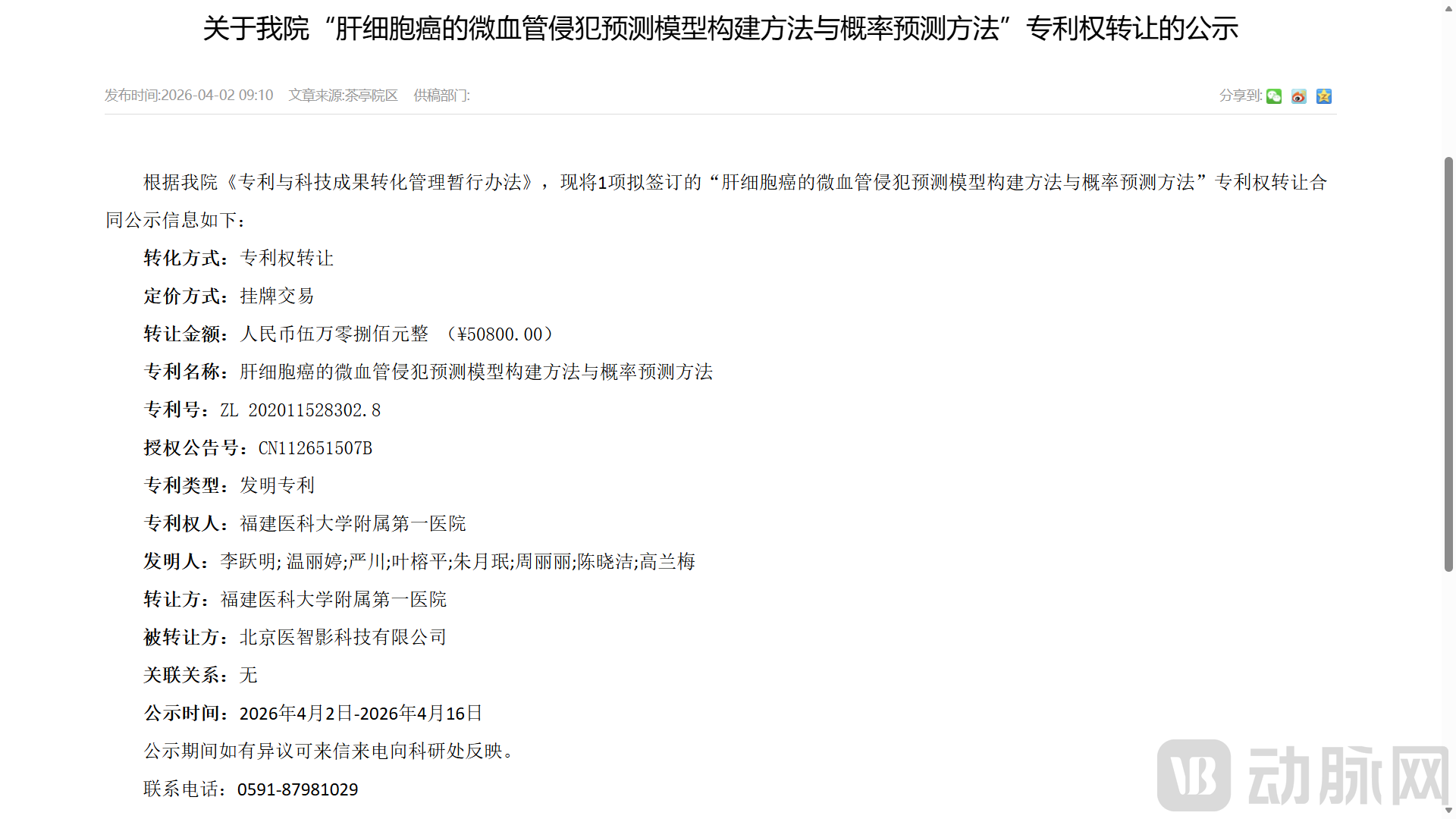
Image from the official website of the First Affiliated Hospital of Fujian Medical University
Based on multi-sequence MRI images of patients with hepatocellular carcinoma, this technology extracts the most discriminative factors through texture analysis of the tumor region of interest. By combining imaging and clinical features via logistic regression to construct a prediction model, it enables accurate, non-invasive preoperative prediction of the probability of microvascular invasion, providing an objective basis for determining the extent of hepatectomy and effectively reducing the risk of postoperative recurrence.
The high postoperative recurrence rate of hepatocellular carcinoma presents a prominent clinical challenge,Microvascular Invasion (MVI)Inability to Accurately Assess Preoperatively, which has become the core bottleneck restricting curative treatment for liver cancer.
Microvascular InvasionIt is a key risk factor for recurrence within two years after surgery for liver cancer. Currently, clinical diagnosis can only be confirmed through postoperative pathological examination, and there is a lack of reliable non-invasive predictive methods before surgery, leading to a lack of objective basis for treatment plan formulation. Hepatocellular carcinoma exhibits significant heterogeneity, and there are no stable serological or genomic predictors. Traditional imaging assessments can only provide qualitative observations and cannot quantify the risk of microvascular invasion, making it difficult to support individualized surgical decision-making.
Conventional medical imaging can only identify macroscopic tumor features and is unable to extract subtle intratumoral textural differences and quantitative discriminative indicators, resulting in insufficient sensitivity and specificity for detecting microvascular invasion, which may lead to missed or incorrect diagnoses.
Meanwhile, the predictive performance of single imaging features or clinical indicators is limited, and there is a lack of systematic prediction models integrating multimodal features, which fails to meet the high-precision requirements of clinical practice. Due to the inability to assess the risk of microvascular invasion preoperatively, it is difficult for surgeons to precisely determine the extent of hepatectomy: an insufficient resection margin may leave behind microscopic tumor thrombi, leading to early recurrence, while an excessively extensive resection damages normal liver tissue and impairs postoperative liver function recovery.
This decision-making dilemma directly compromises the curative efficacy of surgery, increases the risk of recurrence and the burden of secondary treatment for patients. There is an urgent clinical need for non-invasive, precise, and quantifiable preoperative prediction techniques for microvascular invasion to fill a critical gap in personalized surgical planning for liver cancer.
This hepatocellular carcinoma microvascular invasion prediction technology throughImage Texture Analysis and Multifactor ModelingIntegrating innovation to comprehensively address the core challenges of preoperative clinical assessment, including the inability to evaluate, insufficient predictive performance, and lack of evidence-based decision-making. It establishes prominent advantages in non-invasiveness, precision, quantification level, and clinical guidance value, providing reliable support for personalized surgical treatment of liver cancer.
From the perspective of core technological innovation, patents leverage multi-sequence MRI imaging and AI-based quantitative analysis to achieve highly accurate preoperative predictions.
On one hand, deep texture analysis is performed on the region of interest (ROI) of tumors using multi-parametric medical images, including T1-weighted imaging (T1WI), T2-weighted imaging (T2WI), arterial phase, portal venous phase, and hepatobiliary phase. High-discriminatory target texture features are extracted to calculate the Maximum Discriminant Factor (MDF), transforming microscopic imaging features indiscernible to the naked eye into quantifiable metrics, thereby overcoming the limitations of conventional imaging that only allows for the observation of macroscopic morphology. On the other hand, univariate and multivariate logistic regression analyses are combined to screen for independent predictive factors and construct a specialized prediction model. This model achieves an area under the curve (AUC) of 0.939, with a sensitivity of 90% and a specificity of 89%. Its predictive performance is significantly superior to that of single imaging or clinical indicators, substantially reducing the risks of missed diagnoses and misdiagnoses.
From the perspective of clinical application value, the patent enables non-invasive preoperative assessment and precisely guides surgical decision-making.
This technology is entirely non-invasive and requires no invasive procedures; it calculates the probability of microvascular invasion solely based on routine MRI images, thereby avoiding additional trauma and risks. The model outputs quantitative probability values, providing physicians with an objective reference to precisely guide the determination of hepatectomy margins—appropriately expanding surgical margins for high-risk patients while preserving more normal liver tissue in low-risk patients. This achieves an optimal balance between oncological radicality and preservation of liver function, ultimately reducing the rate of early postoperative recurrence at its source.
From the perspective of technical practicality, the model is stable and reliable, and compatible with clinical workflows.
Standardized feature selection and modeling workflow enables batch processing of imaging data with high computational efficiency and reproducible results. With clearly defined independent predictors and fixed parameters, the model requires no complex tuning, facilitating its implementation in clinical radiology and surgical departments. It addresses the lack of stable predictors in serological and genomic approaches and is compatible with routine diagnostic and therapeutic workflows for liver cancer across different hospitals.
These advantages directly address the core pain points in clinical practice:Multimodal texture analysis breaks through the bottlenecks of traditional imaging assessment, while AI modeling enables highly accurate quantitative prediction. Its non-invasive and reproducible nature makes it suitable for routine preoperative evaluation, with quantitative results directly guiding the selection of surgical margins. For the diagnosis and treatment of hepatocellular carcinoma, this patented technology not only fills the technical gap in preoperative prediction of microvascular invasion (MVI), but also achieves a triple improvement in non-invasiveness, accuracy, and clinical guidance, providing key technical support for reducing postoperative recurrence of liver cancer, optimizing surgical plans, and improving long-term patient prognosis.
Preoperative prediction of microvascular invasion (MVI) in hepatocellular carcinoma has evolved into an R&D landscape centered on multimodal imaging combined with AI radiomics modeling. Universities, hospitals, and medical imaging AI teams both in China and abroad are intensively deploying resources in this field, leading to continuous improvements in model performance. The field as a whole is currently transitioning from clinical validation to practical implementation.
Radiomics Prediction Model Based on Contrast-Enhanced CT, radiomics features of the tumor and peritumoral regions were extracted from multiphase contrast-enhanced CT scans, and a Lasso-Logistic model was constructed by combining these features with clinical indicators. The model achieved an AUC of approximately 0.81–0.88 in external validation and is primarily used for preoperative risk stratification; single-center and multicenter retrospective validations have been completed.
A Clinical–Radiomics Combined Model Based on Multi-Sequence MRI, integrating MRI features from T1WI, T2WI, arterial phase, portal venous phase, and hepatobiliary phase with clinical indicators such as AFP to construct a nomogram model; the AUC was 0.849–0.856 in the training set and 0.772 in the validation set. This approach represents the mainstream strategy in current clinical research and is currently undergoing multicenter validation.
Overall, similar technologies remain in the stages of academic research and clinical validation, with no standardized commercial software products yet approved by the National Medical Products Administration (NMPA). The patented modeling scheme based on multi-sequence MRI Maximum Discriminant Factor (MDF) plus Specific Independent Predictors achieves an AUC of 0.939, demonstrating significant competitive advantages in prediction accuracy and preoperative guidance value.