

Hands-on Workshop on Building Hospitals' Own AI Systems: From Data and Models to Intelligent Agent Applications
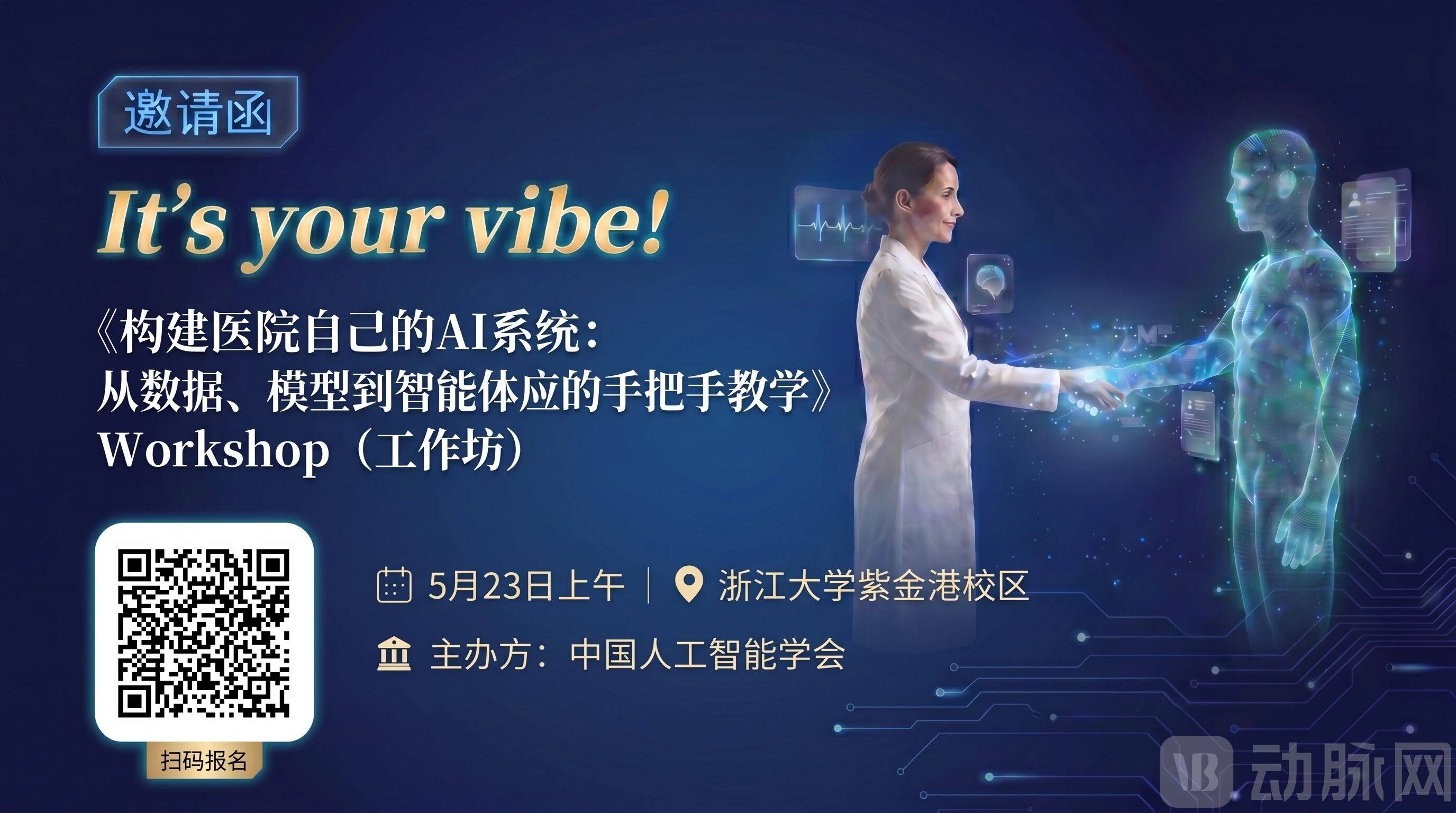
Targeting information centers, clinical departments, medical affairs, quality control, operations, nursing, pharmacy, and research management departments of healthcare institutions across China, as well as personnel from universities and research institutes, and professionals in the field of medical artificial intelligence,"Building a Hospital's Own AI System: A Hands-On Workshop from Data and Models to Agent Applications"Workshop)Planned forMay 23, 2026In the morning atZhejiang University, Zijingang Campusheld.
I. Training Background
For hospitals, the focus of AI development is no longer limited to introducing external tools or standalone applications,but rather to build an AI system that integrates proprietary data, knowledge, workflows, and business requirements, enabling continuous operation, evaluation, and iteration.
II. Training Objectives
This training focuses on the capability to independently build medical AI systems, aiming to help participants:
Understanding the New Approach to Building Medical AI Applications in the Vibe Coding Era; Master the fundamental methods for building medical AI applications through natural language interaction and visual workflows; Understand the development pathway of hospital AI systems, from data preparation and model capabilities to agent orchestration and application generation; Learn the basic processes of data synthesis, automatic annotation, data feedback, and model evaluation; Master the concepts of safety governance, boundary control, and continuous iteration in the implementation of medical AI systems; Promote the development of a common language and implementation framework for AI applications through collaborative efforts among the Information Center, clinical departments, and functional departments.
III. Target Audience
Personnel in charge of hospital information centers, data centers, and informatization construction, as well as engineering and technical staff; Directors of clinical departments, clinicians, clinical researchers, and specialists exploring AI applications; Personnel from functional departments including medical affairs, quality control, operations, nursing, pharmacy, and scientific research management; Personnel from university research institutions, as well as professionals from companies specializing in medical artificial intelligence, large language models, agent platforms, and healthcare informatization; Industry practitioners focusing on the intelligent transformation of hospitals, the implementation of medical AI applications, and the construction of AI systems.
Particularly suitable for learners who wish to transition further from “using AI tools” to “participating in the design and development of hospital AI applications.”Individuals without a computer science background are also eligible to apply.
IV. Training Content
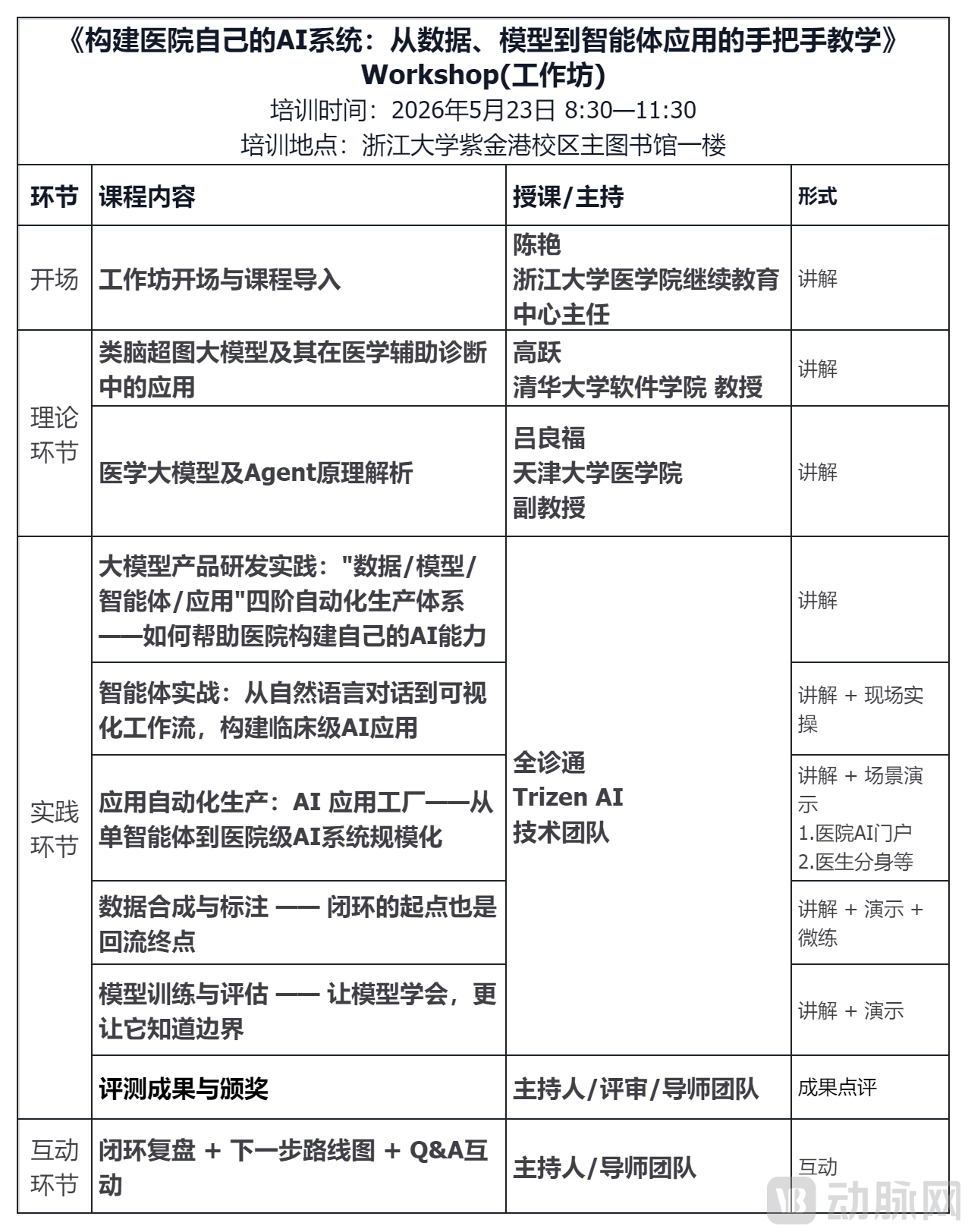
1. Theoretical Component
IncludingAnalysis of the Principles of Large Medical Models and Agents,Brain-Inspired Hypergraph Large Models and Their Applications in Computer-Aided Medical Diagnosis, to help learners understand large language models, AI agents, and the fundamentals of their applications in medical scenarios.
2. Practical Session
Focusing on “R&D Practices for Large Model Products,” this session explains the four-stage automated production system of “Data/Model/Agent/Application,” demonstrating how to help hospitals build their own AI capabilities.
3. Agent and Application Development
Through lectures and hands-on demonstrations, we will show how to develop clinical-grade AI applications by transforming natural language conversations into visualized workflows. Additionally, using the AI Application Factory, we will demonstrate the scalable development process from individual AI agents to hospital-level AI systems, covering typical scenarios such as hospital AI portals and digital doctor avatars.
4. Data and Model Capability Development
Explain data synthesis, data annotation, dataset preparation and feedback loop mechanisms, as well as model training, model evaluation, automated benchmarking, and boundary control, to help students understand the key components of continuous AI system optimization.
5. Outcome Evaluation and Interactive Review
Evaluation, Commentary, and Award Ceremony; Review, Roadmap Clarification, and Q&A Session.
V. Training Features
1. Build AI Applications Without Coding Skills
Build medical AI agents and applications through natural language conversations, lowering the barrier for non-technical professionals in clinical care, medical services, operations, nursing, research, and management to participate in AI development.
2. Start with applications to drive system understanding
The course first shows learners how AI applications are built, and then further helps them understand the underlying data, models, evaluation, and governance mechanisms.
3. On-site, hands-on instruction by experts
The expert team will conduct on-site demonstrations and hands-on training covering key stages, including requirements description, agent development, data processing, model evaluation, and application generation.
4. Advance Preparation of Teaching Environment and Cases
The workshop will integrate de-identified data, typical case studies, platform tools, accounts, and datasets to deliver training, enabling participants to gain hands-on experience with the end-to-end process of building medical AI systems.
5. Certificate awarded upon completion of training
Upon completion of the course hours, participants will receive a training certificate issued by the Chinese Association for Artificial Intelligence.
VI. Upgrade Highlights
Compared with traditional technical training and the training conducted during the same period last year, the 2026 workshop features the following enhancements:
1. From Learning Tools to System Building
2. From Manual Configuration to Natural Language Construction
3. From Single-Point Agents to Hospital AI Application Systems
4. From Technical Staff Involvement to Multi-Departmental Collaboration
5. From Lecture-Based Learning to Practical Certification
VII. Training Schedule and Venue
Training Duration: May 23, 2026 8:30–11:30
Training Venue: First Floor, Main Library, Zijingang Campus, Zhejiang University
Training Format: Offline Workshop
Training Scale: Limited to 60 participants
Registration Principles: Registration confirmation will be processed on a first-come, first-served basis upon successful payment. The final registration status is subject to notification from the conference organizing committee.
VIII. Course Schedule
The course schedule is subject to on-site implementation and is proposed to include the following modules:
9. Faculty Team
The workshop assembles a multidisciplinary faculty team comprising university experts, medical AI industry specialists, and the platform’s R&D team.
Academic Mentor——
Professor Gao Yue, School of Software, Tsinghua University
Course Focus: Brain-Inspired Hypergraph Large Models and Their Applications in Computer-Aided Medical Diagnosis
Professor Gao Yue is a tenured associate professor and doctoral supervisor at Tsinghua University. His primary research interests include artificial intelligence, computer vision, and medical image processing. He has long been engaged in research on hypergraph computing theory, high-order association modeling, and AI applications.
Tianjin University School of Medicine, Associate Professor Lu Liangfu
Lecture Topic: Analysis of the Principles of Large Medical Models and Agents
Associate Professor Lü Liangfu is a doctoral and master’s supervisor at the School of Medicine, Tianjin University. His research interests lie in medical artificial intelligence, with a long-term focus on large medical models, AI agents, and healthcare AI applications.
Industry Mentor——
Quanzhentong Trizen AI Technical Team
Teaching Focus: Large Model Product R&D Practices, Agent Practical Applications, AI Application Factory, Data Synthesis and Annotation, Model Training and Evaluation
The team will center on the four-stage automated production system of “data/model/agent/application,” integrating real-world product R&D and hospital application practices to conduct on-site explanations, scenario demonstrations, hands-on training, and outcome evaluations.
Moderator and Mentor——
Chen Yan, Director of the Center for Continuing Education, Zhejiang University School of Medicine
X. Certificate of Completion
Upon completion of the workshop hours, participants will receive a certificate issued byChinese Association for Artificial IntelligenceIssued Training Certificates. Certificate issuance requirements are subject to the actual arrangements of the conference and workshops.
XI. Organizational Structure
Organizer: Chinese Association for Artificial Intelligence
Organizers: Zhejiang University School of Medicine, Zhejiang Artificial Intelligence Society
Supporting Organizations: Quan Zhentong, Huawei Technologies Co., Ltd., and the Yuhang District Grassroots Committee of the Jiusan Society
XII. Training Fees
Hospital and university personnel: 1,000 yuan/person
Corporate personnel: 2,000 yuan/person
The fee covers course instruction, computing resources, lecture materials, hands-on practice, interactive Q&A sessions, assessment and certification, and a certificate of completion.
Invoice Description: Invoices issued by the Chinese Association for Artificial Intelligence are available.
XIII. Registration and Payment Methods
1. Registration:
Please scan the QR code to register.

2. Payment:
Bank Transfer (via Mobile Banking)
Account Name: Chinese Association for Artificial Intelligence
Account Opening Bank: Industrial and Commercial Bank of China, Beijing Xinjiekou Sub-branch
SilverAccount Number: 0200002909200166203
Address: Room 606, Building 86, Beijing University of Posts and Telecommunications, No. 10 Xitucheng Road, Haidian District, Beijing
Please be sure to include the following note when making payment: Name + Workshop,For financial reconciliation purposes. After payment, please be sure to send the payment screenshot and billing information to: houcong@trizen.ai
Registration is confirmed only upon completion of payment and notification by the conference organizing committee. Registrants will also receive priority access to other sessions of the thematic conference.
Payment Deadline: May 21, 2026, 0:00
XIV. Contact Information
Contact: Mr./Ms. Hou 13600541642
Email: houcong@trizen.ai
XV. Other Explanations
This workshop will be conducted as an in-person training session. Participants are requested to register on time and attend the training in accordance with the conference notice. The workshop will combine de-identified data, platform demonstrations, case studies, and account and dataset preparation to conduct hands-on training. Specific content is subject to on-site arrangements.(Students are required to bring their own laptops and power cords) Attendees shall comply with the conference organizer’s requirements regarding data security, intellectual property rights, and on-site order. Due to limited availability, seats will be confirmed on a first-come, first-served basis upon successful registration and payment. Should there be any adjustments to the course schedule, teaching content, or faculty arrangements, the final notification from the conference organizer shall prevail.