From Product Dimension Upgrade to Ecosystem Restructuring: Decoding the 'Four Key Leaps' in Myopia Control Development

DOBOSO
Intelligent Medical Platform Provider
In recent years, China has achieved remarkable results in myopia prevention and control.
According to the 2024 sampling results from the Ministry of Education, China achieved its target of reducing the overall student myopia rate by 0.5 percentage points annually from 2021 to 2024, marking a “four-year consecutive decline.”
However, alongside these encouraging developments, the data from both groups also subtly reveal underlying concerns regarding myopia prevention and control in China. An epidemiological study released by the Eye Center of Beijing Tsinghua Changgung Hospital, in collaboration with multiple domestic institutions, indicates that while the overall prevalence of myopia in China has stabilized, the incidence of high myopia has not yet peaked.
The status of hyperopia reserve among children in China is also concerning. Professor Bi Hongsheng from the Eye Hospital Affiliated to Shandong University of Traditional Chinese Medicine previously stated that the average hyperopia reserve among 6-year-old children in regions such as Shanghai is not only lower than the national health industry standard, "Specification for Evaluation of Uncorrected Visual Acuity and Refractive Status in Children and Adolescents," but is also being depleted at a faster rate. The detection rate of pre-myopia among children aged 6–8 years is as high as 20.7%–42.6%, which is comparable to the prevalence of myopia.
The above data points to a reality:Although China has achieved overall success in myopia prevention and control, the level of precision and personalization remains insufficient.To this end, in recent years, multiple national departments—including the National Health Commission, the Ministry of Education, and the National Disease Control and Prevention Administration—as well as various optometry enterprises have been vigorously promoting the development of a precise and personalized system for myopia prevention and control.
VCBeat learned through interviews that,To achieve this goal, the industry must undergo critical transitions across four dimensions: “tools” evolving from singular to diversified; products shifting from a “mixed bag of good and bad” to “compliant and trustworthy”; prevention and control strategies moving from “isolated efforts” to “combined interventions with integrated solutions”; and the industrial ecosystem transforming from “fragmented operations” to “cross-sector alliances.”
“Tool” Leap: From Limited Choices to a Diversified Matrix, PBM Emerges as a Rising Force
The “toolkit” for myopia prevention and control is undergoing a dual “enrichment” in both quantity and dimensions.
From low-concentration atropine to defocus spectacles and orthokeratology (OK) lenses, it is evident that myopia control tools have long been centered on two main dimensions: pharmacological intervention and optical correction.
Over the past decade, the rise and mature application of cutting-edge technologies such as AI and AR/VR have elevated myopia prevention and control to the dimensions of visual function training and digital therapeutics. VR-based visual training devices have emerged and rapidly gained popularity due to significant improvements in efficacy, convenience, and patient compliance. DOBOSO’s “Duobaoshi” VR holographic visual function training product is a prime representative of this trend.
Leveraging patented dynamic stepless zoom technology, this product simulates real-world environments in three-dimensional space. It offers a range of training modules, including smooth pursuit, saccadic eye movements, fusion, and stereoscopic vision, thereby enhancing extraocular muscle coordination, correcting imbalances in ocular muscle strength, and improving ciliary muscle accommodation. These benefits help mitigate the impact of visual dysfunction on myopia progression, effectively slowing its advancement. To date, DOBOSO’s “Duobaoshi” has provided visual function training services to over 500,000 paying users, earning widespread acclaim and achieving industry recognition as the “Leading Brand in Visual Function Training in China.” Professor Liu Xiangkai from Dongguan Guangming Eye Hospital has publicly stated that “Duobaoshi Holographic” demonstrates significant efficacy in improving binocular visual function and slowing myopia progression, offering a safe and highly effective new approach to myopia prevention and control in children and adolescents.
In fact,In addition to VR visual training devices and digital therapeutics, another category of tools has garnered significant attention within the industry in recent years, further expanding the dimensions of myopia prevention and control: photobiomodulation therapy (PBMT).
Photobiomodulation therapy is a technique that uses low-intensity, non-thermal red or near-infrared light (typically with wavelengths between 600 and 1000 nanometers) to irradiate biological tissues, thereby producing therapeutic effects. It can be widely applied in adjunctive treatment for myopia, management of retinal diseases, wound healing, and recovery from sports injuries.
In the treatment of myopia, red light targets mitochondria in the retina and choroid through photobiomodulation (PBM). Cytochrome c oxidase (CCO) on the inner mitochondrial membrane facilitates the displacement of nitric oxide (NO) by oxygen (O2) from its binding site on CCO, thereby enhancing mitochondrial ATP production. The resulting ATP provides sufficient energy to retinal and choroidal cells, inhibiting scleral hypoxia and extracellular matrix degradation caused by metabolic insufficiency.
Furthermore, red light mitigates oxidative stress-induced damage to scleral fibroblasts by reducing reactive oxygen species (ROS) levels, while simultaneously inhibiting the expression of inflammatory factors (such as TNF-α and COX-1), thereby blocking the pro-inflammatory signaling that promotes scleral remodeling and ultimately suppressing myopia progression.
To date, numerous studies have demonstrated that photobiomodulation therapy exhibits significant efficacy or broad application prospects in myopia prevention, the treatment of high myopia, and the management of adult myopia. Furthermore, in 2025, the International Myopia Institute, a leading international authority, explicitly stated that red light therapy is “superior to any other treatment” for one-year myopia control and prevention, indicating that its efficacy has gained widespread global recognition.
This has naturally attracted numerous enterprises to enter the field. As the first Class II medical device product approved following the issuance of the NMPA’s “Announcement on Publishing the Guiding Principles for Classification and Definition of Medical Devices for Myopia Control and Amblyopia Treatment Containing Light Sources (No. 25, 2025),” DOBOSO’s “Beibele” PBM-LED product undoubtedly serves as an industry benchmark that combines significant therapeutic efficacy with safety and regulatory compliance. It is reported that, in terms of therapeutic effect, the product utilizes an LED red light source with a wavelength range of 630–670 nm, which can precisely target the fundus, activate mitochondrial function in retinal cells, improve choroidal blood circulation, and provide support for controlling excessive axial elongation of the eye.
In terms of safety, the “Beibeile” PBM-LED product employs an LED incoherent red light source with a wavelength range of 630–670 nm, thereby avoiding the risks associated with the concentrated energy of early laser technologies and providing gentler protection for the fundus. Furthermore, the product incorporates four real-time protection systems to comprehensively enhance its safety profile: a real-time power monitoring system with millisecond-level emergency response ensures stable output; a precise time control system limits each single “irradiation” session to no more than 3 minutes; a mandatory 4-hour interval lockout system prevents overuse; and an abnormal current protection system safeguards operational safety at all times. In other words, the “Beibeile” PBM-LED product not only enables users to achieve optimal therapeutic outcomes but also provides peace of mind during use.
With the emergence and application of new-generation red light therapy products, represented by the “Beibeile” PBM-LED product, the industry has established a multi-dimensional intervention product system covering optical correction, pharmacological intervention, digital therapeutics, and red light therapy across various dimensions and usage scenarios, thereby achieving a profound upgrade in the “toolkit” for myopia prevention and control.
However, the enrichment of the “toolkit” merely provides the “material foundation” for achieving precise and personalized myopia prevention and control. Before this goal can be realized, three key transitions must be completed, with the shift from a “mixed bag” to “compliant and safe” representing the second critical transition.
Compliance Leap: From “Chaos” to “Rule-Based Order,” the Industry Accelerates onto the Fast Track of Standardized Development
From registration and market access to fitting and use, compliance requirements for myopia control products have continued to tighten in recent years.
Let's start by looking atRed Light Product Access Policy Further ClarifiedPreviously, the myopia prevention and control market was flooded with numerous “three-no” red light products lacking qualifications, clinical data, and safety assurances. These products not only had questionable efficacy but also posed safety hazards such as excessive optical radiation, inappropriate dosing, and unreasonable optical pathways, potentially triggering a crisis of confidence and trapping the industry in a situation where “bad money drives out good.” In 2025, the National Medical Products Administration issued the Guiding Principles for the Classification and Definition of Medical Devices for Myopia Control and Amblyopia Treatment Containing Light Sources, explicitly incorporating LED-based red light products into Class II medical device management. This move marks a further step toward standardization in the development of red light products for myopia prevention and control. DOBOSO’s “Beibele” PBM-LED product secured the first Class II medical device certificate for LED red light devices in China under the new regulations. This achievement not only demonstrates the high recognition by relevant national authorities of the product’s safety and efficacy but also sets a benchmark model for product market access within the industry.
Let's take another lookRegulatory Oversight of OK Lenses Extends to the Entire ProcessAs the earliest myopia control product to be regulated as a Class III medical device, orthokeratology (OK) lenses are no longer subject only to registration oversight. In June 2025, the General Office of the National Health Commission urgently launched a nationwide inspection and rectification campaign for OK lens fitting, aiming to eliminate irregularities such as off-label misuse. In 2026, the National Health Commission issued the “Administrative Specifications for Clinical Application and Technical Management of Orthokeratology Lens Fitting (2026 Edition),” which sets forth systematic requirements across four dimensions—medical institutions, physician and technical personnel, technical management, and administrative systems—thereby further standardizing OK lens fitting practices in medical institutions and safeguarding medical quality and safety. In other words, China has established a standardized and normalized management system covering the entire OK lens fitting value chain, from institutional qualifications and practitioner credentials to operational procedures and post-market follow-up.
In fact, in addition to the above two cases,The release of VR visual training standards is also a strong testament to the myopia prevention and control industry’s move toward standardized development.VR-based visual training products are not currently subject to medical device regulations. However, due to the absence of unified technical specifications, products manufactured by different companies vary in hardware performance, training efficacy, and safety assurances. These discrepancies not only affect user experience but also hinder the large-scale development of the industry. To address this issue, DOBOSO, leveraging its core strengths in VR technology, visual training algorithms, and clinical application validation, along with extensive clinical practice data, took the lead in formulating the Group Standard “Technical and Application Specifications for VR Visual Training Systems.” This standard establishes uniform guidelines for the research and development, production, inspection, and application of VR visual training products, thereby promoting the orderly and high-quality development of VR visual training equipment.
It is evident that safety compliance and standardized development are no longer confined to a single product category or superficial measures; instead, they are deeply integrated into the development of every product, laying a solid foundation of safety and trust for achieving precise and personalized myopia control.
So, when a rich product portfolio offers numerous options for myopia prevention and control, and when stricter regulations have affixed a “safe and effective” trust label to these products, what further efforts are required from the industry to achieve precise and personalized myopia prevention and control?
Strategic Leap—From “Single Tool” to “Combined Solutions,” Joint Intervention Is Imperative
The answer is clear and direct:Personalized and precise myopia control requires combined intervention with a multi-modal approach.
The so-called combined intervention with a combination regimen refers to the scientific integration of measures with different mechanisms, such as optical correction, pharmacological intervention, bio-optical therapy, and visual training, based on evidence regarding age, myopia status, axial length growth rate, and corneal morphology across different populations, while taking into account individual characteristics such as user compliance preferences, to achieve a synergistic effect where “1+1>2.”
The underlying reasons mainly include two aspects: first, the etiology of myopia is complex and cannot be addressed by a single approach.Taking axial myopia, the most common clinical form, as an example: its etiology involves multiple factors, including the release of pro-growth signals from the retina, rapid changes in choroidal thickness and perfusion, and remodeling of scleral structure and biomechanical strength. Unfortunately, no single intervention currently targets all pathways involved in myopia progression; therefore, combination therapies are required.
Second, there are significant individual differences, and no one-size-fits-all solution exists.Individual differences, including age, degree of myopia, axial length growth rate, visual habits, and compliance, determine that the same treatment regimen yields markedly different outcomes across patients.
In other words, combined intervention with multi-modal regimens is the inevitable path toward achieving precise and personalized myopia prevention and control. From the explicit call in the White Paper on Myopia Prevention and Control Management (2022) to “promote the combined application of optical correction, pharmacological interventions, and behavioral interventions,” to the International Myopia Institute’s 2025 White Paper, which for the first time dedicated a separate chapter to “combination therapy” alongside optical interventions, pharmacological interventions, and red-light therapy, combined intervention with multi-modal regimens has long become an industry consensus.
This industry consensus has not only significantly influenced myopia prevention and control strategies but also compelled the industrial ecosystem to undergo iterative upgrades.
Ecological Leap: From “Going It Alone” to “Organic Synergy,” Cross-Industry Alliances Take Shape
Cross-sector alliances are an inevitable outcome of the innovation in industrial collaboration models under the trend of combined intervention through integrated solutions.
The underlying reason is that a combined intervention approach implies that a single user may require multiple types of myopia control products. Under the traditional model of industrial collaboration, this may give rise to two major issues: First, users need to “piece together” a complete set of intervention products from different channels, which undoubtedly causes inconvenience to some extent. Second, if supplementary products must be purchased through other channels, the myopia control plans formulated by terminals such as hospitals and optometry clinics may be incomplete or unable to be fully implemented, thereby compromising the effectiveness of myopia control. Furthermore, data silos may exist among different products from various channels, which can hinder subsequent follow-ups and the formulation of intervention strategies, ultimately preventing effective myopia control.
Therefore, whether considering convenience or factors such as the scientific formulation, comprehensive implementation, effective tracking, and adjustment of myopia prevention and control strategies, traditional business models fail to support the effective implementation of combined intervention approaches. To address this, cross-industry alliances among enterprises with different attributes have become the “optimal solution.”
Taking the alliance formed by DOBOSO, HOYA Optics, and Nidec as an example, we concretely demonstrate the value and advantages of cross-industry alliances.
At the product level, Nidek’s optometric examination equipment, Hoya Optical’s defocus lenses, and DOBOSO’s “Duobaoshi” series of VR vision training products and “Beibeile” series of red-light therapy products can be directly combined into a multidimensional “blockbuster” product portfolio for myopia screening and correction, aimed at end-user sales. Users can enjoy high-quality, full-process, multi-product one-stop myopia screening and prevention/control services in a single terminal setting, which not only enhances intervention outcomes but also saves time and effort in product selection.
It is important to emphasize that, in addition to providing combination products, the cross-industry alliance among DOBOSO, Hoya Optics, and Nidek will offer end-users comprehensive support—including product training, operational solutions, and pre- and after-sales services—empowering them to upgrade from “single optical product distributors” to “full-lifecycle vision health management institutions.”
“This is not a matter of who helps whom, but rather the key to jointly advancing the construction of a precise and personalized myopia prevention and control system by leveraging each party’s respective strengths. This is the underlying logic behind the establishment of the cross-sector alliance.”Zhou Mosheng, Founder and Chairman of DOBOSO, stated, “In this collaboration, DOBOSO provides innovative technologies and digital therapeutic capabilities, HOYA Optical contributes brand influence and innovative products, and Nidek offers equipment and channel empowerment. The integration of these three parties forms a complete closed loop encompassing examination, training, and correction.”
Hoya Optical and Nidek also concur that “amid increasingly intense homogeneous competition in lenses and equipment, integrated solutions have become an effective pathway to break free from price wars and enhance professional value. For distributors and end users, one-stop services significantly improve efficiency and experience while reducing management costs and coordination challenges; patients can enjoy seamless services spanning from examination to prevention and control, thereby achieving precise and personalized, yet effective, myopia management.”"The industry is no longer a zero-sum game, but rather achieves multi-party win-win outcomes through complementary strengths."
Indeed, the optometry industry is undergoing a profound transformation—from elevating methods to enhancing compliance, and from combination solutions to cross-industry alliances. In this transformation, challenges are inevitable and undoubtedly arduous. To better address these challenges and advance the goal of precise, personalized myopia prevention and control, the industry needs in-depth dialogue to build consensus and clarify pathways.
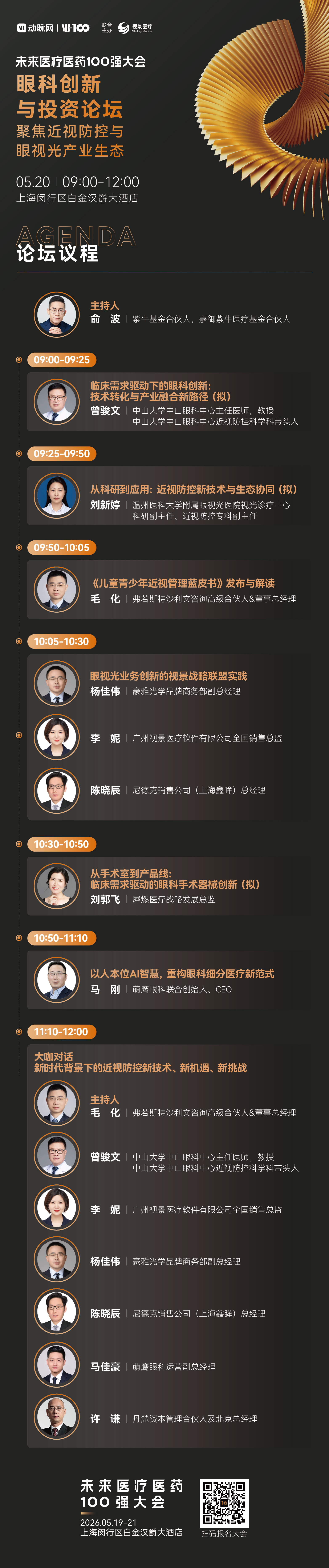
Therefore,On May 20, the Ophthalmology Innovation and Investment Forum, co-hosted by VCBeat and DOBOSO, and strongly supported by Danlu Capital and Frost & SullivanWe will continue to conduct in-depth discussions on the core challenges in myopia prevention and control and the high-quality development of ophthalmology.Focusing on technological innovation, service innovation, and innovative collaboration models, we will share the latest industry trends. Please scan the QR code to register for the event.