

Zhongshan Ophthalmic Center's Innovative Batch Cleaning and Drying System for Ophthalmic Class A Lumens Advances to Commercialization
Recently, the Zhongshan Ophthalmic Center of Sun Yat-sen University released a public notice on the transformation of scientific and technological achievements, whereby the university intends to transfer patent rights through“A Batch Cleaning and Drying Device and System for Ophthalmic Class A Lumens”The relevant patents have been transferred to Guangzhou Bright Medical Technology Co., Ltd., with a transfer fee ofRMB 80,000 + 5% commission on sales. The inventor of this patented technology isDeng Xingling and her team。
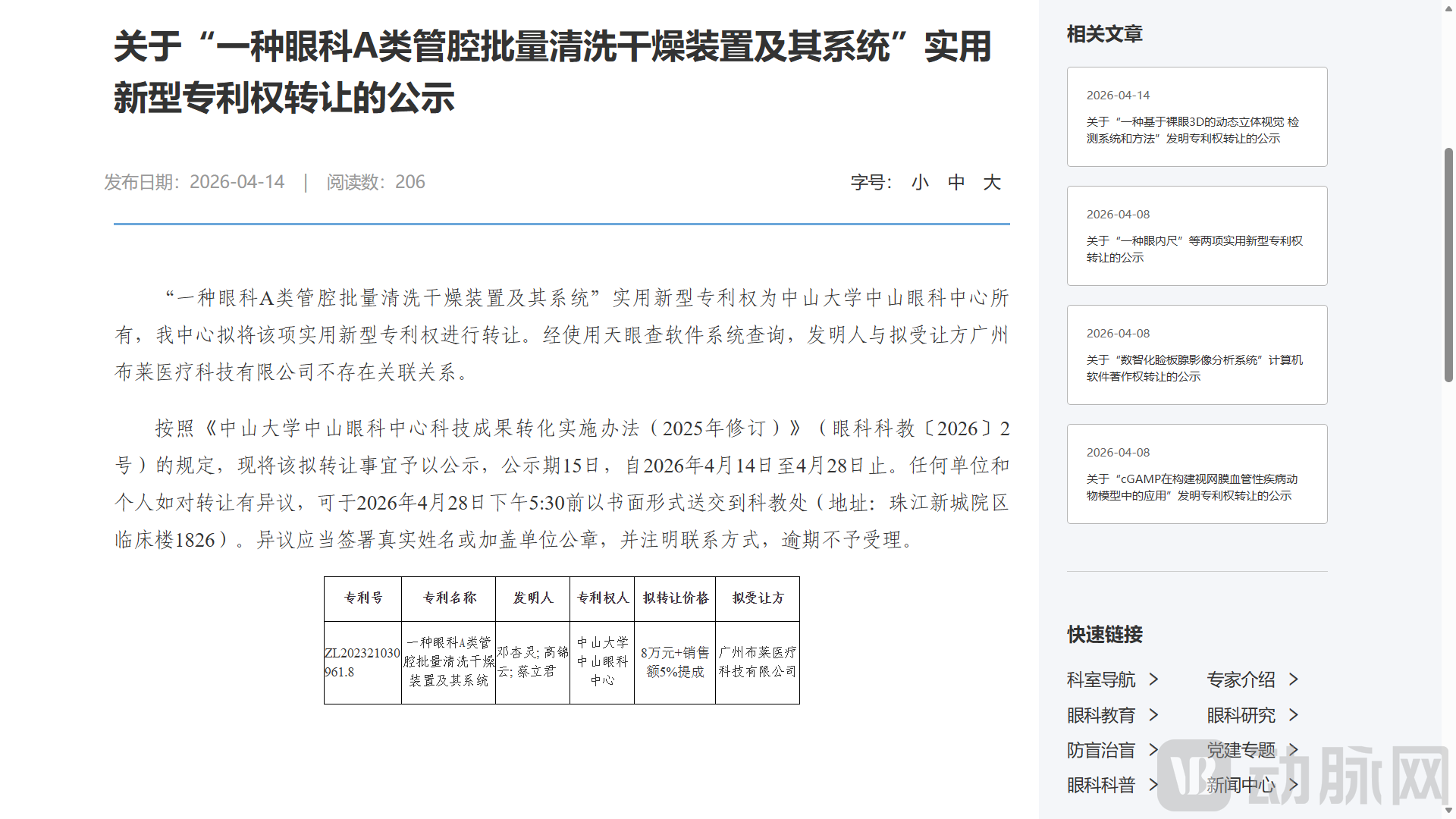
Image from the official website of Zhongshan Ophthalmic Center, Sun Yat-sen University
This is aBatch Cleaning and Drying Technology for Class A Ophthalmic LumensBy dividing the device housing into independent upper and lower dual chambers, it forms separate negative-pressure and positive-pressure channels that do not interfere with each other. This enables simultaneous batch cleaning and drying of ophthalmic Class A lumens with different flow directions, addressing the limitations of traditional equipment—such as single-mode cleaning, low efficiency, water accumulation in lumens, and residual hygiene dead spots. The device offers simple operation, thorough cleaning, and complete drying.
Ophthalmic Class A LumensAs a precision instrument frequently used in ophthalmic diagnosis and treatment, itsCleaning and Drying QualityDirectly impacting the prevention and control of hospital-acquired infections and the safety of diagnosis and treatment, it is a core component of daily operations in ophthalmic operating rooms and central sterile supply departments. However, in clinical scenarios involving batch processing, traditional cleaning and drying methods exhibit significant drawbacks, failing to balance efficiency, cleanliness, and operational convenience, thereby becoming a key bottleneck that hinders the standardization and high-efficiency processing of ophthalmic instruments.
From a clinical practice perspective, existing Class A lumen cleaning and drying equipment for ophthalmology suffers from inherent drawbacks, including limited operational modes and the inability to perform simultaneous tasks.Conventional devices support only either positive-pressure or negative-pressure cleaning, requiring lumens with different working fluid flow directions to be processed in separate batches. This approach is not only time-consuming and labor-intensive but also results in low batch-processing efficiency. The issues of resource waste and high time costs are particularly pronounced in scenarios involving a small number of lumens with diverse flow directions. Furthermore, the internal chambers of traditional equipment are prone to water accumulation, and the lower drainage pipelines are difficult to dry thoroughly. Sediments generated by negative-pressure suction tend to accumulate within the lumens, creating sanitary dead zones that fail to meet high-level cleanliness standards and pose a risk of cross-infection.
From the perspectives of device structure and user experience, traditional devices lack adequate self-cleaning and maintenance capabilities, further exacerbating clinical usage challenges.The internal chamber of the device lacks independent compartmentalization, making it difficult to thoroughly remove cleaning solution residues and soil deposits; long-term use readily promotes biofilm formation. Furthermore, the absence of dedicated drainage and ventilation structures renders cleaning and drying of the device body time-consuming and labor-intensive, which not only increases the risk of healthcare-associated infections but also exacerbates the burden on medical staff during instrument pre-processing.
From the perspective of market supply, existing ophthalmic lumen cleaning equipment generally lacks an integrated solution featuring dual independent channels, synchronized positive and negative pressure, and high-efficiency batch processing.Most devices only meet basic cleaning requirements and fall short in critical areas such as compatibility with multi-directional lumens, dead-spot-free drying, and self-cleaning capabilities. Consequently, they fail to meet the high-efficiency, high-cleanliness, and high-safety processing standards of modern hospital sterile supply departments, resulting in a long-standing lack of ideal dedicated equipment for Class A ophthalmic lumens in clinical practice.
Addressing the pain points of traditional Class A ophthalmic lumen cleaning equipment, such as single-mode operation, low efficiency, incomplete cleaning, and sanitary dead zones, this patented technology achieves a dual breakthrough in efficiency and cleanliness for processing precision ophthalmic lumens. Through an innovative design featuring independent dual-chamber separation, simultaneous positive and negative pressure operation, and integrated cleaning and drying, it constructs a highly efficient solution better adapted to clinical needs.
The core breakthrough of this technology lies in its dual-lumen independent channels, enabling simultaneous positive and negative pressure irrigation.Conventional devices are limited to either positive-pressure or negative-pressure cleaning, requiring batch processing for lumens with different working fluid flow directions, which is time-consuming and inefficient. This patent employs a partition to divide the housing into independent upper and lower chambers. The upper chamber is dedicated to negative-pressure cleaning and drying, while the lower chamber is dedicated to positive-pressure cleaning and drying. The two pathways are completely isolated and do not interfere with each other, enabling simultaneous, synchronized cleaning of grouped Class A ophthalmic lumens with different flow directions. This eliminates the need for batch processing and waiting, significantly improving bulk processing efficiency, particularly for scenarios requiring rapid processing of small batches with diverse lumen types.
Secondly, the technology structurally and thoroughly resolves hygiene blind spots caused by water accumulation, incomplete drying, and sediment buildup.Conventional equipment is prone to water accumulation at the bottom of the internal cavity, making it difficult to dry the lower drainage pipes, and sediments from negative pressure suction tend to remain within the lumen. This patent features dedicated drainage pipes at the bottoms of both the upper and lower chambers, enabling rapid discharge of residual liquids after cleaning. Coupled with high-pressure air drying, this design ensures no water accumulation or residue remains inside the lumen. Additionally, openable end ports are equipped at both ends of the device, facilitating ultrasonic cleaning and internal drying after use. This effectively removes deposits, prevents biofilm formation, and comprehensively enhances the level of cleanliness and safety.
Meanwhile, this solution offers practical advantages, including ease of operation, strong adaptability, and efficient maintenance.Multiple groups of tubular connectors are evenly distributed on the front panel, enabling simultaneous connection of multiple ophthalmic Class A lumens. The rear features multiple ports with valve controls, ensuring clear separation of water and air pathways for intuitive operation and a short learning curve for medical staff. The elongated housing with ear-like supports allows stable placement in cleaning sinks, adapting to standard clinical environments. Accessories such as sealed hoses and threaded plugs feature simple designs that facilitate sealing and quick assembly/disassembly, significantly improving daily maintenance and self-cleaning efficiency.
Furthermore, the system integrates optimized designs such as negative-pressure water storage tanks, multi-way valve control, and shared air supply sources to further enhance operational stability.The water outlet pipe is connected to a negative-pressure water storage tank, enabling stable generation of negative pressure and centralized collection of waste liquid to prevent contamination. The air intake system employs a combination of a main valve and branch valves, allowing flexible switching between single-channel drying and dual-channel synchronous drying modes. A single high-pressure air source meets all drying requirements, simplifying equipment layout and reducing operational costs, thereby truly achieving the ideal clinical outcome of “one-time installation, batch processing, and clean, efficient operation.”
Rising demand for reprocessing ophthalmic precision instruments and Class A lumens is driving rapid iteration of specialized cleaning and drying equipment, leading to market formation.Universal Endoscope Washer, Specialized Cleaning Device, Fully Automated Washer-DisinfectorAmong the three major technical routes, mainstream products are oriented toward automation, multi-channel processing, and vacuum drying. However, specialized solutions featuring synchronized positive and negative pressure, independent dual chambers, and high-throughput efficiency remain scarce. This patent offers significant differentiated advantages in niche application scenarios.
Shenzhen Meiyajie Technology Co., Ltd.'s MAG-CL3/CL4 Multi-Chamber Washer-DisinfectorSuitable for Central Sterile Supply Departments (CSSD), this system integrates spray rinsing, enzymatic cleaning, perfusion, ultrasonic cleaning, hot water disinfection, and circulating drying. It is capable of processing ophthalmic instruments, endoscopes, tubing, and other devices. Featuring multi-chamber parallel processing and automated operation, it completes one basket in 10–15 minutes, designed for hospital-wide centralized processing. The product has achieved mature mass production and is widely used in hospital CSSDs.
Endoscope Cleaning Workstation of Jiangsu Jieman Medical Technology Co., Ltd., adhering to the standard workflow of “pre-rinse → enzymatic cleaning → rinsing → disinfection → final rinse → drying,” it supports perfusion cleaning for both flexible and rigid endoscopes and lumen instruments, and features vacuum drying functionality. This highly versatile standardized workstation solution enhances infection control standards. With a mature product line, it serves endoscopy centers and sterile supply departments in hospitals at all levels.
Henan Sanqiang Medical Equipment's SQ Series Fully Automatic Endoscope Washer-Disinfector, featuring multi-channel irrigation and PLC intelligent control, it integrates cleaning, disinfection, rinsing, drying, and data traceability into a single system. It is optimized for dead-angle-free cleaning of long, narrow lumens, with automation and process compliance as its core advantages, specifically designed for endoscopy centers. The product has achieved mature commercialization with a stable installed base in clinical settings.
In summary, current comparable products are predominantly general-purpose endoscope cleaners, single-channel switching systems, or large-scale hospital-wide equipment. These solutions either offer broad versatility but lack specialty-specific adaptation, or feature simple structures that cannot perform simultaneous positive and negative pressure operations, thereby prone to leaving hygiene dead zones. This patent’s design—featuring independent dual lumens, synchronized positive and negative pressure, and dedicated drainage with self-cleaning capabilities—precisely addresses the niche gap for Class A ophthalmic lumens by enabling “batch processing, high efficiency, thorough cleanliness, and no dead zones.” It demonstrates leading advantages in scenarios requiring departmental in-house use, compact footprint, and high operational efficiency.