

Zhejiang University Oral Surgeon Aims to Break Monopoly in Gingival Regeneration Materials with Novel Collagen Matrix Technology
Recently, Zhejiang University publicly announced a transaction for the transfer of an invention patent, proposing to transfer the patent titled"A Wet-State Volume-Stable Collagen Matrix Flap and Its Preparation Method"the authorized technology is transferred through listed trading, with a total transaction priceRMB 5 million (including an initial payment of RMB 1.88 million and milestone payments of RMB 3.12 million)。
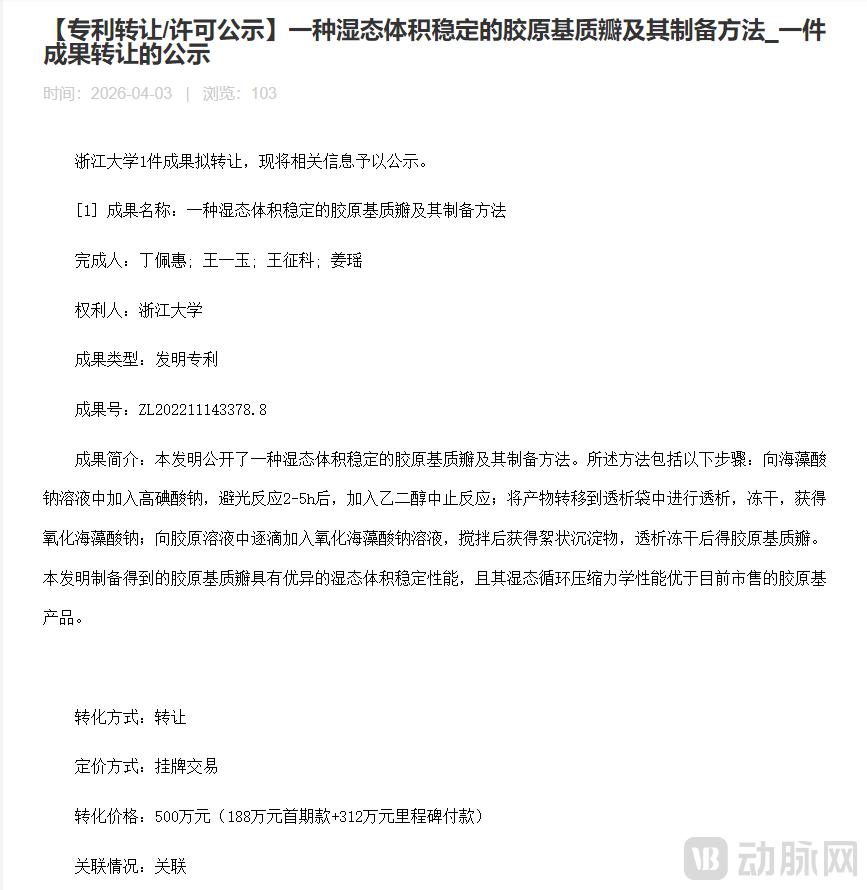
Image from the official website of Zhejiang University
Notably, the transferee in this transaction—Hangzhou Huizhou Technology Co., Ltd.—is 55% controlled by the inventor, Ding Peihui, constituting a typical related-party transaction. In December 2025, Zhejiang University published a notice of compliance review regarding this technology transfer activity.
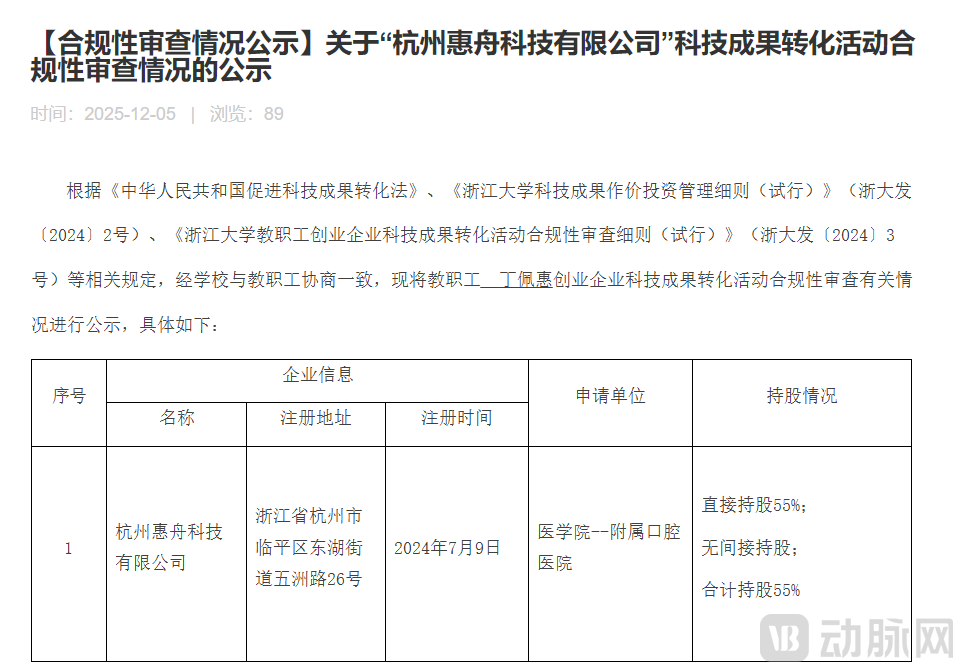
Image from the official website of Zhejiang University
Gingival RecessionIt is a common oral soft tissue disease characterized by the apical migration of the gingival margin toward the root, resulting in root exposure. In clinical treatment,Autologous connective tissue grafting (CTG) is regarded as the "gold standard" for repairing such defects.
However, autogenous connective tissue grafts (CTG) present two challenges: limited availability of donor tissue and increased surgical trauma at the palatal donor site. Consequently, soft tissue substitute materials have been introduced into clinical practice, primarily categorized into two types:Acellular dermal matrix (ADM), represented by AlloDerm, and xenogeneic collagen matrix (XCM), represented by Mucograft.
However, existing alternative materials all have significant drawbacks: long-term follow-up of ADM shows poor stability at the gingival margin; although XCM can shorten surgical time, it has poor biological stability and mechanical properties, with an excessively rapid degradation rate; while the second-generation material Fibro-Gide offers better volumetric stability, its thickness of 6 mm results in poor clinical handling.
Furthermore, domestically marketed xenogeneic collagen matrices are predominantly pure collagen with a simple bilayer structure, exhibiting performance similar to that of Mucograft. Currently, most materials used in clinical practice rely on imports and are expensive.
This is the core pain point that Ding Peihui’s team aims to address.
The breakthrough of this technology lies in abandoning traditional physical mixing or external strong acid/strong alkali cross-linking methods.
Specifically,Preparation of Aldehyde-Containing Oxidized Sodium Alginate via Selective Oxidation of Sodium Alginate with Sodium Periodate. During the preparation process, the aldehyde groups of oxidized sodium alginate undergo a Schiff base reaction with the amino groups on collagen molecules.
This in situ chemical cross-linking reaction forms a robust covalent bond network among collagen molecules, which not only tightly connects collagen fibers but also preserves the natural triple-helix structure of collagen, fundamentally addressing the challenge of pure collagen materials softening and collapsing upon exposure to water.
Based on performance testing data, the material exhibits a tensile strength of up to 66 kPa at 60% compressive deformation. In comparison, commercially available bovine collagen products demonstrate only 0.5 kPa, and porcine collagen products only 1.1 kPa—representing a performance improvement of over 100-fold.
Furthermore, hemocompatibility testing demonstrated a hemolysis rate of less than 2%, complying with the biological evaluation standards for medical devices; cytotoxicity assays also confirmed its non-toxic effects on surrounding cells.
This technology is byDing Peihui and Her TeamR&D. Public information indicates that Dr. Ding Peihui holds a Ph.D. from the University of Hong Kong. She currently serves as the Head of the Periodontology Teaching and Research Section at the School of Stomatology, Zhejiang University; Executive Deputy Director of the Department of Periodontology at the Affiliated Stomatological Hospital; and a recipient of the Zhejiang Provincial Excellent Young Scientists Fund. Her primary research focuses on the mechanisms underlying the maintenance and remodeling of periodontal regional homeostasis, as well as their translational applications.
How soon can it be put into use? This is the question that concerns most people.
From patent to product, there is a long journey of clinical validation and regulatory review and approval. According to the classification rules for medical devices, such oral soft tissue repair materials are typically classified as Class III medical devices (implantable materials). It usually takes 3–5 years, or even longer, to go from clinical trials to obtaining the registration certificate.
Specifically, the process involves: process scale-up and GMP manufacturing → type testing (registration testing) → clinical trials → registration submission → review and approval → production licensing.
However, Ding Peihui’s team has a natural advantage—The clinical site is located at the Affiliated Stomatological Hospital of Zhejiang University.. This means that during the clinical trial phase, the team can accelerate patient enrollment and follow-up, demonstrating significant synergies compared to pure startups.
What tangible benefits does it offer to the general public? If all goes well, the clinical implementation of this technology will provide patients with gingival recession with superior treatment options.
First, it reduces secondary trauma.Currently, the soft-tissue substitute materials widely used in clinical practice are largely reliant on imports and exhibit significant performance limitations. Patients must either undergo autologous transplantation (harvesting tissue from the palate) or use imported materials, which are expensive and do not always yield optimal outcomes. If successfully commercialized, this new domestically produced material is expected to provide a superior alternative without increasing the financial burden on patients.
Secondly, to improve long-term efficacy.A core issue with existing materials is their rapid degradation and poor stability, leading to suboptimal long-term postoperative outcomes. The new material, with a wet compressive strength of 66 kPa, can theoretically better maintain volumetric stability and reduce postoperative recurrence.
Third, improve accessibility.Imported materials are expensive, increasing the financial burden on patients. If domestically produced alternatives can be successfully commercialized and included in medical insurance or centralized procurement programs, their usage costs are expected to drop significantly.
What makes translation possible is the most concerned issue for researchers and scientific research managers.
From the perspective of the results themselves, this technology has several elements that support its translation:
· The clinical problem is real.Gingival recession is a common condition. There is a clear clinical demand for high-performance soft tissue substitutes, yet existing products have significant limitations, leaving an unmet clinical need.
· The technology has differentiated barriers.The wet compressive strength of 66 kPa represents an order-of-magnitude improvement over commercially available products. Furthermore, the material utilizes a unique Schiff base cross-linking pathway, which is distinctly different from existing technical routes. The inventor, Ding Peihui, is a clinical expert in stomatology who integrates both research and clinical perspectives, ensuring that the technology aligns more closely with practical needs.
· The conversion mechanism has been established.Zhejiang University has completed the compliance review of this related-party transaction, with no objections raised during the public notice period. The listed trading price of RMB 5 million has been validated by the market. Huizhou Technology, in which inventor Ding Peihui holds a 55% equity stake, is capable of undertaking subsequent industrialization and commercialization efforts.
· Supported by clinical practice.As one of the largest specialized stomatological hospitals in Zhejiang Province, the Stomatological Hospital Affiliated to Zhejiang University can provide support for subsequent clinical trials and product iterations.
Of course, the risks are also clear: there is a significant gap between laboratory-scale processes and industrial mass production; the medical device registration cycle is long and highly uncertain; and the operational and commercialization capabilities of startups remain to be validated.
“Is there a ‘money prospect’?” This is the most pressing concern for investors.
From the perspective of market size, the demand for oral soft tissue regeneration materials mainly comes from three aspects:Periodontal Restoration, Implant Soft Tissue Augmentation, and Treatment of Gingival Recession. With the implementation of centralized procurement for dental implants and consumption upgrades, the volume of gingival soft tissue augmentation procedures continues to grow, driving up demand for related materials.
In terms of the competitive landscape, the domestic market is currently dominated byImported ProductsImported brands such as Geistlich’s Mucograft and Collagen Solutions’ Fibro-Gide dominate the high-end market, leaving substantial room for domestic substitution. As one of the largest specialized stomatological hospitals in Zhejiang Province, the Affiliated Stomatological Hospital of Zhejiang University School of Medicine provides Dr. Ding Peihui’s team with natural clinical application scenarios.
From the perspective of the transaction structure, the initial payment of RMB 1.88 million reduces the transferee’s upfront financial burden, while the milestone payment of RMB 3.12 million is tied to subsequent clinical progress—this means that the transferor (Zhejiang University) assumes part of the early-stage risk, and the transferee (Huizhou Technology) bears greater responsibility in the later commercialization phase.
There is room for imagination: If the product achieves successful commercialization and is included in centralized procurement, the pricing potential for domestically produced high-end oral soft tissue materials is promising. However, this hinges on surviving the 3–5 year registration period, during which continuous R&D investment is required while revenue remains nearly zero.
What level does a transaction consideration of 5 million represent in the field of dental regenerative materials?
First, examine the pricing of comparable products. Taking BonaSe® Oral Collagen Sponge as an example, such soft tissue repair materials are typically listed on public hospital procurement platforms at prices ranging from several hundred to one thousand yuan per piece. As a more premium Class III implantable material, collagen matrix flaps command a higher unit price.
Huizhou Technology’s path to recouping its investment may look like this:
Step 1: Establish product evidence through clinical trials, while leveraging the clinical resources of the Stomatological Hospital Affiliated to Zhejiang University for iterative application improvements;
Step 2: Obtain the Class III medical device registration certificate and get included in hospital procurement catalogs;
Step 3: Leverage the price advantage of domestically produced alternatives, combined with clinical resources, to achieve rapid volume growth.
However, the real challenge lies inMedical Device Registration Certificate. From laboratory results to Class III medical device products, there is still a long period of clinical trials and review and approval processes. According to industry conventions, it usually takes 3-5 years or even longer for an innovative medical device to go from clinical trials to obtaining certification.
This means that Huizhou Technology will require a "cash infusion period" of at least 3–5 years, during which it must invest in R&D, clinical trials, and regulatory filings, while generating virtually no revenue from this technology.
Nevertheless, these risks and processes are common and normal in the commercialization of scientific and technological achievements. Regardless of the outcome, this initiative serves as a compelling example of best practices in university technology transfer mechanisms.
In 2024, Zhejiang University introduced new regulations allowing startups in which the creators of scientific and technological achievements hold more than 70% equity to acquire technology transfers from the university, while also permitting related-party transactions. The RMB 5 million pricing was determined through a listed trading process, ensuring procedural compliance. Ding Peihui has established a closed-loop pathway from “academic publications to clinical practice to entrepreneurship,” supported by these policies.
Secondly,This technology itself possesses differentiated value.Rather than allowing imported materials to monopolize the market, it is better to promote domestic alternatives. With a wet compressive strength of 66 kPa, representing an order-of-magnitude improvement over commercially available products, successful commercialization holds promise for breaking the monopoly held by imported brands in the high-end dental regenerative materials sector.
There is a genuine clinical need.The volume of surgeries for treating gingival recession and peri-implant soft tissue augmentation continues to grow, yet existing materials either lack sufficient performance or are prohibitively expensive. A domestically produced collagen matrix membrane that offers both superior performance and cost-effectiveness holds clear clinical value.
From patent to product, there is still a long road ahead.Can clinical trials proceed smoothly, will regulatory approval be obtained, and is commercialization capability in place?These are the questions that Huizhou Technology needs to answer, and they are also the questions that every technology-driven innovative company needs to answer.