

From Obscure Moss to Anti-Liver Cancer Star: Hebei University of Chinese Medicine Team Discovers Novel Flavanol from Polytrichum commune
Liver cancer has long been one of the most prevalent cancers in China, creating an urgent clinical need for novel small-molecule drugs with unique scaffolds, low toxicity, and high efficacy. Could “moss,” seemingly insignificant in the eyes of many, actually possess anticancer properties?
Recently, Hebei University of Chinese Medicine released a public notice stating that the team led by Duan Xuhong at the university intends to"A Novel Compound Isolated from Polytrichum commune and Its Preparation Method and Application"Transferred to Hebei Shengjian Technology Co., Ltd., with the patent transfer fee being50,500 yuanWithout expensive equipment or cross-industry gimmicks, what was the key to isolating a novel global compound from common golden hair moss, confirming its anti-liver cancer activity, and successfully obtaining patent authorization to achieve commercialization?
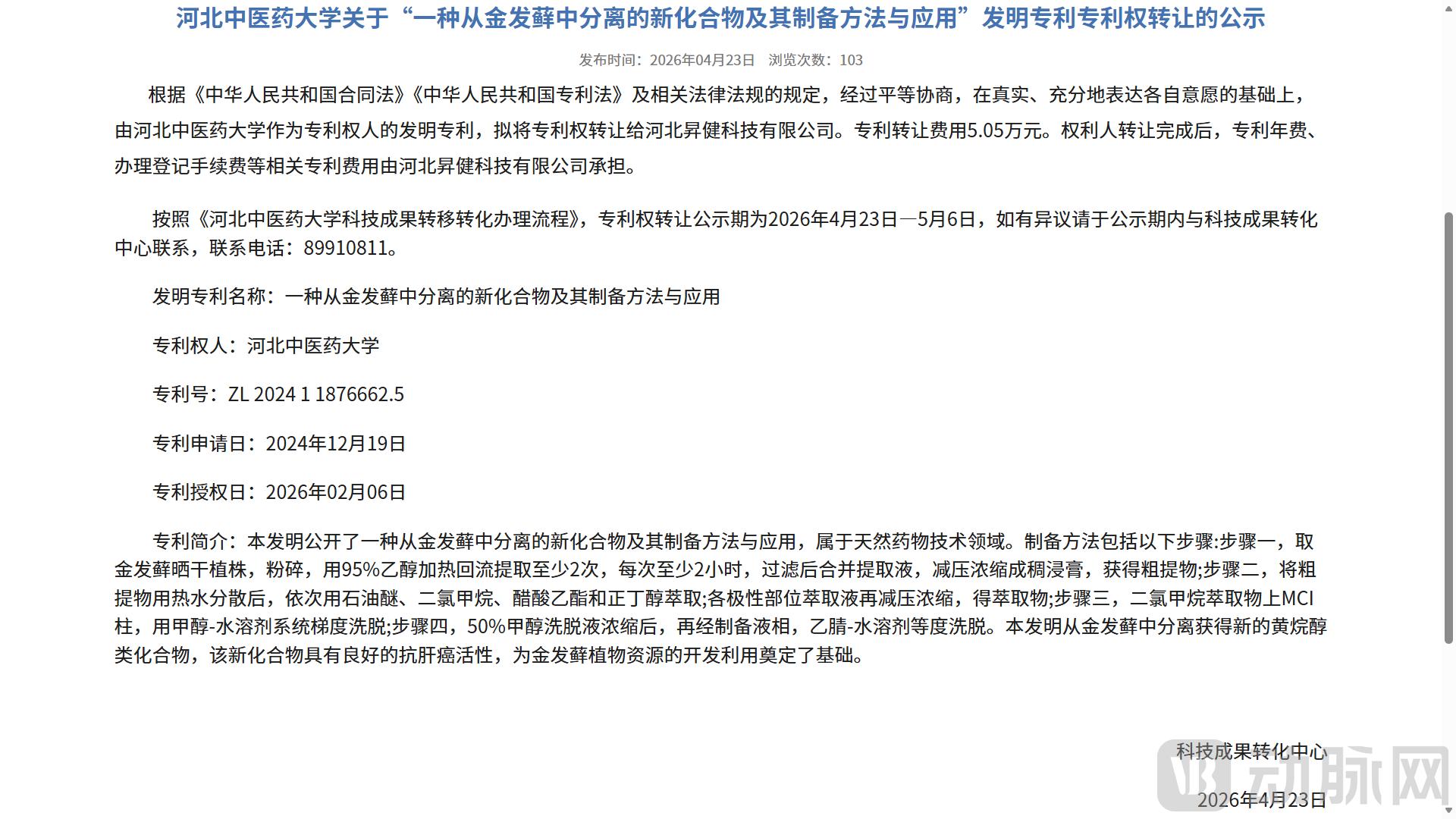
Image from the official website of Hebei University of Chinese Medicine
In plant resource banks, mosses have long occupied a “neglected” position. They are widely distributed, inconspicuous in appearance, and rarely incorporated into the industrial development of traditional Chinese medicine (TCM). However, the team from Hebei University of Chinese Medicine has pioneered novel innovations using Polytrichum commune.
The team collected wild Polytrichum commune from Guizhou and, through multi-step extraction and isolation, discovered and identified novel flavanol compounds from this plant for the first time—Polytrichum Flavanol E, the structure was confirmed by multiple NMR spectra, including 1H NMR, 13C NMR, HMBC, and 1H-1H COSY. More importantly, in vitro experiments demonstrated that this compound inhibits four human hepatocellular carcinoma cell lines—HepG2, Huh7, Hep3B, and SMMC7721—with particularly pronounced efficacy against Hep3B cells, thereby providing a novel molecular scaffold for anti-hepatocellular carcinoma drug development.
Primary liver cancer is characterized by an insidious onset, high heterogeneity, a propensity for drug resistance, and a high risk of recurrence, leaving many unmet clinical needs. A significant proportion of patients present at intermediate to advanced stages, resulting in a low overall 5-year survival rate. Primary or acquired resistance frequently emerges during systemic therapy, and certain treatment modalities are limited in patients with compromised baseline liver function. There is an urgent clinical need for candidate molecules with novel structures and mechanisms of action to expand therapeutic options and address challenges related to drug resistance and safety.
This TechnologyIsolation of Novel Flavanol Compounds from the Natural Plant *Polytrichum commune*, featuring a molecular scaffold distinct from existing clinical drugs. In vitro experiments have confirmed its inhibitory effects on multiple human hepatocellular carcinoma cell lines, providing a novel source molecule for the development of new anti-hepatocellular carcinoma drugs. This compound is of natural origin, and the team has established a stable and controllable isolation and preparation process, laying the foundation and offering advantages for subsequent research as a novel lead compound for anti-hepatocellular carcinoma therapy.
Don’t dismiss this unassuming moss as merely a single compound,Its path to industrialization is clearly defined.
First, it can be directly developed into research-grade chemical compounds for supply to universities and pharmaceutical companies for screening studies, enabling rapid small-scale commercialization. Second, structural optimization can be performed on this basis to advance the development of anti-hepatocellular carcinoma candidate drugs and facilitate collaborative development with pharmaceutical enterprises. Third, the raw material, *Polytrichum commune* (common haircap moss), is widely distributed and amenable to artificial cultivation; its extraction process is mature and scalable, with future potential extending into functional ingredients and extract-based products.
What makes this case most worthy of reference for peers is not how cutting-edge the technology is,but rather a highly pragmatic approach。
It demonstrates three key points: First, niche resources equate to high-potential opportunities; mosses, herbs, and locally used medicinal materials may harbor novel structures and bioactivities. Second, small yet refined achievements can achieve high conversion rates; there is no need to pursue large platforms or substantial funding—solidifying “bioactivity + patents + manufacturing processes” creates collaborative value. Third, the translational advantages of traditional Chinese medicine (TCM) and natural products are resurging, with new scaffolds, new targets, and new indications more readily attracting capital and industry attention.
For numerous teams engaged in the research and development of natural products, traditional Chinese medicine (TCM) monomers, and botanical drugs:Less pure theoretical research, and more steps toward patent layout + application scenarios, can move achievements from the "bookshelf" to the "store shelf."