

Orbital Sampling Device Patent Licensed for RMB 219,900 to Address Clinical Pain Points
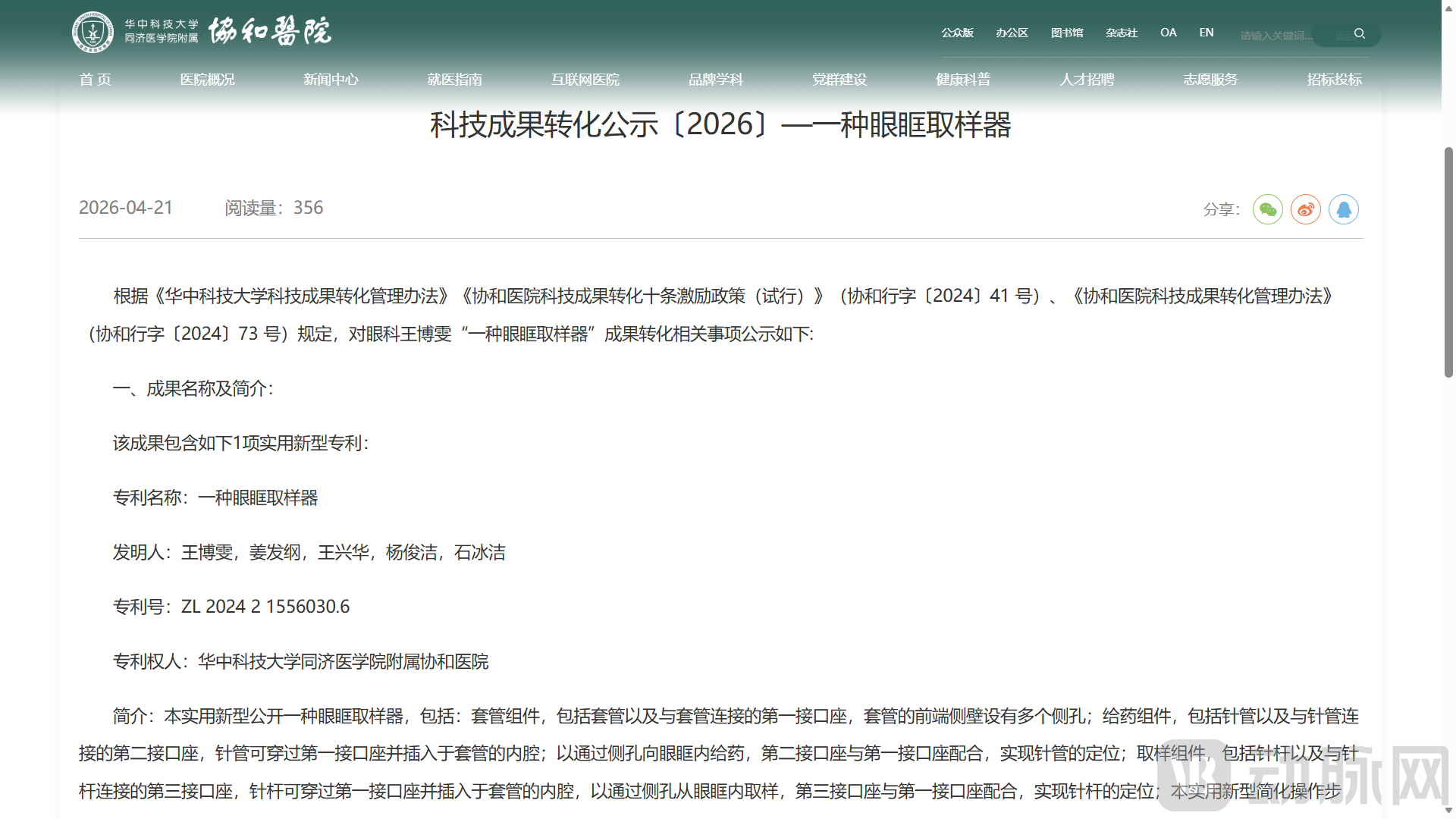
Image from the official website of Union Hospital, Tongji Medical College, Huazhong University of Science and Technology
A utility model patent was sold for less than 220,000 yuan.It does not address any major “chokehold” issues, but it tangibly spares patients one injection.
Recently, Union Hospital affiliated to Tongji Medical College of Huazhong University of Science and Technology released a public notice on the transformation of scientific and technological achievements, concerning the developedA Utility Model Patent for an Orbital Samplervia agreement-based transfer, priced atRMB 219,900Licensed to Qingdao Fengyi Automation Technology Co., Ltd.
During the diagnosis and treatment of orbital inflammation, tumors, or cysts, physicians often need to perform two procedures around the orbital connective tissue:First, drug administration; second, sampling.Traditional Practice: Insert a needle for drug administration, then withdraw it; insert another needle for sampling, then withdraw it.
This is not a "chokehold" technological bottleneck, but it is indeed a real pain point in clinical practice—"Repeated punctures mean repeated pain, cumbersome procedures, and low efficiency."
Professor Jiang Fagang, Deputy Director of the Department of Ophthalmology at Peking Union Medical College HospitalWith years of experience in managing patients with orbital fractures, tumors, and ocular trauma. In such surgical and clinical practices, a particular issue has become increasingly prominent due to the frequent need for orbital puncture procedures:Can all procedures be completed with a single puncture?This is the origin of the "cannula-first" concept.
Core innovation is simple:Cannula Indwelling.
Only a cannula needs to be inserted into the orbit; subsequent drug administration and sampling are both performed through this cannula. For drug delivery, a needle is inserted, and the solution disperses into the orbit through side ports at the tip of the cannula. For sampling, the needle is replaced with a sampling rod, and the sample enters through the same side ports.
Three Technical Innovations:
1. Cannula indwelling.A single puncture allows for indwelling catheter placement, eliminating the need for re-puncturing when switching between drug administration and sample collection.
Second, multi-site dispersed drug administration.Traditional straight-tip needles concentrate the injectate at a single point; the side-port design enables broader dispersion of the medication within the tissue, thereby avoiding direct impact on sensitive tissues.
Third, precise volume control via piston.The piston structure at the front end of the syringe barrel opens the side port during drug administration and, upon completion, rotates to seal the side port, thereby fully expelling residual medication from the cannula to ensure accurate dosing.
Innovations in utility model patents are often not breakthroughs at the principle level, but optimizations at the structural level—From “Usable” to “More Usable.”
The transferee of this transaction, Qingdao Fengyi Automation Technology Co., Ltd., originally specialized in industrial automation system development and mechanical equipment installation, with no prior involvement in the medical device industry.
Why Did an Industrial Automation Company Acquire This Patent?
First, the registration threshold for utility model medical devices is lower than that for Class III devices, and the approval cycle is shorter. Second, for puncture devices with relatively simple structures, precision machining and mass production capabilities are precisely the strengths of automation companies. Of course, whether the company can successfully obtain medical device manufacturing qualifications and product registration remains to be seen.
The Department of Ophthalmology at Wuhan Union Hospital is the only key discipline in ophthalmology in Hubei Province, ranking among the top four nationwide on the Fudan University Hospital Rankings, with an annual outpatient volume of nearly 200,000 visits. Given the scale of such a hospital, how many minor inventions of the “quick-fix” variety are generated each year?
The experience of Professor Jiang Fagang’s team may well illustrate the point. A holder of a German medical doctorate, a National Second-Grade Professor, and a doctoral supervisor, he has presided over two projects funded by the National Natural Science Foundation of China, served as editor-in-chief for eight monographs, and supervised more than 70 master’s and doctoral students. Despite such distinguished credentials, he remains willing to devote time to a minor patent valued at RMB 219,900.
This indicates that the translation of scientific and technological achievements is not entirely driven by financial amounts.If the clinical problem is genuine, the technical solution is implementable, and the team demonstrates strong execution capabilities, then it is worth advancing.
219,900 yuan may not seem like a major deal, but this"Clinical Issues - Technical Solutions - Manufacturing Takeover - Product Implementation"path, which is precisely the most fundamental aspect of hospital technology transfer that deserves to be seen.