

Top Ophthalmologist Behind 200,000 Surgeries Licenses $10,000 'Intraocular Ruler' to Aid Precision Cataract Surgery
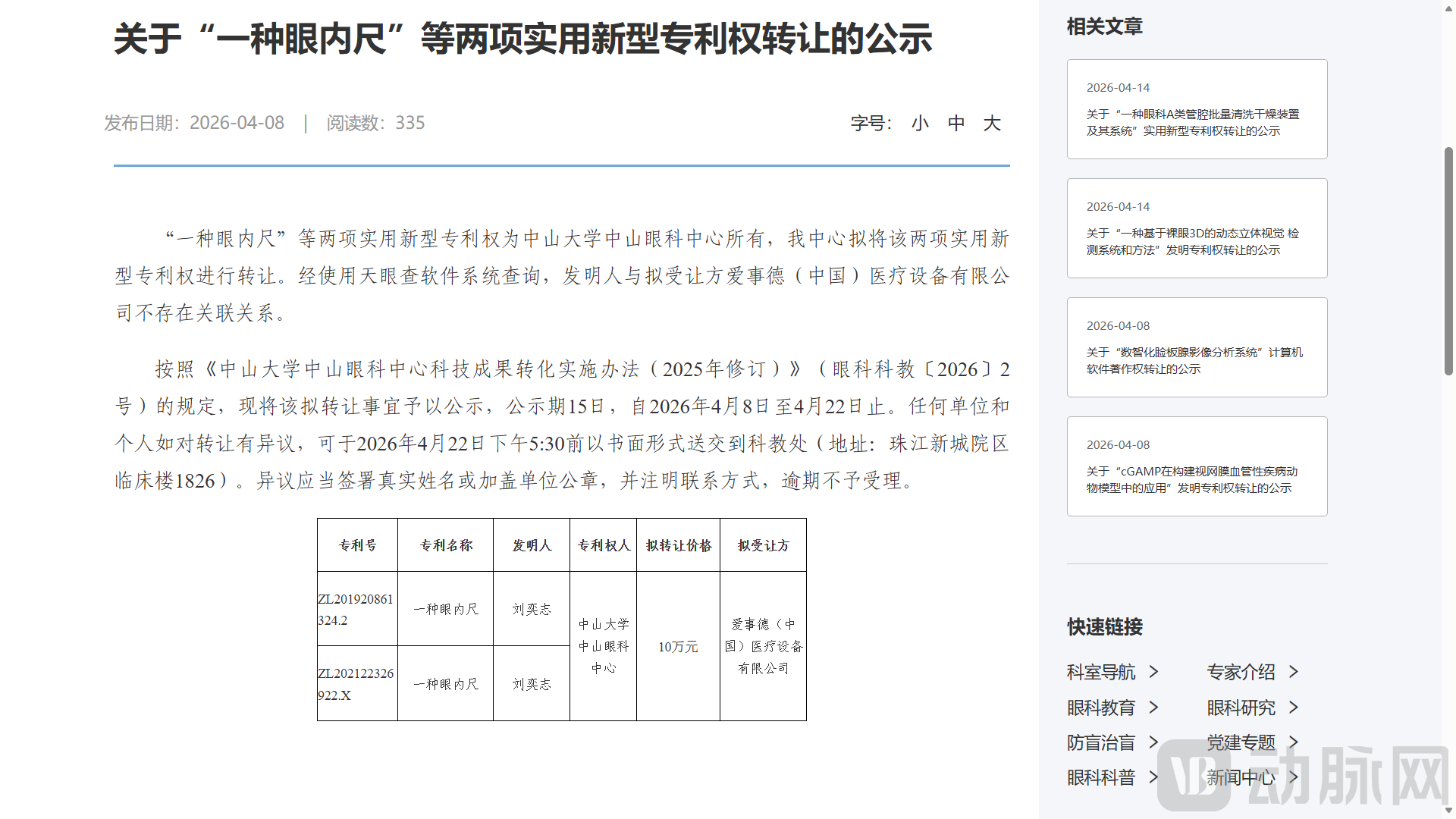
Image from the official website of Zhongshan Ophthalmic Center, Sun Yat-sen University
Capsulorhexis: The Key to Cataract Surgery——The surgeon must tear a circular opening in the eyeball, with the size precisely controlled to 5.5 millimeters, relying entirely on tactile sensation. Even after performing hundreds of thousands of cases, the rate of perfect capsulorhexis remains only slightly above 20%.
Prof. Liu YizhiHe is one of the most prolific cataract surgeons in China, an author for Nature, and a recipient of the National Science and Technology Progress Award. He has performed capsulorhexis nearly 200,000 times. Perhaps because the training cycle to cultivate a surgeon capable of performing perfect capsulorhexis is too long, or perhaps because he did not want patients’ surgical outcomes to rely entirely on physicians’ experience, he took an initiative: he designed a small ruler to guide this maneuver.
Recently, the device he developed, called"Intraocular Ruler"small instruments——Transferred to a medical device company named Aishide for RMB 100,000.。
Cataractis the leading cause of blindness worldwide,Phacoemulsification Combined with Intraocular Lens ImplantationIt is the mainstream curative approach. A critical step in the surgery is called "capsulorhexis"—creating a circular opening on the anterior surface of the lens capsule, followed by removal of the opaque lens and implantation of an intraocular lens.
The quality of capsulorhexis determines the success or failure of the surgery and also affects postoperative visual outcomes. An ideal capsulorhexis opening should meet three criteria:Centered, perfectly round, with a diameter of approximately 5.5 mm.
However, in reality, surgeons primarily rely on intraocular structures such as pupil size and lens morphology as references, making judgments based solely on experience. Pupil size varies among individuals, and the microscope introduces magnification interference—even among experienced physicians, the rate of perfect capsulorhexis is only 22.77%, while the incidence of excessively large capsulorhexis openings reaches as high as 30.69%.
Non-standard capsulorhexis increases the risk of capsular rupture and intraocular lens dislocation, affecting postoperative refractive stability.
The problem lies with the tool.The tips of traditional capsulorhexis needles are sharp, making them highly likely to damage the lens capsule, which is only 3–20 micrometers thick, during intraocular measurements. Furthermore, some graduated needles fail to conform to the curvature of the anterior lens surface, resulting in significant measurement errors. Single-function instruments require repeated entry into and exit from the anterior chamber, thereby increasing the risk of infection and prolonging surgical time.
Professor Liu Yizhi has accumulated 200,000 cases in this area. He knows better than most:The core challenge of capsulorhexis is not "whether it can be done," but "how to achieve precision."
The intraocular ruler invented by Professor Liu Yizhi’s team has the core concept of"Measurement + Marking + Assistance" Trinity。
In terms of measurement, an arc-shaped shaft design consistent with the curvature of the anterior surface of the lens is adopted.Traditional straight-shaft instruments leave gaps upon contact, whereas the curved shaft conforms tightly to intraocular tissues, preventing slippage and deviation. The scale is marked according to the true chord length, with the zero point at the needle tip. Key dimensions are precisely segmented at 0.2 mm, 0.4 mm, and 5.4 mm, enabling rapid intraoperative localization of the ideal capsulorhexis diameter of 5.0–5.5 mm.
Marking: The needle tip is fully blunted, with a hard protrusion added to the side.Gentle pressure with the blunt tip can leave cortical imprints without damaging the capsule; the lateral protrusion allows for direct pinpoint marking without instrument rotation, minimizing disturbance to the anterior chamber.
As an auxiliary device, the tubular through-hole structure can simultaneously perform three procedures: injection of viscoelastic agents, capsulorhexis measurement, and boundary marking, eliminating the need for repeated instrument exchanges in and out of the anterior chamber.The rigid protrusion can also serve as a point of force application during hydrodissection, facilitating rotation of the lens nucleus.
Core Data:The rate of perfect capsulorhexis increased from 22.77% to 71.40%, while the proportion of oversized capsulorhexis decreased from 30.69% to 10.20%.
For young physicians at the primary care level, the significance of this instrument is more direct: capsulorhexis no longer relies heavily on hand-eye coordination. The clearly defined imprint boundaries transform "centrally positioned and perfectly circular" into a reproducible procedure, rather than merely the outcome of accumulated experience.
Professor Liu Yizhi’s curriculum vitae is extensive:Published a study on lens regeneration in Nature in 2016; recognized as one of the "Top Eight Medical Breakthroughs Worldwide" by Nature Medicine; promoted the global application of torsional-mode phacoemulsification technology; cultivated recipients of the National Science Fund for Distinguished Young Scholars and numerous discipline leaders; awarded the Ho Leung Ho Lee Foundation Prize for Progress in Science and Technology...
But he is willing to devote his energy to a “intraocular ruler” worth 100,000 yuan. This actually illustrates a simple fact:The driving force behind clinical innovation is often not “I want to achieve a major breakthrough,” but rather “I perform this procedure every day; can it be made more convenient?”