

The Year of Large Model Implementation Arrives: JD Health's Practical AI Flourishes Across Healthcare

JD Health
Internet Medical and Health Service Platform Provider
At the recently concluded Top 100 Future Healthcare and Pharmaceuticals Conference, three forums on medical AI and large language model applications were held in quick succession. These forums systematically presented the real-world implementation pathways and growth opportunities for AI in the healthcare industry, focusing on areas such as healthcare services, hospital digitalization and intelligence, AI-empowered pharmaceutical enterprise operations, and industrial collaboration.
As medical AI transitions from explosive growth to rational implementation, practical value has become the core dimension for measuring technological effectiveness.
During the conference, JD Health presented under the title “Large Model-Driven: Building a New Ecosystem for All-Scenario Medical AI,” sharing technical advancements of its Jingyi Qianxun large language model and its implementation achievements within JD Health’s business ecosystem. In other sub-forums of the conference, JD Health’s discussions on patient services, digital marketing, and hospital-side operations further underscored that the practical value of medical AI must be demonstrated by addressing real pain points in the healthcare industry.
Building on its established full-scenario application system, JD Health has continued to expand the boundaries and granularity of its AI applications since 2026, with an increasingly pronounced practical orientation in its medical AI.
Over the past two years, the field of large medical models has witnessed surging enthusiasm. After an intense competition primarily focused on parameter scale and benchmark rankings, the industry has increasingly recognized that the core challenge facing medical AI is not merely a lack of technological sophistication, but rather a gap between technology and clinical needs, as well as user trust.
As the growth in the number of large medical models slows, scenario adaptation and tangible implementation outcomes have become the industry’s primary concerns. The “2026 Research Report on Scenario-Based Implementation of Large Medical Models,” recently released by VBInsight, also states thatThe deployment of large language models in specific application scenarios has become the main theme, with industry bubble clearing and entry into a new phase of rational growth.
Against this backdrop, JD Health’s “Jingyi Qianxun” large model has firmly established its positioning as a practical medical AI. In March 2026, “Jingyi Qianxun” topped both the large language model and multimodal model categories on the MedBench evaluation platform. More noteworthy than these results is its utility-centric technical architecture.
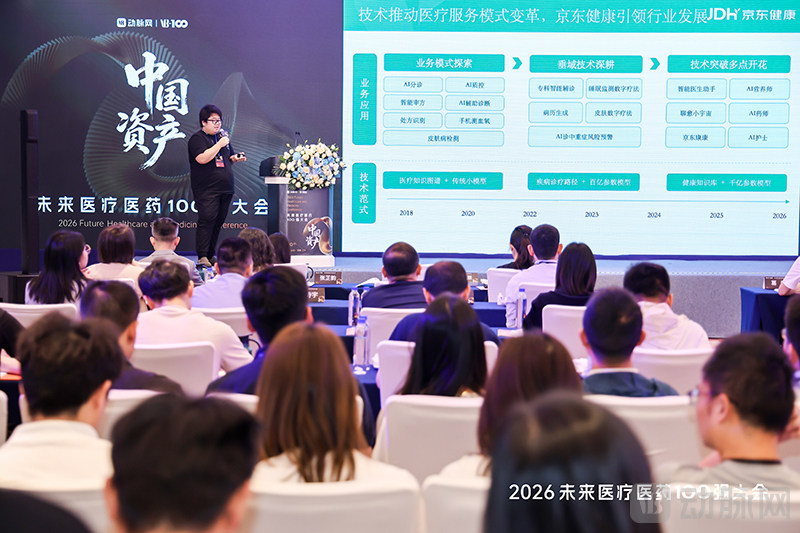 JD Health Showcases AI Application Results
JD Health’s strategy is clear: it consistently adheres to the three core principles of medical feasibility, diagnostic and therapeutic professionalism, and service efficiency, pursuing a pathway grounded in general practice models while deepening expertise through disease-specific models.
Currently, Jingyi Qianxun has established a “Three Engines + Four Models” architecture: the evidence-based data engine, clinical case engine, and doctor-patient interaction simulation engine are employed to conduct trustworthy data training, ensuring the professionalism and accuracy of information at the source; the general practitioner model, specialist model, health agent, and imaging large language model constitute the application core, each tailored to different service scenarios to achieve precise alignment between technology and user needs.
Leveraging this architecture, Jingyi Qianxun possesses three core capabilities—multimodal perception, human-like conversation, and trustworthy reasoning—to support comprehensive healthcare services across all scenarios.
Multimodal perception is a critical capability in healthcare settings. Jingyi Qianxun performs pixel-level image analysis, accurately identifying anatomical structures and lesion regions in brain MRI, endoscopy, ultrasound, and other imaging modalities. Its reasoning logic aligns closely with clinical thinking: it begins with a holistic observation, then focuses on details, and finally integrates multi-source information to draw conclusions, thereby avoiding black-box outputs.
Trustworthy reasoning is the baseline for medical AI. Jingyi Qianxun strictly adheres to clinical diagnosis and treatment pathways, constructing a complete reasoning chain that spans from symptoms to laboratory tests and examinations, imaging recognition, differential diagnosis, and final conclusions. This process is underpinned by tens of millions of medical literature records and a nearly 1-terabyte health knowledge base, ensuring that every conclusion is evidence-based and effectively mitigating the risk of AI hallucinations.
Anthropomorphic dialogue makes interactions more natural, preventing users from perceiving a strong “AI flavor.” By simulating the clinical reasoning process of physicians, AI clarifies patients’ conditions through multi-turn conversations. It not only understands colloquial expressions but also provides evidence-based recommendations, thereby enhancing user trust.
In short, Jingyi Qianxun’s technical approach is to deliver sufficiently professional and accurate information through human-like expression.
Further requirements for practical AI include executable services and closed-loop processes, rather than remaining at the level of question-and-answer interactions.For users, some medical AI systems remain limited to providing consultative advice, leaving them to independently navigate subsequent needs such as clinical consultations, diagnostic tests, and medication purchases. This results in a fragmented experience and suboptimal efficiency.
In recent years, JD Health has continuously refined its closed-loop service ecosystem encompassing medical care, testing, diagnosis, and pharmaceuticals, while deeply integrating AI into every stage to establish a seamless end-to-end pathway from online consultations to offline fulfillment, and from treatment to health management.
JD Health’s AI Jingyi, designed for users, has launched over 1,500 expert AI agents. In April 2026, the AI Jingyi agent cluster underwent a major upgrade, integrating the JD App, JD Health App, and the WeChat ecosystem. Users can now complete consultations, medical diagnoses, tests, medication purchases, and health management through a single entry point without switching between platforms.
Taking the AI physician “Da Wei” as an example, after users raise health-related questions, the system provides professional assessments and directly matches them with follow-up services. If a consultation is needed, users can connect to an internet hospital with one click; if laboratory tests are required, they can schedule rapid at-home testing; if nursing care is needed, nurses are arranged for home visits; and if medication is prescribed, orders are fulfilled through partner pharmacies. This creates a coherent and actionable end-to-end service workflow. In the first three months of 2026, the number of users served by “Da Wei” already surpassed the total for the entire year of 2025, with user stickiness continuing to rise.
In reality, physicians spend a significant amount of time reviewing literature, organizing medical records, and verifying clinical guidelines, which encroaches on the time available for patient diagnosis and treatment.
Addressing pain points in clinical practice and scientific research, JD Health has launched “JD Zhiyi,” a professional evidence-based medicine tool. The “JD Zhiyi” system integrates 40 million medical literature articles, 40,000 clinical practice guidelines, and over 30,000 drug package inserts, with content reviewed and validated by nearly 400 experts from top-tier hospitals.
Currently, “JD Zhiyi” has also added multimodal parsing capabilities, supporting the upload of reports, prescriptions, and medical images to automatically extract key information and reduce manual entry. Its dynamic evidence localization feature automatically matches the basis for conclusions, making diagnoses traceable and verifiable. Meanwhile, the system can integrate patients’ historical consultation records, prescription data, and follow-up information to provide physicians with personalized diagnostic and treatment references.
When AI helps doctors break free from repetitive, administrative tasks, they can devote more time to patients and focus on diagnosis and treatment itself.
On the hospital side, AI focuses on extending the service chain and bridging in-hospital and out-of-hospital care. In 2026, JD Health’s hospital-side product, “JD Zhuoyi,” was upgraded to version 2.0. The most prominent change is the integration of AI with supply chain capabilities, focusing on three key scenarios: clinical nutrition, pharmaceutical services, and weight management, thereby providing patients with comprehensive health management solutions.
In the realm of AI-driven clinical applications, JD Health, in collaboration with the First Affiliated Hospital of Wenzhou Medical University and relevant laboratories under the National Health Commission, has launched an AI-powered standardized management solution for clinical nutrition. Within this innovative framework, AI formulates personalized nutrition plans based on individual patient conditions, while the supply chain ensures a diverse range of product availability, thereby providing patients with long-term, continuous nutritional support.
Therefore,JD Health’s practical AI services are all designed around a patient-centric closed-loop system. By integrating roles such as physicians and hospitals, medical AI truly becomes a foundational tool for enhancing healthcare efficiency and ensuring service continuity.
The practical value of medical AI is reflected not only on the service side but also in its capacity to empower the industry.
An Overview of the Healthcare Industry: The Two Core Sectors of Pharmaceuticals and Medical Devices Are Facing Their Respective Development Bottlenecks. As healthcare reforms continue to deepen and compliance regulations on pharmaceutical marketing become stricter, traditional marketing models are no longer sustainable. Pharmaceutical companies are generally confronted with challenges such as high customer acquisition costs, difficulties in achieving precise outreach, prolonged periods for market volume expansion, weak out-of-hospital patient management, and non-closed data loops. In the medical device industry, homogeneous competition is becoming increasingly fierce, with insufficient product service capabilities and unclear paths for differentiated development, creating an urgent need to explore new growth drivers.
In this regard,JD Health focuses on two major areas—AI + Pharmaceuticals and AI + Medical Devices—and builds a practical AI system based on the urgent needs of pharmaceutical and medical device companies.
Since 2026, JD Health has systematically launched the Yaozhi Model. Built upon the Jingyi Qianxun foundation and integrating 40 million pieces of medical knowledge, 2 million medical entities, and hundreds of millions of user behavior data points, the model creates tools for the entire medication process, providing pharmaceutical companies with digital growth solutions.
Within the product matrix of the Yaozhi Model, three core tools directly serve patients: The AI Pharmacist provides 24/7 medication services, offering symptom assessment and medication recommendations prior to purchase, personalized guidance during the purchasing process, and reminders for refills and follow-up visits after purchase; Yao Xiaozhi records medication habits, customizes medication plans, and provides scheduled reminders to help patients adhere to standardized and consistent medication regimens; The Global Medicine Search Platform leverages knowledge graphs and supply chain networks to rapidly locate scarce medications and facilitate procurement and delivery, thereby reducing the difficulty patients face in finding necessary drugs.
The aforementioned tools not only address the core pain points of medication selection, administration, and precise drug sourcing for patients, but also enable pharmaceutical companies to achieve precise, professional, and sustained patient engagement, leveraging AI capabilities to conduct compliant digital marketing efficiently.
Thus, JD Health leverages the “Yaozhi Model” to develop customized AI systems for pharmaceutical companies, establishing compliant and traceable digital academic promotion platforms. By employing AI digital humans to deliver professional content, precisely target audiences, and push personalized information, JD Health drives business growth.
In the medical device sector, JD Health upgraded its “AI + Medical Devices” strategy in 2026 to promote deep integration of AI with hardware and enhance the overall value of its products. Currently, JD Health has partnered with leading brands such as Yuwell Medical, Cofoe Medical, and iFlytek Medical, collaborating on intelligent product upgrades and innovation in chronic disease management services.
Meanwhile, JD Health is accelerating the deployment of its JoyInside intelligent connectivity system in age-friendly scenarios, integrating home appliances, smart home devices, health monitoring equipment, and service robots. The company plans to connect one million smart devices within one year, covering age-appropriate categories such as wheelchairs, nursing beds, and health monitors. Within three years, it aims to achieve over RMB 20 billion in sales of AI-enabled medical devices, establishing an industry-leading intelligent connectivity ecosystem.
The “AI + Medical Device” model directly enhances product competitiveness by building differentiated advantages through features such as intelligent interaction, data monitoring, and analysis. Taking the world’s first medical device integrated with JoyInside as an example, the Bangbangche “Guardian Star” C30 Ultra AI wheelchair supports voice interaction, remote positioning, geo-fencing, and one-touch emergency calling, better meeting the needs of children providing remote care for their elderly parents.
By integrating practical AI, medical devices can also enhance users’ purchase intent and repurchase rates through AI-driven pre-sales consultation and after-sales operation and maintenance, thereby effectively promoting sales conversion.From the perspective of industry development, AI-integrated medical devices can diversify revenue models, driving the sector’s transition from standalone hardware sales to a long-term health management model that integrates hardware, data, and services, thereby further unlocking growth potential.
As China’s first fully open-source large language model specialized in healthcare, “Jingyi Qianxun” has released its core code and model parameters to dozens of medical institutions and pharmaceutical companies. Leveraging this model, JD Health has established an Intelligent Interconnected Ecosystem Alliance, partnering with medical device manufacturers such as Yuwell and MicroTech to build an integrated “hardware-software-service-ecosystem” framework. Additionally, it has launched the AI Inclusive Healthcare Acceleration Plan to develop dedicated AI agents for primary care medical institutions.
"Openness has become another key keyword for JD Health's practical medical AI."
Medical AI remains in its early stages of development, with an urgent industry need for stronger scenario insights and innovation capabilities. JD Health adheres to a practicality-oriented approach, continuously expanding the coverage of AI applications through open ecosystem initiatives, driving all parties across the industrial chain to share in the technological dividends, and propelling the industry toward greater maturity and inclusiveness.In the future, it is believed that more practical medical AI tools aligned with real-world needs will become an integral part of everyday life.