

Split-Design Innovation Enables Precision Empowerment: Beijing Luhe Hospital's Implantable Port Needle Fixation Patent Successfully Transferred
Recently, Beijing Luhe Hospital Affiliated to Capital Medical University released a public notice on the transformation of scientific and technological achievements, proposing to transfer its “A Fixation Structure for Implantable Port Needles”The utility model patent has been transferred to Shandong Weigao Group Medical Polymer Products Co., Ltd. The transfer fee is40,000 yuan. The inventor of this achievement isXu Na。
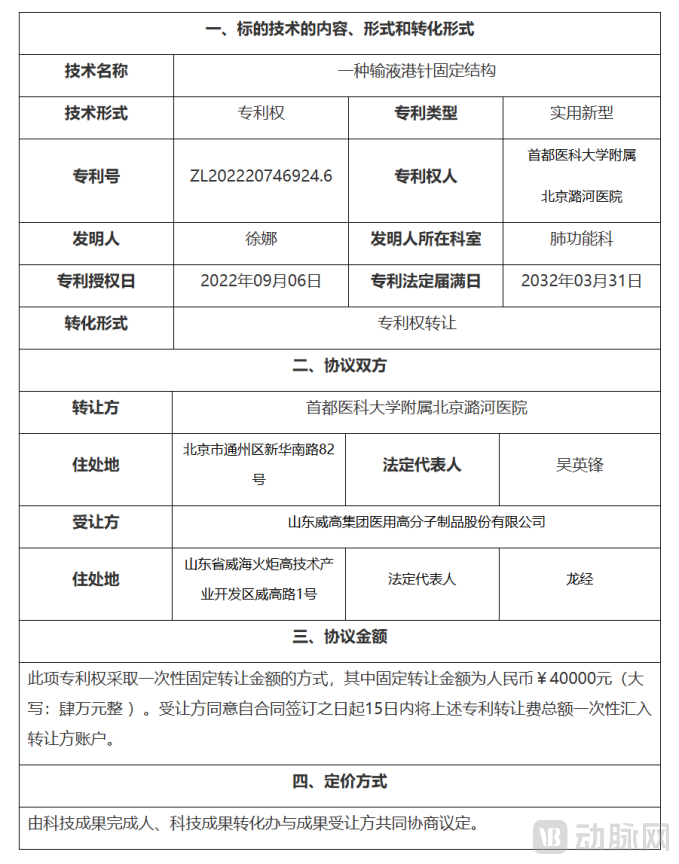
Image source: Official website of Beijing Luhe Hospital, Capital Medical University
“A Fixation Structure for Implantable Port Needles"The utility model patent adopts a split design with a first fixation patch and a second fixation patch to secure the connector and needle hub, respectively. The connector area features a Velcro strap with a预留 opening to accommodate Y-shaped connectors, while the needle hub area uses transparent film combined with butterfly tape to secure the catheter, providing dual restraint against movement and dislodgement. Hypoallergenic breathable medical tape is used, leaving no residue and allowing easy observation, thereby enhancing patient comfort and indwelling safety. This design addresses common issues with traditional fixation methods, such as loosening, poor adaptability, and skin damage, offering a simple structure that is easy to use in clinical settings."
The currently prevalent methods for securing implantable venous access port needles in clinical practice exhibit numerous inherent limitations, failing to meet modern nursing requirements in terms of fixation efficacy, structural compatibility, material safety, and operational convenience. The specific pain points are primarily manifested in the following aspects:
Insufficient overall fixation reliability, prone to loosening and displacement.Traditional fixation methods mostly rely on a single dressing or simple adhesive tape wrapping, without implementing zoned positioning and restraint for the needle hub and connector, resulting in poor overall stability. During daily activities, patients are prone to needle displacement, connector loosening, or even dislodgement, significantly increasing safety risks such as drug extravasation and infusion interruption.
Weak catheter fixation and support, susceptible to external traction forces.The catheter lacks effective fixation and stress-buffering design, allowing external traction forces to be directly transmitted to the puncture needle tip. This can easily cause local pain, needle displacement, or even catheter dislodgement in patients, thereby compromising the safety and clinical stability of long-term indwelling use.
Poor connector adaptability and limited universal compatibility.The fixed structure is not optimized for different types of connectors, resulting in limited compatibility with single-port and Y-shaped dual-port connectors. Insufficient fixation and fit may lead to tubing torsion, compression, or kinking, directly compromising infusion patency and therapeutic efficacy.
Poor skin compatibility, prone to causing local adverse reactions.Traditional fixation materials have poor breathability, tend to leave adhesive residue after application, and can cause skin allergies, redness, and damage due to repeated removal and reapplication. This increases the risk of local infection, complicates nursing care, and heightens patient discomfort.
Clinical operational procedures are cumbersome, which hinders standardized implementation.The fixation process requires multi-layer adhesion and on-site trimming, involving complex and time-consuming steps. This makes it difficult to establish uniform standards, thereby hindering efficient nursing operations and the promotion of standardized clinical workflows.
To address the numerous shortcomings of traditional fixation methods, this patent introduces innovative optimizations across four key dimensions—structure, material, stability, and clinical adaptability—thereby establishing a safe, efficient, and highly adaptable fixation solution for implantable port needles.
Split-Type Targeted Fixation for More Reliable and Precise ConstraintThe design combines a first adhesive patch and a second adhesive patch to achieve segmented fixation of the connector, needle, and catheter. The first adhesive patch consists of a lower layer of medical tape and an upper Velcro fastening strip, specifically designed to secure the connector, effectively preventing torsion and movement. It features a pre-cut opening that perfectly accommodates Y-shaped dual-head connectors. The second adhesive patch utilizes a transparent base film paired with a butterfly-shaped top fastener, specifically designed to secure the needle and the connected catheter. This dual-locking mechanism significantly reduces the risk of catheter dislodgement and minimizes the impact of external traction forces.
Hypoallergenic and breathable, safe and gentle.The lower layer of the fixation dressing utilizes hypoallergenic, highly breathable medical tape that adheres firmly without leaving residue, significantly reducing the risk of skin allergy, damage, and infection. The bottom film is made of transparent material, allowing healthcare professionals to directly observe the puncture site without interfering with daily nursing assessments, thereby enhancing usage safety and patient comfort.
Dual-Point Locking, Long-Lasting Stability.The connector is secured via a wrap-around Velcro fastening mechanism, while the needle hub is affixed using an adhesive film and butterfly catheter fixation, establishing a dual-point stabilization system. This design significantly reduces issues such as loosening, displacement, or dislodgement of the needle and connector. The catheter fixation structure effectively dissipates external tensile forces, preventing direct traction on the needle, thereby enhancing the stability and safety of long-term indwelling use.
Highly versatile, convenient, and efficient.The product is compatible with both single-port and Y-shaped connectors, covering the mainstream specifications of implantable port needles used in clinical practice, thereby offering a wide range of applications. Its prefabricated, integrated design allows for immediate use without on-site trimming, significantly simplifying operational procedures, enhancing nursing efficiency, and facilitating standardized clinical adoption.
Ongoing innovations in patents related to the fixation of needles for implantable venous access ports have led to the development of multiple utility model technologies focused on preventing catheter dislodgement, ease of operation, high compatibility, and enhanced comfort.
Tianjin Medical University Cancer Institute and Hospital"Application forDisposable Implantable Port Access Needle Fixation Device“Utility Model Patent (Publication No. CN223504432U) is a disposable fixation device for implantable port access needles. It adheres to the skin via an adhesive layer, aligning with the implantable port through a circular through-hole. The device employs a first limiting plate, a hollow protrusion, and an insertion post to initially secure the catheter at the tail of the access needle. Secondary locking is achieved through an auxiliary limiting layer, a limiting groove, and a second limiting plate. This dual-fixation mechanism enhances stability, preventing catheter dislodgement and drug extravasation caused by external traction. The device is equipped with a skin-friendly gauze pad for breathability and comfort, and its plug-in structure ensures ease of operation.”
The First Medical Center of the Chinese People's Liberation Army General HospitalShenPlease hire“Implantable Port Needle Dressing“Utility Model Patent (Publication No. CN223555267U), featuring medical non-woven fabric as the main material, with a central sealing area and peripheral adhesive areas, can stably cover and secure the port needle. The proximal end is equipped with two sets of extension tabs and pre-formed seams, forming a semi-circular catheter groove specifically designed to accommodate the port needle catheter, significantly reducing adhesive wrinkles and preventing displacement or needle migration. The sealing area may feature a transparent film for easy observation, and its surface can be designed with a wavy, multi-ridged structure to facilitate reinforced adhesion. The overall design is breathable, conformable, and secure, addressing issues such as insecure fixation, wrinkling, and catheter compression associated with traditional dressings, thereby enhancing the safety of indwelling infusion ports and patient comfort.”
Chongqing Shapingba District Chenjiaqiao Hospital"Application for"Multifunctional Adjustable Port Needle Fixation Device“Utility Model Patent (Publication No. CN222871078U), consisting of a base, connecting tube, protective cover, connecting shell, and limiting mechanism. The needle insertion depth can be adjusted via the limit block and limit slot to accommodate different usage requirements; rapid assembly is achieved through the combination of the protective cover, connecting shell, and Velcro. Gauze at the bottom enhances comfort, while an external transparent dressing ensures secure fixation. The overall design eliminates the need for on-site gauze cutting, offering simple and efficient operation that resolves the cumbersome nature and poor stability associated with traditional fixation methods. It combines adjustability, protection, and ease of use, making it suitable for clinical maintenance of implantable venous access ports.”