

A Blocked Drainage Tube Inspired a $3M Medical Breakthrough: Tongji Hospital's Self-Cleaning Negative Pressure Drainage Device Files for IPO
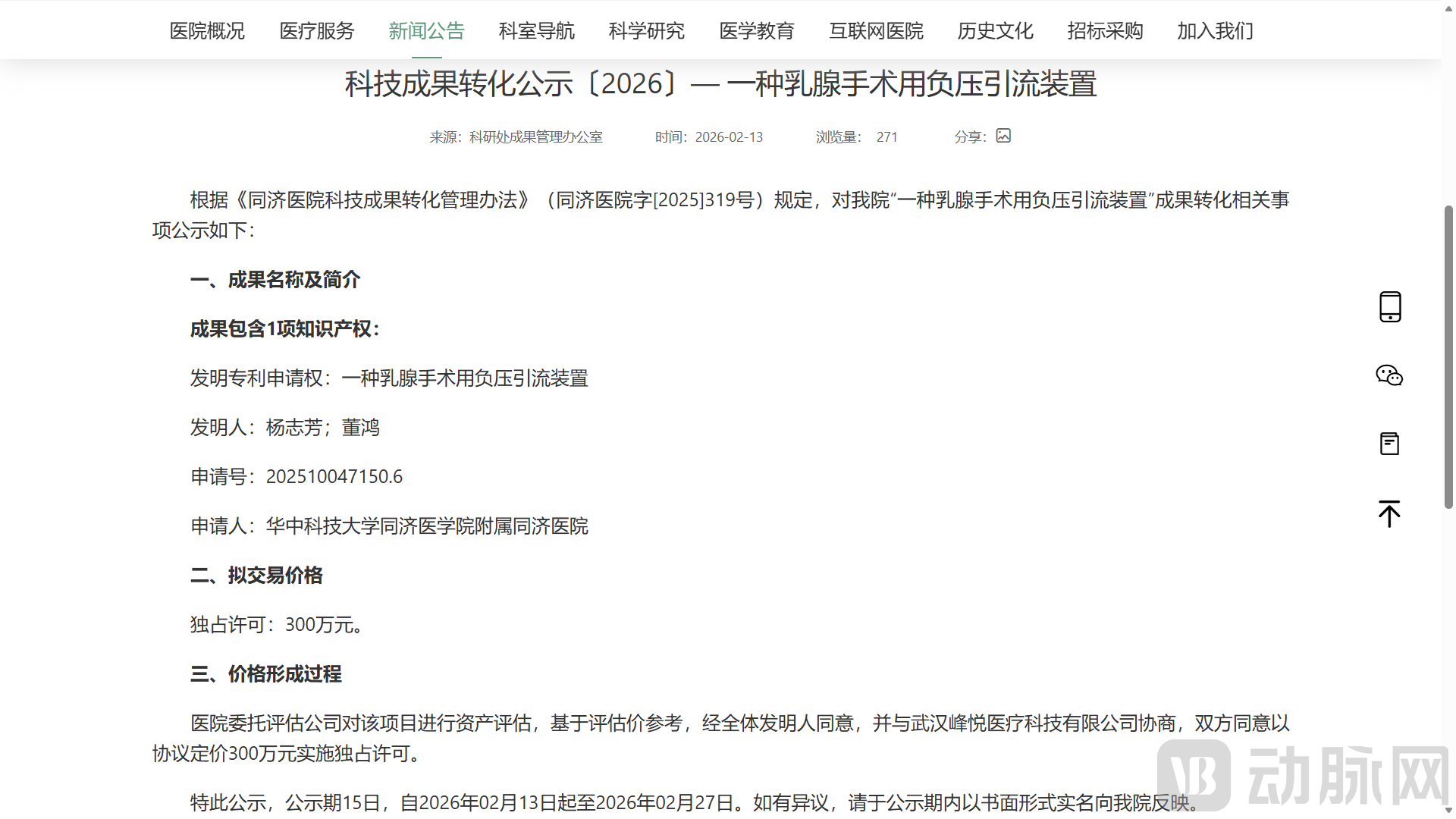
Image source: Official website of Tongji Hospital, Tongji Medical College, Huazhong University of Science and Technology
After breast surgery, drainage tubes are prone to blockage by blood and pus, making them difficult to flush clean or keep patent, which leads to drainage failure, patient discomfort, and impaired wound healing. This patent from Tongji Hospital effectively addresses these issues.
Recently, Tongji Hospital Affiliated to Tongji Medical College of Huazhong University of Science and Technology issued a public notice, proposing to"A Negative Pressure Drainage Device for Breast Surgery"Through negotiation with Wuhan Fengyue Medical Technology Co., Ltd., both parties agreed to set the price by mutual agreement.3 million yuanImplement an exclusive license. The inventor of this patent isYang Zhifang and Dong Hong。
Most individuals who have undergone breast surgery have experienced this difficult period:
A thin drainage tube inserted postoperatively, intended to serve as a “lifeline” for evacuating accumulated blood, pus, and exudate from the wound, often becomes obstructed due to blood crusts and secretions adhering to its inner wall. Once the tube is blocked, fluid accumulation cannot be drained, leading to distending pain at the wound site. Consequently, clinicians are forced to manually strip the tube repeatedly, perform repeated irrigations, or even reposition the drain.
Every bout of manipulation brings piercing pain; every catheter blockage fills one with dread—fear of infection, fear of delayed healing, and fear of enduring additional suffering. This time, however, someone has truly taken this “pain” to heart.
“A Negative Pressure Drainage Device for Breast Surgery” Co-Developed by Yang Zhifang and Dong Hong at Tongji Hospital, It does not involve complex or obscure high technology; it is merely a clever design feature that resolves the most vexing problem.
During use, it first relies on negative pressure to steadily remove accumulated blood and pus from the wound, ensuring effective drainage. When adherents stick to the inner wall of the drainage tube and impending occlusion occurs,The device will automatically initiate the "compression + flushing" mode:The rollers on both sides gently clamp the tube, mimicking the manual action of stripping a catheter. While applying strong compression, they move slowly along the tubing to thoroughly dislodge blood clots and secretions adhering to the inner wall. Subsequently, normal saline is automatically infused to flush the debris into the waste container. This entire process eliminates the need for repeated manual squeezing, frequent flushing, or causing distress to the patient.
From “recanalization after occlusion” to “proactive prevention of occlusion,” this approach eliminates the need for strenuous manual interventions by medical staff and spares patients from enduring severe pain, ensuring a quiet and smooth postoperative recovery. This once again demonstrates that even small innovations can address significant, yet often unspoken, challenges faced by patients.
It is not a disruptive, choke-point technology for the industry, but rather a valuable innovation that addresses critical clinical needs, is embraced by physicians, and is valued by patients.
Breast surgery volumes remain consistently high. As an essential, mandatory, and high-frequency consumable in postoperative care, drainage tubes face sustained and massive demand driven by millions of procedures performed annually across China. Traditional drainage tubes suffer from high occlusion rates, cumbersome nursing requirements, and frequent complications. This device, featuring integrated compression and self-flushing capabilities, directly addresses these critical clinical pain points in one solution—saving time for physicians, reducing workload for nurses, and minimizing patient suffering, thereby ensuring inherently high clinical acceptance.
More critically:The product is classified as a Class II medical device, featuring a streamlined registration process, moderate entry barriers, and limited market saturation. As an essential consumable for postoperative drainage, it facilitates easy hospital adoption, rapid volume growth, and strong repurchase rates. The product avoids complex, high-end technologies, ensuring controllable costs and clear patent ownership.
Without the boom-and-bust hype cycles, there are only small, elegant, specialized, and stable long-term cash flows. Projects that address real problems, stay close to actual clinical practice, and generate reliable revenue may be easier to implement than hollow concepts.