PUMCH's Low-Cost Patent Enables Single-Handed 'Chopsticks Technique' for Neuroendoscopic Surgery: A Breakthrough Device for Solo Surgeon Operation
Currently, with the in-depth implementation of the Healthy China strategy, technological innovation and the translation of scientific achievements in the pharmaceutical and healthcare sectors have become the core support for high-quality industrial development. To address prominent issues such as information asymmetry regarding medical achievements, inefficient matchmaking channels, and low translation efficiency, the China Technology Exchange has joined forces with VCBeat’s Chengguo Bureau. Leveraging the resource advantages of a national-level technology trading platform and professional industry media, this collaboration aims to interpret and promote case studies of translated scientific and technological achievements, establish an authoritative and efficient collaborative platform among medical institutions, research entities, and enterprises, accelerate the practical application of high-quality medical innovations, and empower the innovative development of the pharmaceutical and healthcare industry.
Recently, Peking Union Medical College Hospital addressed the issue regarding its holdings of“Auxiliary Holder and Suction Device for Neuroendoscopy and Method Thereof”Invention patents are traded through the transfer of achievements, and transferee partners are publicly solicited from the society.
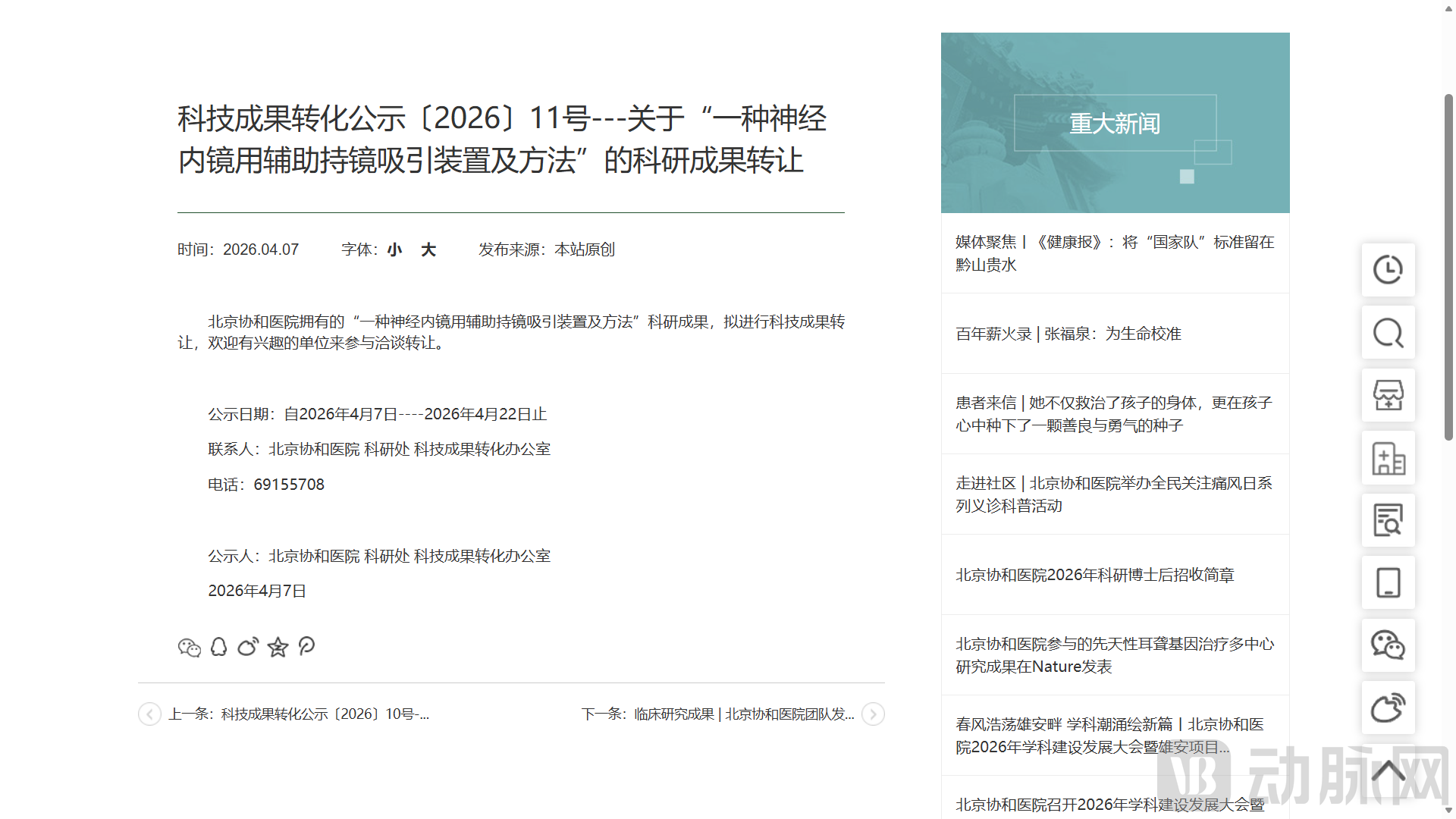
Image from the official website of Peking Union Medical College Hospital
Zhang YiAs the first inventor of this patent, he serves as Assistant to the Director of the Department of Neurosurgery at Peking Union Medical College Hospital and is an Attending Physician. He graduated from the eight-year clinical medicine program jointly offered by Tsinghua University and Peking Union Medical College, holds a Doctor of Medicine (M.D.) degree, and is a member of the Pituitary Disease Innovative Diagnosis and Treatment Center at Peking Union Medical College Hospital. He also served as a Visiting Scholar at Stanford University in the United States. He has been long engaged in clinical and basic research on sellar region diseases and rare intracranial tumors such as germ cell tumors. He has presided over and participated in multiple research projects, published more than 20 academic papers, and obtained several related patents.
First, let me provide some basic information for everyone.NeuroendoscopyAs a minimally invasive surgical instrument, it can position the light source near the surgical field, providing superior illumination for clinical procedures without the need for repeated focusing. Meanwhile, it enables high-resolution intraoperative imaging, supporting both panoramic and close-up observation, and clearly delineating the boundaries between pathological and normal tissues.
Currently, neuroendoscopic surgery is rapidly advancing in the field of neurosurgery and is widely applied in the treatment of various neurological conditions, including ventricular and skull base disorders, intraparenchymal hematomas, pineal region tumors, and microvascular decompression.
In existing clinical protocols, requirements for endoscopic working conditions existOperating Channel and Cavity, the channel is used for the endoscope to pass through. The cavity may exist naturally, or it may be caused by disease or created surgically. The cavity must have sufficient space to ensure that the endoscope can visualize surrounding structures and allow safe and effective surgical maneuvers within it.
In the early days, endoscopy primarily served an auxiliary observational role and could be performed by a single operator using a single scope. With technological advancements and the gradual expansion of its applications, the current mainstream approach involves a "two-person, four-hands" technique, where the surgeon and assistant work in tandem: the assistant holds the endoscope and performs irrigation, while the surgeon manipulates the instruments. This surgical method requires both the surgeon and the assistant to possess sufficient professional knowledge and endoscopic training, as well as to maintain close coordination, to ensure the successful execution of the procedure.
Therefore, there is an urgent clinical need for an auxiliary device that overcomes the aforementioned limitations. Such a device should enable efficient single-operator use, reduce reliance on surgical assistance, and avoid the high costs associated with equipment upgrades, thereby enhancing surgical efficiency and ensuring patient safety.
The core advantages of the patents proposed for transfer in this instance lie inAchieved high-level human-machine adaptation through the control adjustment mechanism.. The device incorporates a linkage system within the finger shell, comprising springs, an arc-shaped frame, and connecting rods, which automatically adjusts the position of the compression block to accommodate varying finger thicknesses among different physicians. This design enables the physician’s non-dominant hand to stably manipulate the endoscope using the index, middle, and ring fingers, achieving a snug fit between the fingers and the finger holes. Consequently, it ensures stability and safety during endoscope holding in single-operator mode, perfectly replicating the operational logic of the “chopsticks technique.”
In terms of instrument fixation and adjustment, the device demonstrates exceptional flexibility and adaptability.It features a unique clamping mechanism that utilizes a system composed of an inclined block, a spring, and an elastic wheel to secure the suction device. By simply pressing the pressure block with the thumb joint, the locking mechanism can be released, allowing for rapid and smooth adjustment of the suction device’s depth and position. This ensures the device can promptly enter the endoscopic field of view to assist in procedures, significantly enhancing the convenience of intraoperative adjustments.
Furthermore, when installing the neuroendoscope lens,The device is secured using screws equipped with pressure sensors.. The sensor is electrically connected to the built-in controller and status indicator light, enabling real-time monitoring of screw insertion depth. In the event of abnormal pressure, the status light provides an early warning, thereby preventing damage to expensive endoscope lenses caused by over-tightening.
In summary, this mechanical structure integrated with an electronic feedback mechanism provides neurosurgeons with a low-cost, high-safety single-operator endoscopic surgical solution.
The global market for neuroendoscopic surgical instruments continues to expand,Minimally Invasive, Single-Operator, High-EfficiencyIt has become a core development trend in the industry, yet the clinical mainstream still predominantly relies on the combination of split-type neuroendoscopes and independent suction instruments. The current domestic market is dominated by general-purpose suction devices and basic endoscopic accessories, while original integrated specialized devices featuring adaptive adjustment, safety warnings, and rapid locking mechanisms remain scarce. High-end auxiliary instruments are heavily dependent on imports, and homogenized competition is evident among mid- to low-end products. There is a clear and urgent clinical demand for auxiliary scope-holding and suction devices that are simpler, more stable, and highly compatible.
STrattner Chopsticks Neuroendoscopic Instrument Set is an integrated surgical instrument combination specifically developed for the "chopstick technique" in neuroendoscopy.The product is designed to meet the needs of minimally invasive neuroendoscopic surgery, enabling single-handed simultaneous control of the endoscope and suction-related instruments. Its overall configuration is adapted for single-nostril and narrow-channel operative scenarios. This neuroendoscopic instrument set is primarily used for transnasal endoscopic skull base surgery and is also suitable for endoscopic procedures involving the ventricular system. It has already been adopted for clinical use and academic promotion in numerous major neurosurgical centers and specialized skull base surgery institutions both domestically and internationally.
The Medtronic Midas Rex® Neuroendoscopic Suction/Irrigation System is a complementary set of surgical instruments designed for minimally invasive endoscopic neurosurgical procedures.This system integrates suction and irrigation functions to maintain a clear surgical field during procedures. It is designed for endoscopic scenarios involving drilling and resection, with an overall structure that aligns with clinical operational habits. The system is compatible with mainstream neuroendoscopes and surgical power devices. It is primarily used in various neuroendoscopy-assisted minimally invasive surgeries, covering clinical applications such as skull base lesion management, ventricular surgery, intracranial lesion resection, and spine-related endoscopic procedures. Thanks to its strong compatibility with the brand’s comprehensive neurosurgical solutions, this system has been widely adopted in neurosurgery departments across medical institutions at all levels, both domestically and internationally.
Therefore, against the backdrop of rising penetration rates for neuroendoscopic surgery, accelerated innovation in domestically produced medical devices, and the continued decentralization of healthcare resources, the technology proposed for transfer herein can fill the market gap for high-end specialized auxiliary instruments in China. It demonstrates strong clinical applicability and promotional value, boasts broad prospects for commercial translation and scaled application, and is poised to become a competitive innovative product in the field of minimally invasive neuroendoscopy.