Deep Dive | 2026 Researcher Insights Report (With Download)
Amid a macroeconomic environment fraught with uncertainty, budget allocation in the scientific research market and user procurement habits are undergoing profound, subtle transformations.DXY and DXY BioMart Jointly Release the "2026 Researcher Insights Report"The report is based on1,843 individualsQuantitative surveys and qualitative interviews with researchers aim to authentically capture behavioral trends in their work and study, information acquisition, product procurement, and AI usage, while exploring the underlying logic behind these behaviors to deepen our understanding of researchers.

Scientific research is a task that demands both mental and physical exertion. Online research has become a frequent norm, and research needs are quietly evolving.
A Research Ecosystem Characterized by Coexisting High Intensity and Fragmentation
The report shows that more than half of researchers spend over 6 hours per day on scientific research, with 29% spending more than 8 hours daily.Among them, higher education institutions and research institutes remain the main force in life sciences research.In contrast, research time in hospitals is influenced by clinical workflows, exhibiting a highly fragmented nature.
The Evolution of Demand: From “Literature Review” to “Practical Application”
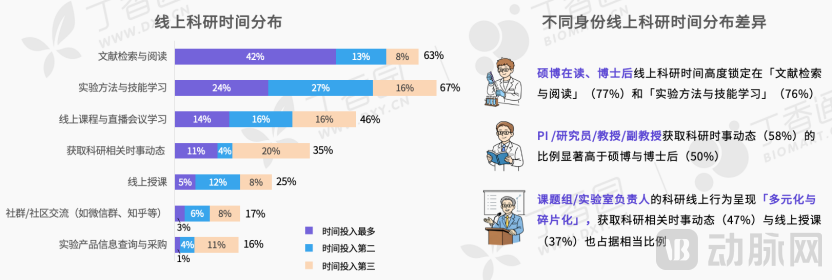
In the allocation of time for online scientific research,"Literature Search and Reading" continues to dominate,42% of researchers devote the most time to this area. ButThere is a broader demand for learning experimental methods and skills,This indicates that researchers not only need to read literature and understand theories, but also urgently need to address the practical challenge of "how to conduct experiments."
Channels for accessing academic and product information have become thoroughly decentralized, with traditional channels and emerging platforms reshaping customer perceptions.
The Core Status of Traditional Literature Databases and the Surge of AI Tools
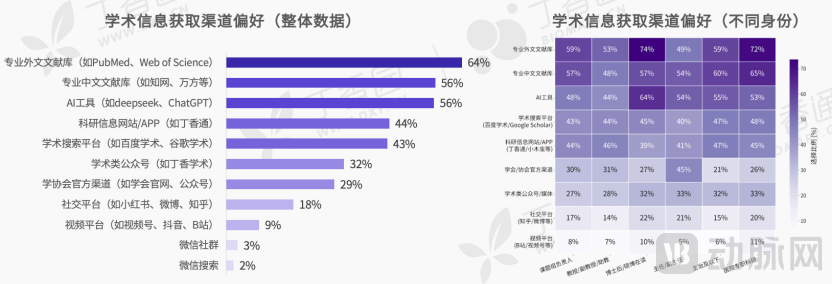
In terms of accessing academic information, specialized foreign-language literature databases (64%) and Chinese-language literature databases (56%) remain the “infrastructure” of scientific research. Furthermore,The penetration rate of AI tools has climbed to 56%, making them a key gateway for accessing academic information.
From the perspective of different identity groups,The literature database is the primary gateway for accessing academic information,Differentiation is more evident in the choice of channels, such as AI tools, official channels of academic societies/associations, and social media platforms.
"Acquaintance Recommendations" and "Platform-Driven Product Seeding" for Product Information Acquisition
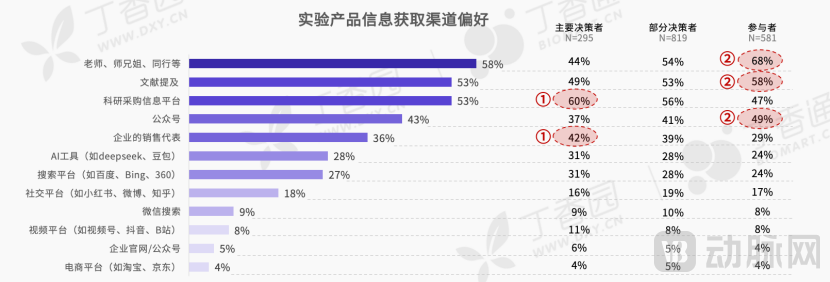
The top three channels for obtaining information on experimental products are recommendations from professors, senior students, or peers (58%), mentions in literature (53%), and scientific research procurement information platforms (53%).
For ordinary procurement participants, acquiring information relies more on peer recommendations (68%) and literature mentions (58%). However, forKey decision-makers in procurement are significantly more likely than other groups to obtain product information through scientific research procurement information platforms (60%) and enterprise sales representatives (42%).
Scientific procurement differs fundamentally from routine consumption, as it is an evidence-based process centered on the reliability of experimental results.
Laboratory Research Funding Remains Stable Overall
Overall, laboratory research funding has shown a trend of steady growth. Funding for 37% of laboratories remained flat compared to last year, while 27% saw an increase, with 7% experiencing a rise of more than 50%.
Decentralization of Procurement Authority, Exhibiting a “High-Frequency, Low-Value” Pattern
The report shows that approximately 60% of scientific researchers have a certain degree of autonomy in procurement.The focus is mainly on categories such as general consumables (50%) and common chemical/biochemical reagents (48%).In terms of amount,Laboratory products under RMB 10,000,60% of researchers with purchasing authority can make independent purchases. This exhibits typical characteristics of high frequency and low average transaction value.
The Impact on Procurement Decisions: Building an Information Foundation with Data
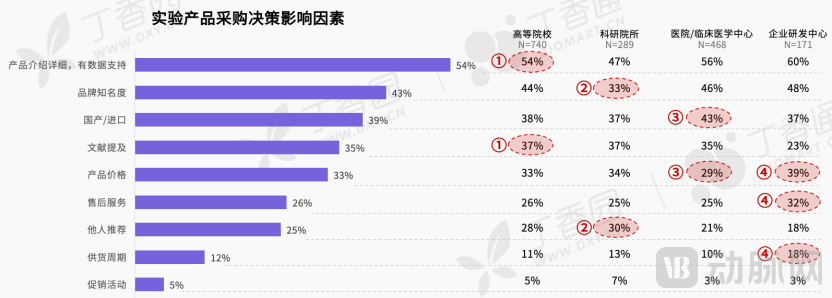
In the procurement decision-making logic of researchers, experimental reliability is far more critical than price incentives:54% of researchers consider “detailed product introduction with data support” as the primary factor of concern,Brand awareness (43%) ranks second.
In contrast, the overall attention paid to product price is only at a moderate level (33%), while promotional activities have a relatively weak impact on decision-making (5%). This rational approach to decision-making may stem from caution regarding the costs of trial and error.
Domestic substitution has been one of the main themes in the industry in recent years. Data from the report reveals the market’s pragmatism and rationality. Domestic substitution is not something that can be achieved overnight with mere slogans; significant differences exist across product categories and among various institutions.
Reagents and Consumables Accelerate Replacement, While Core Instrument Barriers Remain
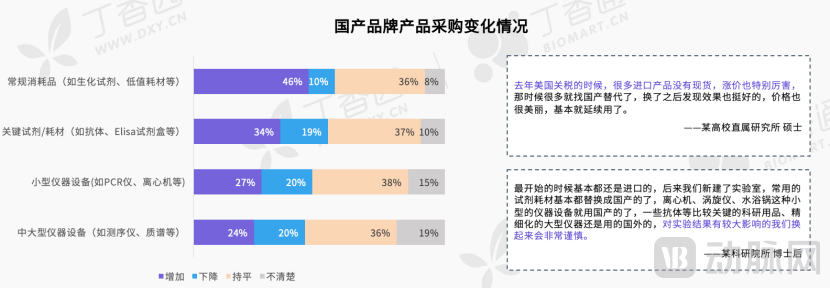
Routine consumables (such as biochemical reagents and low-value disposables) are the earliest and most accessible areas for domestic substitution in China. Forty-six percent of respondents reported increased procurement of such domestically produced products, followed closely by key reagents (such as antibodies), with 34% reporting increased purchases. This indicates thatIn sectors with low entry barriers and relatively low trial-and-error costs, supply chain disruptions such as shortages and price hikes have significantly accelerated the process of domestic substitution.
When it comes to medium- and large-scale instruments and equipment (such as sequencers and mass spectrometers), only 24% of researchers reported an increase in the procurement of domestically produced brands.Researchers are relatively cautious about replacing such precision equipment, which has a decisive impact on experimental results and comes with a high unit price.
Institutional Differences: Universities Embrace Change, Hospitals Prioritize Stability
Different institutions have varying attitudes toward the substitution of domestic products for imported ones.Higher education institutions have played the role of “vanguard” in the process of domestication.For routine consumables and critical reagents, universities have increased the proportion of domestically sourced procurement by as much as 51% and 40%, respectively, far exceeding the average level. The hospital system is more conservative in procurement and exhibits higher sensitivity to the domestic versus imported origin of products.
Artificial intelligence is reshaping scientific research workflows at an unprecedented pace; it is no longer merely an auxiliary tool but is evolving into a fundamental research infrastructure.
AI hasDeeply Embedded in the Core Stages of Scientific Research
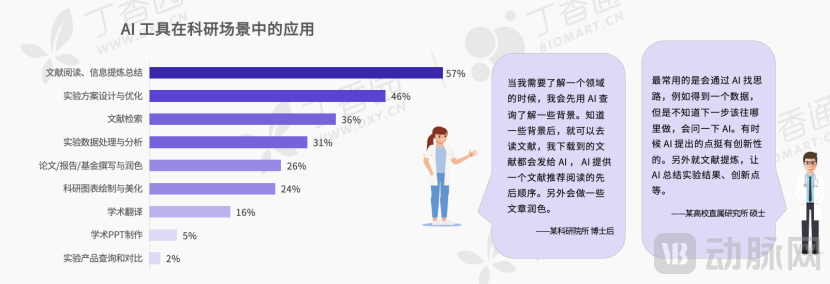
Currently, literature review and information extraction (57%), experimental design and optimization (46%), and literature search (36%) have become the three research scenarios with the deepest AI penetration, marking its substantial involvement in the intellectual labor of scientific research.
Despite the surge in AI applications, concerns persist. Data privacy and security (70%) and academic compliance (69%) are the primary concerns among researchers. Furthermore, more than half (54%) of users remain skeptical about the accuracy of AI-generated results.
To learn more about the behaviors and attitudes of Chinese researchers, scan the QR code below to add our Enterprise WeChat account and reply with “Research Report”.Get the full version of the "2026 Researcher Insights Report" for free for a limited time.