

A Smart Wireless Medical Footswitch Circuit and Device: Solving the Overlooked Pain Points at the End of Clinical Control Chains
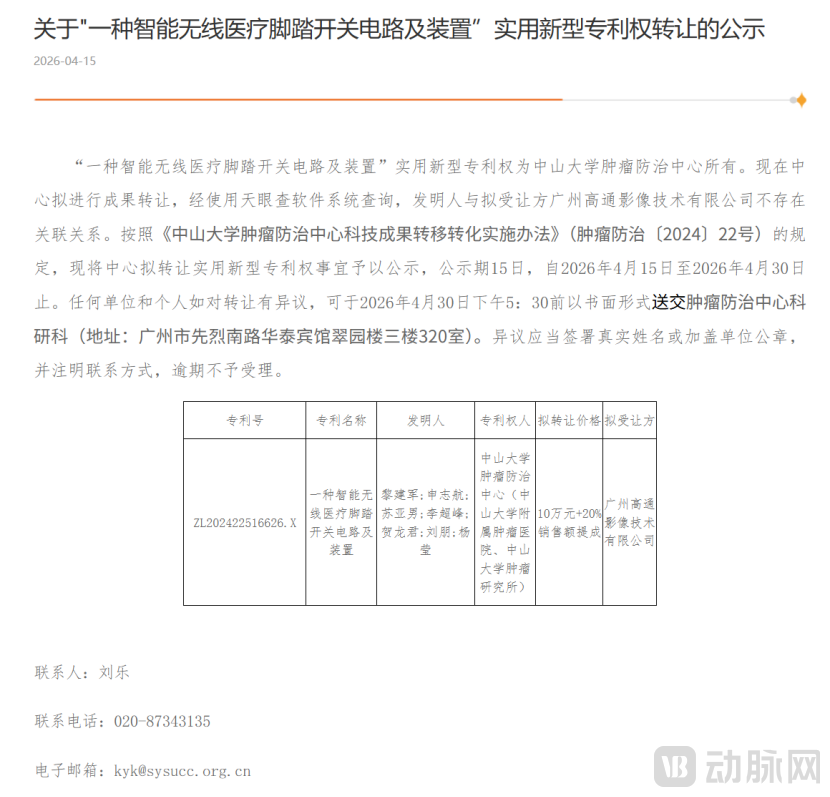
Image from the official website of Sun Yat-sen University Cancer Center
Foot Switch: The Final Link in the Medical Device Control Chain.
In operating rooms and endoscopy centers, it is often buried beneath floor cables and piles of equipment. A simple foot press from the physician freezes the screen display or activates water irrigation—that is all. No one gives it special thanks after a successful procedure, yet its malfunction or inconvenience can directly impact the pace and fluidity of an endoscopic examination.
A recent patent transfer announcement by the Sun Yat-sen University Cancer Center has drawn attention to this “small incision.” The Center has transferred its held"A Smart Wireless Medical Foot Switch Circuit and Device"The utility model patent has been assigned to Guangzhou GaoTong Imaging Technology Co., Ltd. at a transfer price ofRMB 100,000 base fee plus 20% commission on sales。
The inventors are Li Jianjun and his team.
In terms of monetary value, this does not qualify as a large-scale transaction. However, if we broaden our perspective to examine the current realities of clinical practice, the wave of innovation in domestically produced minimally invasive medical devices, and the hurdles that must be overcome to translate scientific achievements from the laboratory to the operating room, the rationale behind the transfer of this “small tool” may well warrant careful analysis.
In medical device control systems, the foot switch is a typical "functional accessory"—it does not diagnose, image, or treat; its purpose is to assist physicians in issuing command inputs to the primary equipment.
For this reason, its optimization has long remained in the “marginal zone.”
The first layer of pain points is physical.
The cables of traditional wired foot pedals are constantly dragged along the floor. In endoscopy centers or operating rooms, the spatial arrangement among foot pedals, surgeons, assistants, and equipment is already compact; cable entanglement can directly obstruct the surgeon’s movement path. This issue is particularly prominent in procedures with extremely limited operational space, such as neurosurgery and ventricular surgery—where an accidental trip over a cable may disrupt the entire surgical workflow.
Cables also introduce another hidden risk: blind spots in cleaning and disinfection.Foot pedal cables tend to accumulate patient body fluids and contaminants from healthcare workers’ gloves in their crevices, while existing disinfection methods struggle to achieve comprehensive and thorough sterilization of these cables. Amid continuously escalating requirements for nosocomial infection control, this has long been an overlooked vulnerability.
The second major pain point is at the functional level.
Modern endoscopy centers commonly involve scenarios requiring coordinated operation of multiple devices. A single gastrointestinal endoscopic examination may necessitate simultaneous control of multiple functions, such as image capture by the main unit, water irrigation and air insufflation by the pump, and light source adjustment, each corresponding to separate foot pedals positioned at different locations on the floor. During procedures, physicians must look down to confirm pedal positions and execute precise steps, repeatedly shifting their gaze between the patient and the foot pedals. While this action may only account for a few dozen seconds per individual examination, the cumulative cognitive load becomes significant when considering daily volumes of dozens of procedures and annual totals reaching thousands.
Accidental stepping and inadvertent touching constitute another layer of risk. When multiple foot pedals are arranged in parallel, a physician may press the wrong pedal during high-pressure procedures, potentially triggering the wrong device or transmitting incorrect commands. While such risks are relatively controllable during endoscopic examinations, the consequences can be far more severe in surgical settings.
The third major pain point lies in system compatibility.
Traditional foot pedals adopt a "one-to-one" fixed configuration, where one switch corresponds to a single function of a device. When new equipment is added or existing devices are upgraded within a department, it is often necessary to replace or add foot pedals accordingly, resulting in considerable adaptation costs for the entire control system. Against the backdrop of widespread cost pressures in medical equipment procurement, the "good enough" mindset has long led to the postponement of foot pedal upgrades.
These three compounding pain points are prevalent across multiple departments, including endoscopy, surgery, and imaging; however, products that systematically address them from the perspective of clinical user experience remain relatively scarce in the Chinese market.
According to the public disclosure, the core innovation of this patent lies in the restructuring of control logic, rather than a mere change in hardware form.
At the circuit level, the device identifies the duration of pedal actuation via a built-in timer, expanding the simple “pressed/not pressed” signal into composite commands with temporal characteristics. Short press, long press, double-click, and triple-click correspond to different control instructions, enabling coordinated control of multiple devices with a single foot pedal.
The value of this design lies in: It does not require changes to the host’s control protocol; instead, it achieves signal-level “multiplexing” at the foot pedal end—replacing multiple pedals with a single one, thereby physically reducing the number of floor-mounted foot pedals and the risk of accidental activation.
At the communication levelThe device utilizes multiple wireless communication protocols, including Wi-Fi, Bluetooth, and LoRa. This directly addresses the physical barriers posed by cables: with no exposed wiring, there is no risk of entanglement or tripping, nor are there hard-to-clean crevices where dirt and germs can accumulate. The split-shell design, combined with an elastic reset mechanism, ensures both ease of cleaning and optimal tactile feedback from a mechanical perspective.
At the power supply level, the rechargeable battery solution eliminates the device’s dependence on mains wiring, while its wireless portability enhances flexibility across various usage scenarios—a benefit that is particularly pronounced in mobile diagnostics and temporary equipment deployment.
Overall, the core logic of this solution is to upgrade the foot pedal from a single-function accessory to a control terminal with intelligent recognition and multi-channel output capabilities, while simultaneously addressing cleaning and safety issues caused by physical connections through wireless technology.
Utility model patents typically undergo a shorter examination cycle, offer weaker protection than invention patents, and focus primarily on structural improvements with secondary emphasis on theoretical breakthroughs. This positioning renders such patents highly convertible, but it also means that their commercialization must overcome three hurdles: transitioning from "technical feasibility" to "mass production" and finally to "procurement readiness."
The first hurdle is engineering and reliability.
Utility model patents protect structural designs, but the engineering process involves multiple stages, including component selection, mold development, anti-interference design, battery safety, and waterproofing. In particular, medical scenarios demand far higher equipment reliability than consumer electronics—a malfunction of a foot switch can disrupt an entire examination procedure, and in severe cases, compromise patient safety. Quality control in engineering represents the critical leap from prototype to product.
The second hurdle is clinical fit and physician acceptance.
Foot pedals are a classic example of products where users “vote with their feet”: the switching cost for operators is extremely low, allowing them to revert to traditional solutions at any time if dissatisfied. This necessitates that new products must match or even surpass existing ones in key experiential dimensions—such as tactile feedback, response speed, and command accuracy—to truly become integrated into the clinical workflow loop.
Furthermore, variations in control protocols and signal definitions exist across endoscopic devices of different brands and models. The ability of a product to achieve robust compatibility directly determines the breadth of its market adoption.
The third hurdle is in-hospital procurement and channel penetration.
Equipment procurement in public hospitals in China generally relies on centralized bidding and catalog management. Introducing new product categories into the procurement catalog requires navigating complex processes, including feasibility studies, approvals, and tendering, while the decision-making chain involving department heads, equipment departments, and hospital leadership is lengthy. For “small accessories” such as foot switches, although the unit value is limited, the costs associated with channel development and market access are by no means low.
If we shift our focus away from this specific patent, a more worthy topic of discussion is:What Role Do Clinical “Gadgets” Play in the Overall Medical Device Innovation Ecosystem?
In recent years, attention to medical device innovation has largely focused on "major categories" such as high-end imaging equipment, surgical robots, and vascular interventional devices. These fields are characterized by high technical barriers, substantial market potential, and significant media exposure, making them popular directions for capital investment and industrial strategic layout.
However, real clinical needs often extend beyond "large equipment."
The success of a surgical procedure depends not only on the surgeon’s technical expertise and the precise execution of the robotic system, but also on the scrub nurse’s rhythm in passing instruments, the lighting technician’s adjustment of light angles, and the foot pedal’s ability to accurately activate the intended function when needed by the surgeon.
The improvement in clinical efficiency is the result of a series of cumulative "terminal optimizations."A convenient, reliable, and intelligent foot pedal may not become the focus of media coverage, but it can tangibly reduce physicians’ operational burden, lower the risk of healthcare-associated infections, and improve equipment utilization efficiency. While these benefits are often undervalued in healthcare service quality assessment systems, every end-user perceives them directly in daily clinical practice.
From clinical pain points to technical solutions, from engineering to commercial implementation, and from single-product innovation to ecosystem synergy—each stage has its own barriers and underlying logic. The problem-solving approach offered by Li Jianjun’s team centers on redefining an overlooked terminal accessory through intelligent control logic, a strategy that is logically self-consistent.
As for whether this path will prove viable, the market will provide the answer.