

Yutai Xin Medical Acquires Operating Room Needle Locator Patent from Beijing Shijitan Hospital for RMB 110,000
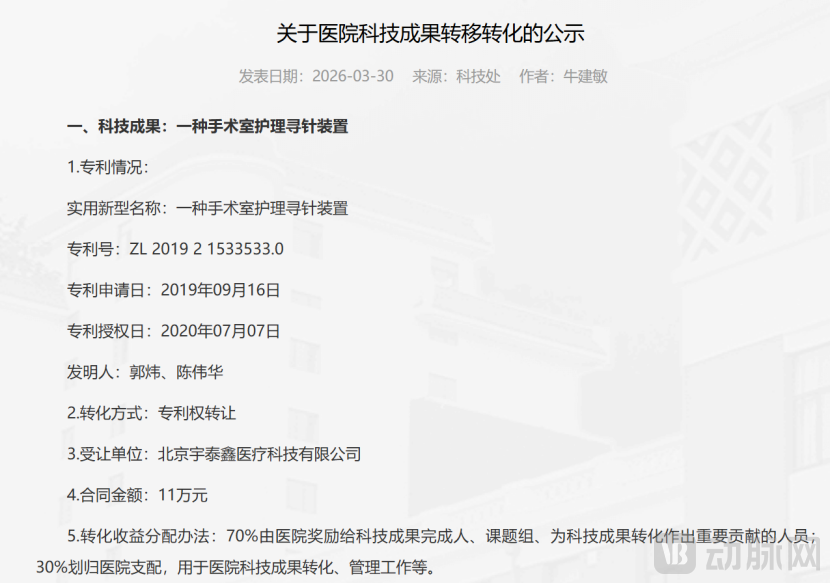
Image from the official website of Beijing Shijitan Hospital, Capital Medical University
Recently, Beijing Shijitan Hospital, Capital Medical University, released a public notice on the transfer of scientific and technological achievements, proposing to assign its utility model patent titled "A Needle-Finding Device for Operating Room Nursing" to Beijing Yutaixin Medical Technology Co., Ltd., with a transfer price of110,000 yuan. The inventors are Guo Wei and Chen Weihua.
If a suture needle is dropped in the operating room, the traditional approach involves searching for it with the naked eye while lying on the floor, or using a simple magnet to pick it up bit by bit while squatting.
The core innovation of this patent is the “detachable dual-module + dual magnetic adsorption” design—the base, equipped with omnidirectional wheels, enables wide-area ground navigation for needle detection; the bedside needle-detection module can be detached independently for precise magnetic attachment in confined spaces such as operating tables and hospital beds. Details such as the rotating platform, telescopic rod, and rubber-edged casing are all designed to reduce physical effort for nursing staff, prevent equipment damage, and save time.
Simple structure, low cost, and easy to promote—these are its most direct advantages.
It’s not that no one is working on this product category. The issues with existing products are concentrated in the following areas:
Single scenario.Most devices can only operate on flat, level surfaces; if a suture needle falls under the operating table or into gaps between instruments, it must be retrieved manually through painstaking searching.
Complex structure.High integration entails high costs and difficult maintenance, resulting in low willingness among primary healthcare institutions to adopt these systems on a large scale.
The procedure is cumbersome.The integrated fixed structure cannot be flexibly disassembled; locating needles on the operating table requires additional auxiliary tools, which prolongs counting time and affects surgical workflow efficiency.
Lack of protection.The metal edges are not hemmed, making it easy to scratch the tabletop when pushing the equipment, and they can get stuck if inadvertently caught on the guardrails.
These pain points may seem minor, but in the race-against-time environment of the operating room, each one has the potential to disrupt workflow.
Based on the disclosed information, this patent has been improved across four dimensions:
Dual modules are detachable.The base and mattress modules detach magnetically: one configuration covers floor-level areas, while the separated units fit into narrow spaces. Switching between modes requires no additional tools.
Dual magnetic coverage.The omnidirectional wheels and secondary magnetic plate at the base of the pedestal are responsible for ground navigation; the primary magnetic plate on the bed surface module ensures precise adhesion, while the outer rubber bumper prevents scratching and accidental suction.
Flexible Adjustment.Rotary base and telescopic rod allow adjustment of angle and length to accommodate different operating postures; detachable pull rod and hanging ring design facilitate storage.
Low cost."Standard materials and simplified structure ensure controllable manufacturing and maintenance costs, making it suitable for bulk deployment in hospitals at all levels."
Utility model patents themselves have limited technical barriers and bargaining power, with 110,000 yuan being within the same category of scienceIt falls within the normal range for technology transfer and commercialization. If Yutaixin Medical can subsequently develop its products and successfully list them in hospital procurement catalogs, the profit margin will lie in the distribution channels rather than in the patents themselves.
Inventors Guo Wei and Chen Weihua hail from the front lines of clinical nursing at Beijing Shijitan Hospital. Inventions such as these, "developed by healthcare professionals through their daily work," are highly practical and address genuine needs, yet they often lack the capacity and resources for large-scale promotion. Transferring the rights to specialized companies for commercialization represents a more rational division of labor.