A Simple Oral Gavage-Based Patent for Acute Lung Injury Modeling Licensed for RMB 50,000
In recent months, the First Affiliated Hospital of Henan University of Science and Technology has been promoting its independently developed invention patent“A Method for Establishing an Animal Model of Acute Lung Injury”Carry out the work of achievement transformation, with patent assignment as the transaction type, and intend to formally assign the patent technology to Shanghai Kewu Technology Co., Ltd., with the assignment amount beingRMB 50,000。
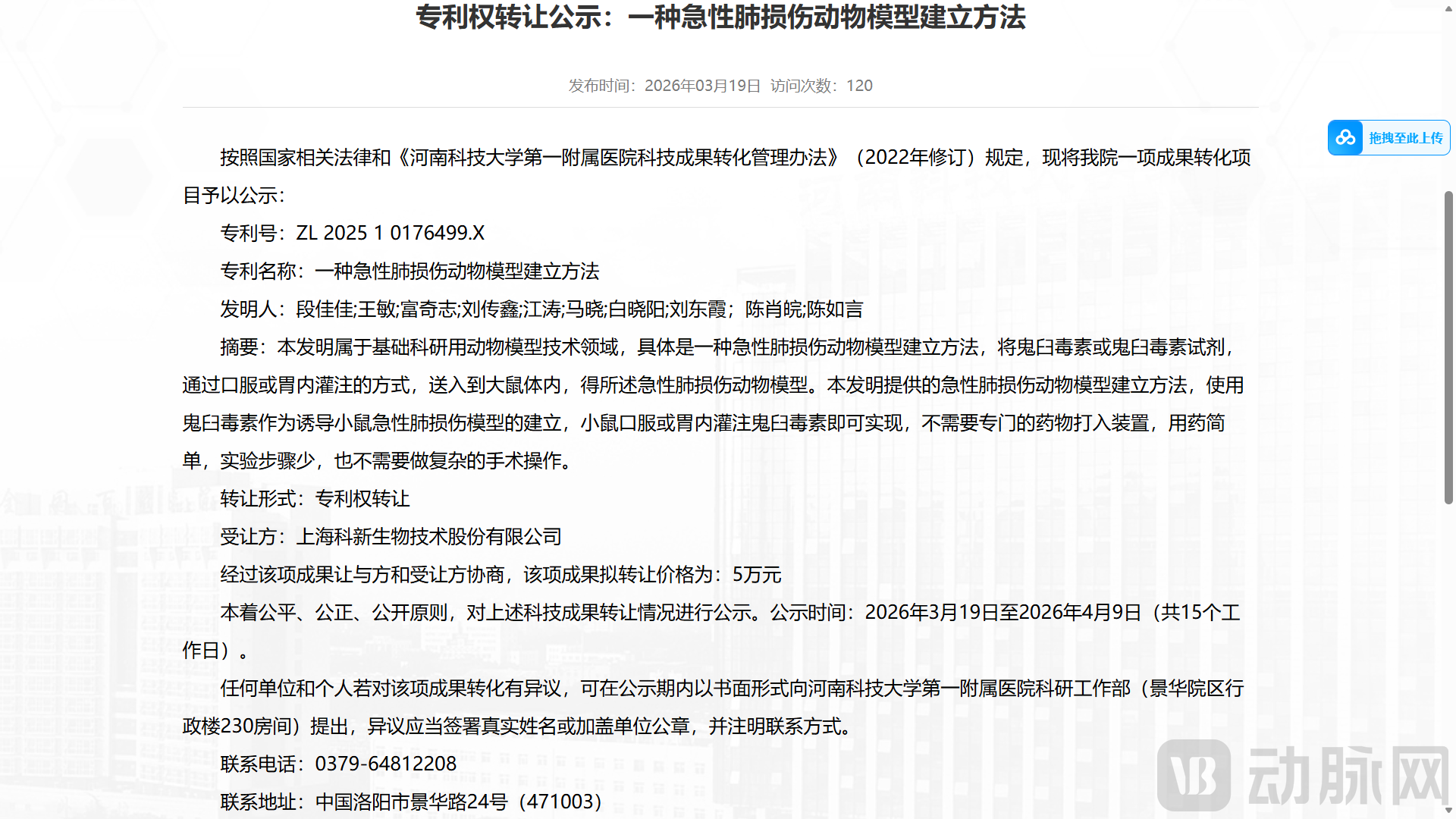
Image from the official website of the First Affiliated Hospital of Henan University of Science and Technology
The core technology of this patent isConstruction of a Rat Model of Acute Lung Injury via Oral Administration or Intragastric Infusion of Podophyllotoxin, breaking through the limitations of traditional modeling that require specialized instruments, complex surgeries, and multi-step induction. It offers technical innovations such as ease of drug administration, rapid operation, high model stability and reproducibility, controllable toxicity, and closer alignment with the clinical features of drug-induced lung injury. This technique can be directly applied to mechanistic studies of acute lung injury and the development of related drugs, representing an animal model construction technology with significant scientific research and translational value.
Acute Lung Injury (ALI)It is a clinical syndrome triggered by multiple pathogenic factors, with its core pathological feature being injury to alveolar epithelial cells and capillary endothelial cells. Clinical manifestations include decreased lung compliance, hypoxemia, and even progressive respiratory failure.
Currently, the scientific research community frequently constructs rat models of acute lung injury (ALI) based on common clinical pathogenic factors.Major strategies include the LPS-ALI model constructed using immune factors (such as LPS), the smoke exposure model simulating environmental factors, and the endotoxin model based on pathogenic factors.However, these models often fail to fully recapitulate all features of human acute lung injury (ALI). Furthermore, due to differences in pulmonary structure and responses to stimuli between humans and animals, the application of existing models in targeted drug development and mechanistic studies is limited.
Meanwhile, the existing specific modeling techniques all have significant operational flaws and safety risks.For example, although the method of establishing a model using ricin is effective, its extreme toxicity and potential for misuse pose significant risks. Furthermore, this approach requires the use of a handheld liquid aerosol pulmonary delivery device to administer the toxin intratracheally into the lungs. This not only incurs high operational costs but also carries a high risk of animal mortality even with slight overdosing.
On the other hand, sepsis-induced models require complex abdominal surgeries, including incising the skin and muscle, isolating the cecum, ligation, and puncture. These procedures are cumbersome and demand a high level of technical expertise.
In view of the aforementioned shortcomings of the prior art, there is an urgent need in the clinical and scientific research fields forA Simple, Cost-Effective, and Safer Method for Constructing an ALI Animal Model。
This technique for establishing an animal model of acute lung injury (ALI) using podophyllotoxin demonstrates significant advantages in operational simplicity and safety compared to existing methods.Its core innovation lies in eliminating the need for complex surgical interventions or specialized drug delivery devices traditionally used in model establishment, enabling model construction solely through oral administration or intragastric gavage.This change in the route of administration greatly simplifies the experimental procedure, eliminating the need for endotracheal intubation, abdominal surgery, or the use of expensive aerosol delivery devices, thereby reducing both experimental costs and technical barriers.
Meanwhile, this method employs a specific dose of 20 mg/kg administered daily for 4–5 consecutive days, which effectively induces a stable lung injury phenotype. This approach avoids the high animal mortality associated with single high-dose administration or surgical trauma, thereby enhancing experimental controllability and animal welfare.
Secondly, this technology utilizesPodophyllotoxin (PPT)Successfully simulated the pathological features of human drug-induced lung injury, filling a gap in existing models within this specific research area. The model constructed using this method allows for clear observation of typical pathological changes highly similar to those seen in human acute lung injury (ALI), including capillary dilation and congestion in the alveolar walls, inflammatory cell infiltration, and disruption of lung tissue architecture.
This drug toxicity-induced model not only better reflects the relationship between drug metabolism and lung injury, but also provides highly relevant and reliable biological samples for studying the pathogenesis of drug-induced lung injury, screening potential therapeutic targets, and evaluating the safety of new drugs, thereby holding significant translational medical value.
The domestic market for animal models of acute lung injury has established a relatively comprehensive product and service ecosystem. Mainstream models primarily utilize lipopolysaccharide (LPS) induction, chemical injury, surgical modeling, and aerosolized induction. These models are widely applied in basic medical research, preclinical drug evaluation, toxicology testing, and the exploration of mechanisms underlying respiratory diseases. Overall market demand remains stable, and commercial service models are mature.
As research into drug-induced lung injury, natural product toxicity, and lung-axis regulation deepens, market demand for innovative animal models that are easy to operate, highly stable, clinically relevant in pathological features, and independent of specialized equipment continues to grow. The industry is evolving toward safer, more convenient, and more physiologically realistic approaches, creating substantial opportunities for the adoption of specialized and differentiated models.
BioCyto ALI Mouse Model SeriesConstructed based on core inflammatory pathways of acute lung injury (ALI), this model employs various inducers such as papain, ALT, and IL-33 to simulate the typical inflammatory responses and tissue damage characteristics observed in clinical ALI by activating pathological mechanisms including airway epithelial injury, inflammatory cell infiltration, and cytokine release. Compatible with both conventional and humanized mice, the model features stable pathological phenotypes and well-defined indicators, offering integrated services for model establishment, detection, and pathological analysis.
Leveraging a mature platform of model animals, this series of models is widely used in basic scientific research and drug development. It is primarily employed to study the immune mechanisms of acute lung injury and inflammatory signaling pathways, as well as to evaluate the preclinical efficacy of anti-inflammatory and anti-lung-injury drugs. With standardized processes and stable service capabilities, it has become a commonly used commercial model product in preclinical research on respiratory diseases in China.
MDL Standardized Lung Injury ModelCentered on chemical induction, surgical induction, and multi-factor induction as core technical approaches, this platform commonly employs inducers such as lipopolysaccharide (LPS), toxic gases, and sodium taurocholate. By triggering pathological mechanisms including the release of inflammatory cytokines, disruption of the vascular barrier, and infiltration of inflammatory cells, it simulates the characteristics of clinically common acute lung injury and toxic lung injury. The modeling system covers mice, rats, and large animals, and is supported by a standardized validation framework comprising histopathological examination, pulmonary function assessment, and detection of inflammatory cytokines and oxidative stress markers, thereby meeting the modeling requirements for varying degrees of injury and diverse research scenarios.
This series of models primarily serves universities, research institutes, biopharmaceutical companies, and CRO organizations. It is widely used for studying the pathological mechanisms of acute lung injury, conducting toxicological evaluations, and performing preclinical efficacy screening and validation of anti-inflammatory and lung-protective drugs. Leveraging standardized operating procedures and multi-species modeling capabilities, it has been extensively applied in the preclinical research of respiratory diseases, representing one of the more mature standardized solutions for lung injury models in the industry.
Podophyllotoxin-Induced Acute Lung Injury Model Provided by This Patent, with features such as non-invasive drug administration, streamlined procedures, no need for specialized equipment, and excellent model reproducibility and stability, it precisely meets the current demands of scientific research and industrial R&D for lightweight, highly reliable models, particularly suited for niche areas such as drug-induced lung injury, pulmonary toxicity of natural compounds, and anti-inflammatory drug screening.
With the implementation of achievement transformation and technology promotion, this model can be rapidly integrated into the research systems of universities, hospitals, biopharmaceutical companies, and CROs. It will establish stable applications in scenarios such as mechanistic studies of acute lung injury, evaluation of candidate drugs, and safety toxicology testing. In the future, it holds sustained expansion potential in areas including preclinical research services, model licensing, and technical collaborations, demonstrating strong overall market prospects and commercialization value.