

Tongji Hospital's Multidimensional Geriatric Assessment Technology Transforms Elderly Healthcare with Holistic, Precision Management
Recently, Tongji Hospital affiliated to Tongji Medical College of Huazhong University of Science and Technology released a public notice on the transformation of scientific and technological achievements. The hospital intends to transfer the said achievements through agreed pricing.“A Comprehensive Medical Assessment Method for the Elderly and Related Equipment”The relevant patent technology package was transferred to Shanghai Zhizhong Medical Technology Co.,Ltd., with a transfer fee ofRMB 1 million + 25% sales commission. The inventor of this patented technology isZhang Cuntai and his team。
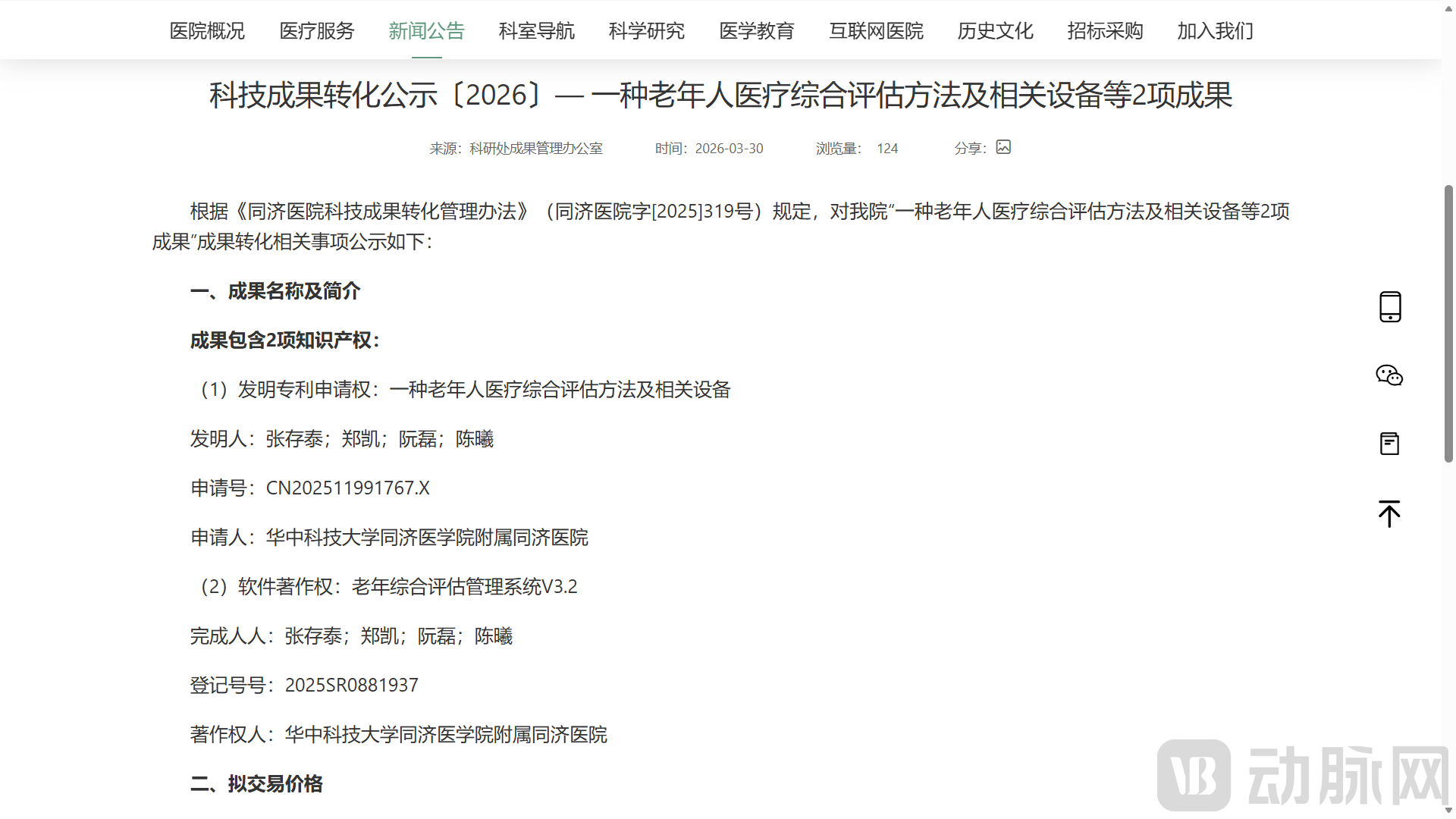
Image from the official website of Tongji Hospital, Tongji Medical College, Huazhong University of Science and Technology
This technology isA Multidimensional Comprehensive Medical Assessment System for the ElderlyBy collecting basic information, conducting core assessments of physical function, nutritional status, and psychological state, and performing cross-dimensional analysis of specialized factors such as frailty, sarcopenia, polypharmacy, and home environment, the system automatically classifies health risks, generates structured assessment reports, and matches precise intervention strategies covering medical care, nursing, rehabilitation, nutrition, and medication management. This comprehensively reflects the overall health risks of older adults, providing a scientific basis for personalized care and clinical decision-making.
Comprehensive Geriatric Assessment is the core technology of modern geriatrics, primarily targeting the elderly population aged 60 and above who present with functional impairment, comorbidities, polypharmacy, psychological issues, or inadequate social support. Its core objective is to comprehensively reflect overall health status, accurately identify risks, and efficiently link to intervention plans, thereby providing reliable support for personalized medical and care decision-making.
Clinically, traditionallySingle Disease Diagnosisa medical model centered on organ pathology, which focuses solely on organ lesions and fails to cover key dimensions such as physical function, nutritional status, and psychological state, making it difficult to accurately reflect the comprehensive health status of older adults and prone to overlooking high-risk issues such as falls, disability, and malnutrition.
However, existing comprehensive geriatric assessment methods still suffer from prominent pain points:First,Fragmented and Disjointed Assessment Content, physical, nutritional, psychological, and social environmental dimensions are conducted independently, lacking systematic integration and failing to form a unified and comprehensive health profile. Secondly,Insufficient Result Correlation, the data from various scales are merely listed without cross-analysis or identification of cumulative risks, making it difficult to accurately determine high-risk patterns such as functional decline and progression of disability. Thirdly,Severe Disconnect Between Assessment and Intervention, the assessment conclusions serve only as descriptive statements of status and cannot automatically match targeted strategies for medical care, nursing, rehabilitation, nutrition, etc., resulting in low clinical translation efficiency. Fourthly,Absence of Risk Stratification, the lack of standardized assessment criteria makes it difficult to rapidly stratify individuals into low-, medium-, and high-risk groups, which hinders the optimized allocation of care resources and the prioritization of interventions.
In addition,The current assessment process is cumbersome and relies on manual statistics., failing to achieve intelligent stratification and automated report generation, which is time-consuming, labor-intensive, and susceptible to the subjective biases of assessors, resulting in insufficient consistency and stability. Meanwhile, there is inadequate coverage of geriatric-specific issues such as frailty, sarcopenia, polypharmacy, and home environment, leading to limited capability in warning against acute adverse events.
Therefore, current geriatric health assessment technologies suffer from shortcomings such as incomplete dimensions, insufficient correlation, disjointed interventions, lack of stratification, and low efficiency, failing to meet the clinical demands for upgraded, precise, standardized, and intelligent geriatric health management.There is an urgent need for a systematic solution that integrates multi-dimensional data, enables intelligent risk stratification, and directly links assessment to intervention.
The core advantages and advanced nature of this patented technology lie in its thorough revolutionization of traditional geriatrics.“Emphasizing Disease, Neglecting Function”evaluation model,ApprovedIntegrated Design of Five Major Modules: Somatic, Nutritional, Psychological, Specialized, and Correlation Analysis, we have established a comprehensive, intelligent, and readily implementable Comprehensive Geriatric Assessment (CGA) system, fundamentally addressing the industry’s pain points of fragmented, disconnected, and difficult-to-translate existing assessments.
This approach first breaks through the limitations of traditional single-dimensional assessment.Current clinical practice focuses solely on disease diagnosis, failing to address the core aspects of elderly care—namely, activities of daily living (ADL), fall risk, nutritional status, and psychological well-being—which often leads to missed high-risk indicators. This technology systematically establishes a four-tier assessment framework: it collects personalized baseline data such as age, gender, lifestyle, and social background; quantifies physical function and fall risk across three dimensions—basic ADL, instrumental ADL (IADL), and balance/gait; screens nutritional status using professional scales; and conducts psychological assessments covering cognition, emotion, and consciousness. By achieving comprehensive coverage of the “physiological-functional-psychological-social” dimensions, it enables early identification of hidden risks such as pre-frailty, potential falls, and early cognitive decline, significantly enhancing the sensitivity of risk预警.
More importantly,This technology enables intelligent correlation of assessment results and automatic risk stratification, addressing the challenges of fragmented traditional data and the inability to identify high-risk combinations.The system can automatically identify three core risk patterns: functional decline, high fall risk, and disability progression. Based on key indicators such as activities of daily living (ADL), fall risk, nutritional status, cognitive function, emotional state, frailty, and sarcopenia, it uniformly classifies risks into low, medium, or high levels according to predefined rules. This approach transforms complex assessment results into clear, standardized, and comparable risk grades, providing a standardized basis for the allocation of medical, nursing, rehabilitation, and caregiving resources, thereby reducing variability in human judgment and enhancing the consistency and stability of assessments.
Building on precise assessment, another core breakthrough of this protocol lies in the one-click conversion from assessment to intervention, thoroughly resolving the clinical bottleneck of “assessment without intervention.”Traditional assessments only provide descriptive conclusions and cannot guide subsequent plans; this technology can automatically match personalized intervention strategies such as medical care, nursing, rehabilitation training, nutritional support, medication management, and social support based on risk levels and characteristics, directly embedding them into the assessment report to form a complete closed loop of "assessment—grading—recommendation—execution."
Meanwhile, it supports flexible, specialized assessment combinations covering frailty, sarcopenia, pain, sleep, vision and hearing, comorbidities, polypharmacy, urinary incontinence, and home environment. These assessments can be adapted to various settings, including outpatient clinics, inpatient wards, community centers, and elderly care institutions, balancing comprehensiveness with efficiency. The system ultimately generates structured, interpretable, and actionable comprehensive assessment reports, providing scientific support for multidisciplinary collaborative diagnosis and treatment, the formulation of individualized care plans, and precision management of elderly health, thereby significantly enhancing the standardization, targeting, and effectiveness of geriatric medical services.
Comprehensive Geriatric Assessment (CGA)As a core technical direction in geriatrics and smart elderly care,Domestic hospitals, technology enterprises, and elderly care platforms have established three major R&D thrusts: standardized assessment, intelligent risk stratification, and the assessment–intervention closed loop., with industry products primarily consisting of software systems and some supporting hardware, widely applied in hospital geriatrics departments, community health centers, and elderly care institutions. The following are representative products and research progress:
Beijing Kaihe Ruihua CGA Comprehensive Geriatric Assessment System (Medical Edition), already commercialized and widely adopted by medical and elderly care institutions. It covers seven dimensions: general medicine, physical function, mental health, social support, environment, quality of life, and geriatric syndromes; it incorporates standardized scales such as ADL/IADL, MMSE, GDS, and NRS-2002, supporting both single-item and comprehensive assessments; it adopts a hybrid C/S + B/S architecture, enabling multi-assessor collaboration, task management, and report generation.
Hongtaisheng X‑Age Comprehensive Geriatric Assessment System, with mature commercial deployment in 2026, entering hospitals and health-and-elderly-care institutions to establish a closed-loop system comprising three modules—assessment, intervention, and data management—supporting automated analysis and comprehensive conclusion output; standardized processes reduce subjective bias, enhancing the consistency of assessment results; supports both local and cloud storage, enabling long-term monitoring, risk early warning, and scientific research data mining.
In summary, the current market is dominated by software systems, most of which hold Class II/Class I filings or software copyrights, with few obtaining Class III medical device registration. The field has evolved from the digitalization of assessment scales to intelligent stratification and automated intervention recommendations. This patent (Tongji Hospital) emphasizes multi-dimensional correlation analysis, automatic risk stratification, and the direct translation of assessment into intervention, thereby aligning more closely with clinical diagnostic and therapeutic decision-making and creating a clear distinction from pure elderly care information platforms.