ASCO 2026: Chinese Innovative Drugs Enter the Era of Head-to-Head Trials, Competing for Global First-Line Standards
Akeso
Innovative Antibody Drug Developer
The annual meeting of the American Society of Clinical Oncology (ASCO) is once again drawing to a close. This year marks the highest level of participation by Chinese innovative drugs in ASCO’s history. If one sentence were to summarize the most significant change for Chinese innovative drugs at this global event, it would be the shift from discussing mechanisms to demonstrating hard-core strength.
At ASCO 2026, multiple Chinese pharmaceutical companies released the latest data from head-to-head trials.In previous clinical trials focused on mechanism of action, single-arm trial designs were commonly employed. However, as the field has progressed to a stage where robust efficacy must be demonstrated, head-to-head trials have become necessary, representing a substantially greater level of difficulty. The former approach, which lacks a control group, is typically used during the early exploratory phase to assess whether a drug with a novel mechanism “works,” thereby providing preliminary evidence. In contrast, the latter directly compares the investigational therapy against the current best standard of care, evaluating hard endpoints such as overall survival (OS) and progression-free survival (PFS).
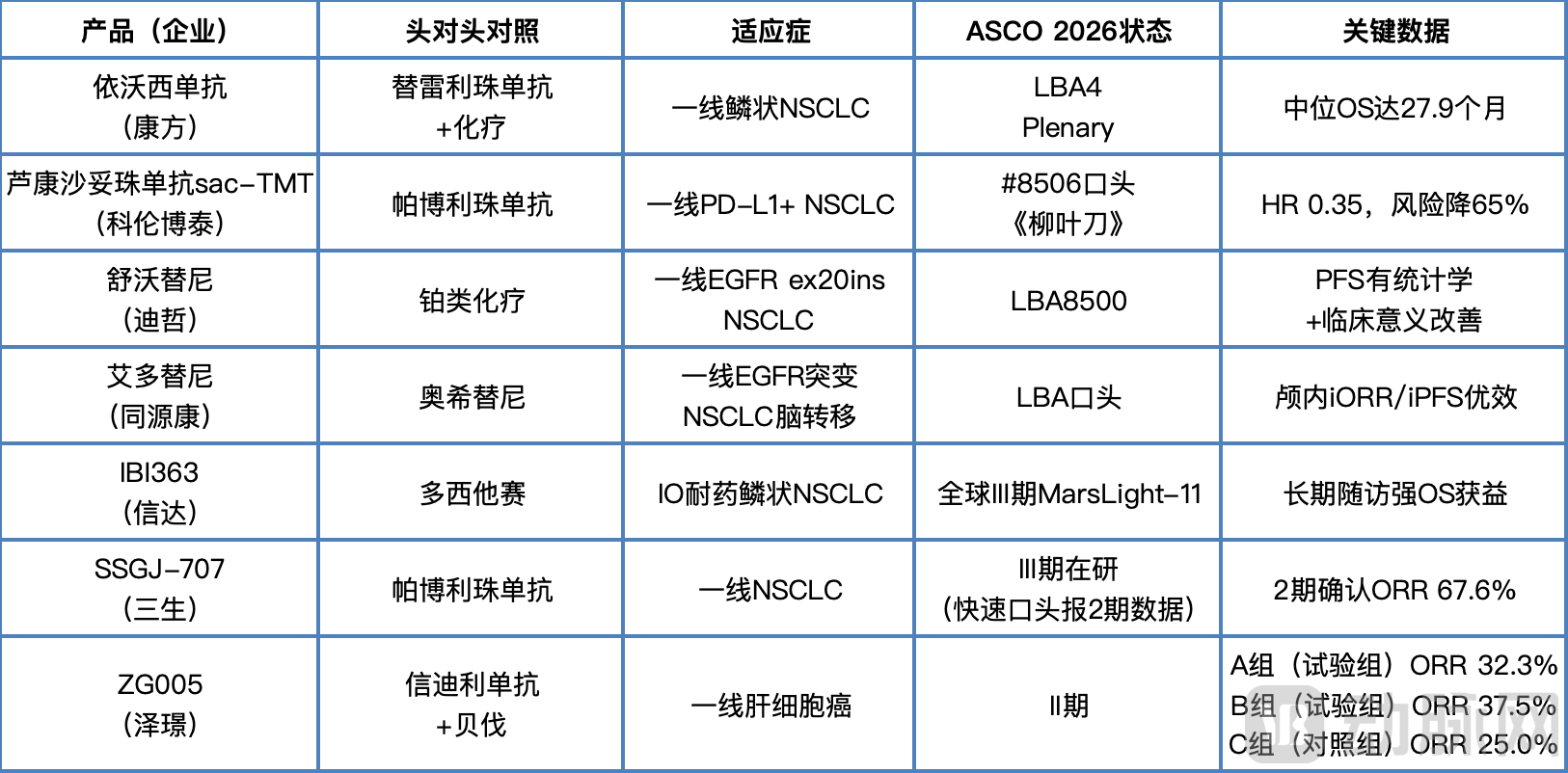
Data source: Company announcements and ASCO 2026 abstracts
At ASCO 2026, Chinese pharmaceutical companies are conducting numerous head-to-head trials against a series of global standard-of-care drugs, including pembrolizumab (Keytruda), osimertinib, and tislelizumab. This trend marks an industrial inflection point: the focus of competition for China’s innovative drugs has shifted from merely capturing domestic market share to contending for global first-line treatment standards and the “power to define innovation.”
The "Head-to-Head All-Star Team" of China's Innovative Drugs
That night, Akeso was the king of the world. “Tears streamed down as China’s innovative drugs truly stepped into the center stage of the global arena,” wrote a pharmaceutical self-media outlet on the evening Akeso released its data.
On May 31, Akeso announced that in the Phase III HARMONi-6 (AK112-306) study, as a first-line therapy for advanced squamous non-small cell lung cancer (sq-NSCLC),The ivonescimab group achieved a median OS of 27.9 months, reducing the risk of death by 34% compared with the tislelizumab plus chemotherapy group, yielding a positive result. This finding instantly sent shockwaves through China’s innovative drug industry.
Akeso’s HARMONi-6 study on ivonescimab compares “ivonescimab plus chemotherapy” versus “tislelizumab plus chemotherapy” in first-line squamous non-small cell lung cancer (NSCLC). This study was selected for the Plenary Session of this year’s ASCO Annual Meeting, marking the only Chinese study to be featured in the general assembly. The Plenary Session represents the highest-profile segment of ASCO, with typically only 4–5 studies selected per conference from all submissions by the organizing committee based on their potential to change global clinical practice. Inclusion in this session signifies that Chinese pharmaceutical companies have, for the first time, secured a “center-stage position” on the world’s largest oncology platform.
The control group in this study is distinctive, utilizing another approved PD-1 monoclonal antibody (tislelizumab). This means the comparison is not between “PD-1 inhibitor plus chemotherapy” and “chemotherapy alone,” but rather evaluates which immunotherapy backbone is superior: one combining a PD-1/VEGF bispecific antibody with chemotherapy, versus the other combining a conventional PD-1 monoclonal antibody with chemotherapy.
PD-1/VEGF bispecific antibodies represent a novel molecular design that has emerged in recent years, integrating anti-PD-1 (releasing immune brakes) and anti-VEGF (inhibiting tumor angiogenesis) functions into a single molecule to enable synergistic immune activation and anti-angiogenic effects within the tumor microenvironment. The positive results recently announced by Akeso suggest that ivonescimab holds promise for helping to establish a new global standard of care for first-line treatment of squamous non-small cell lung cancer (NSCLC).
In addition to this study by Akeso, two other head-to-head studies were particularly representative at ASCO 2026. These three head-to-head studies,Together, they formed the “Head-to-Head Dream Team” of China’s innovative drugs at this year’s ASCO, marking the starting point of this epoch-making new phase.
One is Kelun-Biotech's OptiTROP-Lung05 study,Full title: "Sac-TMT in Combination with Pembrolizumab versus Pembrolizumab Monotherapy" – the first global Phase III trial demonstrating that an ADC plus immunotherapy combination positively outperformed Keytruda monotherapy.
The OptiTROP-Lung05 study targeted patients with first-line PD-L1-positive non-small cell lung cancer (NSCLC). Designed as a randomized controlled Phase III trial, it enrolled 413 participants. The results were presented at the ASCO 2026 Annual Meeting and simultaneously published in The Lancet, a premier international medical journal.
The study showed that the median progression-free survival (PFS) in the experimental arm of the OptiTROP-Lung05 trial was not reached, compared with 5.7 months in the monotherapy arm. A “not reached” result indicates that more than half of the patients had not experienced tumor progression at the time of data analysis, demonstrating substantially superior efficacy relative to the control group. The hazard ratio (HR) was 0.35. As the most critical efficacy endpoint in head-to-head trials—often summarized as a single number—the HR can be interpreted as the instantaneous risk of progression or death per unit time in the combination therapy arm being 35% of that in the monotherapy arm, corresponding to a 65% reduction in the risk of disease progression or death.
Furthermore, the OptiTROP-Lung05 study demonstrated a 12-month progression-free survival (PFS) rate of 62.4% versus 29.0%, and an objective response rate (ORR) of 70.2% versus 42%. This means that the proportion of patients remaining progression-free at one year was more than double in the combination group compared to the monotherapy group, while the proportion of patients experiencing significant tumor shrinkage reached 70% in the combination group versus approximately 40% in the monotherapy group. Collectively, these figures indicate that in the first-line PD-L1-positive non-small cell lung cancer (NSCLC) population, combining Keytruda—the “global benchmark for immunotherapy”—with sac-TMT, a Chinese TROP2 antibody-drug conjugate (ADC), yields significantly superior efficacy compared to Keytruda monotherapy. This marks the first time globally that an ADC combined with immunotherapy has positively defeated Keytruda monotherapy in a Phase III study.
This head-to-head study holds landmark significance at the industry level, as it clinically validates that “ADC plus immunotherapy” is likely to become one of the primary directions for next-generation first-line treatment of lung cancer. Notably, this critical validation was achieved by a TROP2-targeting antibody-drug conjugate (ADC) developed in China. TROP2 is a target widely expressed on the surface of tumor cells. By using an anti-TROP2 antibody as a “guidance system” coupled with a chemotherapy warhead, the drug can precisely kill tumor cells, while also leveraging the “long-tail response” of immunotherapy. Although this combination strategy has long been discussed within the industry, the entity that first confirms its efficacy through robust Phase III clinical data will hold distinctly different strategic significance.
Another representative head-to-head trial is the ESAONA study of aumolertinib (TY-9591) from Tonghua Kang.This is the world’s first head-to-head clinical trial with a superiority design comparing a third-generation EGFR-TKI against osimertinib, and its results have been selected for an LBA oral presentation at ASCO 2026. LBA stands for Late-Breaking Abstract, a category dedicated to including studies with late-released yet highly significant data, thereby carrying substantial prestige.
What makes this study particularly distinctive is its design itself; it is the first global pivotal Phase II study to employ a superiority design of “third-generation EGFR-TKI monotherapy versus osimertinib monotherapy head-to-head” for brain metastases in EGFR-mutated NSCLC. Several terms here warrant separate examination.
The first keyword is brain metastasis, one of the most challenging complications for lung cancer patients. Many drug molecules struggle to cross the blood-brain barrier due to their structural properties, making intracranial efficacy a persistent clinical challenge. The second keyword is osimertinib, the current global standard of care for EGFR-mutated lung cancer. Over the past decade, few drugs from the same generation have dared to compete head-to-head with it in its area of dominance. The third keyword is superiority. In clinical trials, superiority and non-inferiority represent two distinctly different design objectives. A superiority trial must demonstrate that the new drug is significantly better than the existing one, imposing stricter data requirements, whereas a non-inferiority trial only needs to show that the new drug is not substantially worse than the comparator, thus having a lower threshold.
Interim analysis demonstrated that, compared with osimertinib, aumolertinib significantly improved iORR (intracranial objective response rate) and iPFS (intracranial progression-free survival), with a manageable safety profile. The superiority in these two endpoints indicates that aumolertinib provides superior intracranial disease control compared with osimertinib in the challenging setting of brain metastases.
A Historic Inflection Point
Viewed collectively, these studies reveal three layers of industrial implications, signaling another historic inflection point for China’s innovative drug sector.
First, the evaluation criteria have shifted from assessing whether a mechanism is novel to determining whether it can extend life.In recent years, both the market and academia have been easily swayed by concepts such as “global first-in-class mechanism” or “the world’s first drug targeting a specific molecule.” However, returning to the core of clinical practice, the gold standard for assessing a drug’s value remains whether it enables patients to live longer and better.
At ASCO 2026, there was a significant increase in high-level evidence from Chinese pharmaceutical companies focusing on hard endpoints such as progression-free survival (PFS) and overall survival (OS). Whether it was the hazard ratio (HR) of 0.35 for sac-TMT or the superior investigator-assessed objective response rate (iORR) and investigator-assessed progression-free survival (iPFS) demonstrated by aidotinib, the competition centered on metrics directly impacting patient survival or quality of life. The benchmark for evaluating innovative drugs is shifting from “mechanistic innovation” to “whether clear survival benefits can be demonstrated in randomized controlled trials.” This represents a more mature and rigorous evaluation approach, imposing higher demands on companies’ clinical capabilities, patient recruitment efficiency, and study execution quality.
Second, the competitive landscape has shifted, from the Chinese market to the global standard answer.If a drug is tested only against placebo or conventional chemotherapy, its primary objective is often to replace imported drugs within the Chinese market. However, choosing head-to-head trials against Keytruda, osimertinib, and tislelizumab signifies an ambition to demonstrate superior efficacy over the current global standard of care. In retrospect, this represents a critical leap from “me-too” to “me-better,” and ultimately to “first-in-class.”
This breakthrough carries another layer of significance: once a drug demonstrates superiority in head-to-head trials, the clinical evidence required for overseas registration is essentially in place, thereby strengthening the negotiating position in license-out deals. In the past, some studies designed specifically for the Chinese market were later deemed by overseas regulators as providing insufficient evidence. In contrast, Phase III trials conducted directly against global standards can virtually fast-track through the review processes of the FDA and EMA.
Third, the discourse power has shifted, marking the first time that China is vying for definitional authority on the global oncology stage.When the Phase III data of a Chinese drug is published in The Lancet, and when Ivonescimab takes the Plenary stage, Chinese innovative drugs are no longer merely competing for sales revenue, but for the power to define what constitutes superior first-line therapy.
Updates to oncology treatment guidelines are, in essence, a process of building global academic consensus. The inclusion of drugs in first-line or second-line regimens is based on high-level evidence published in top-tier journals. The fact that Chinese pharmaceutical companies are now producing in bulk the evidence required by these guidelines suggests that the proportion of Chinese contributions to international guidelines is poised to rise significantly in the coming years.
Final Thoughts: A Rational Perspective on Head-to-Head Trials Is Still Needed
Of course, it is not objective to elevate head-to-head studies as a "panacea." From an industry perspective, there are numerous uncertainties associated with pharmaceutical companies conducting head-to-head trials.
On the one hand, head-to-head trials themselves are characterized by a “winner-takes-all” dynamic, where losers struggle to recover.For most pharmaceutical companies and their pipelines, head-to-head trials carry substantial risk. If superiority is not demonstrated in Phase III clinical trials, the hundreds of millions to over a billion RMB invested in R&D, several years of development time, and the enrollment costs for thousands of patients cannot be recouped through subsequent minor study adjustments. Furthermore, the global commercial prospects of the drug for that indication would be significantly diminished in future development. This explains why, over the past decade, only a very small number of Chinese pharmaceutical companies have dared to adopt head-to-head trial designs for first-line treatment of major cancer indications.
On the other hand, some studies are still in the early stages with small sample sizes.For instance, the clinical data on ZG005, a PD-1/TIGIT bispecific antibody developed by Zeltis Pharma, in combination with bevacizumab versus sintilimab plus bevacizumab as first-line treatment for advanced hepatocellular carcinoma, presented for the first time at ASCO 2026, were derived solely from a Phase II trial involving only 95 patients. Under current regulatory frameworks, however, Phase III trials require a minimum of 300 patients in the experimental arm, with a control-to-experimental group ratio of no less than 1:3. While early objective response rate (ORR) data are informative, it remains to be seen whether positive results from Phase I and II trials can be replicated in larger-scale Phase III studies and ultimately translate into improvements in progression-free survival (PFS) and overall survival (OS), which will undoubtedly require more time and greater investment to validate.
In addition, beyond clinical data, there are multiple influencing factors such as commercialization, medical insurance reimbursement, and the pace of overseas regulatory approvals. Equating "head-to-head superiority" with "commercial success" treats clinical research as the entirety of industrialization, overlooking the lengthy chain from evidence generation to prescription and ultimately to sales.
However, the shift from purely single-arm trials to head-to-head comparative trials signifies that Chinese innovative drugs have moved one step closer in their standing within the global ecosystem.