

Lab's Most Tedious Task in Mouse Bone Marrow Extraction Finally Automated by New Device
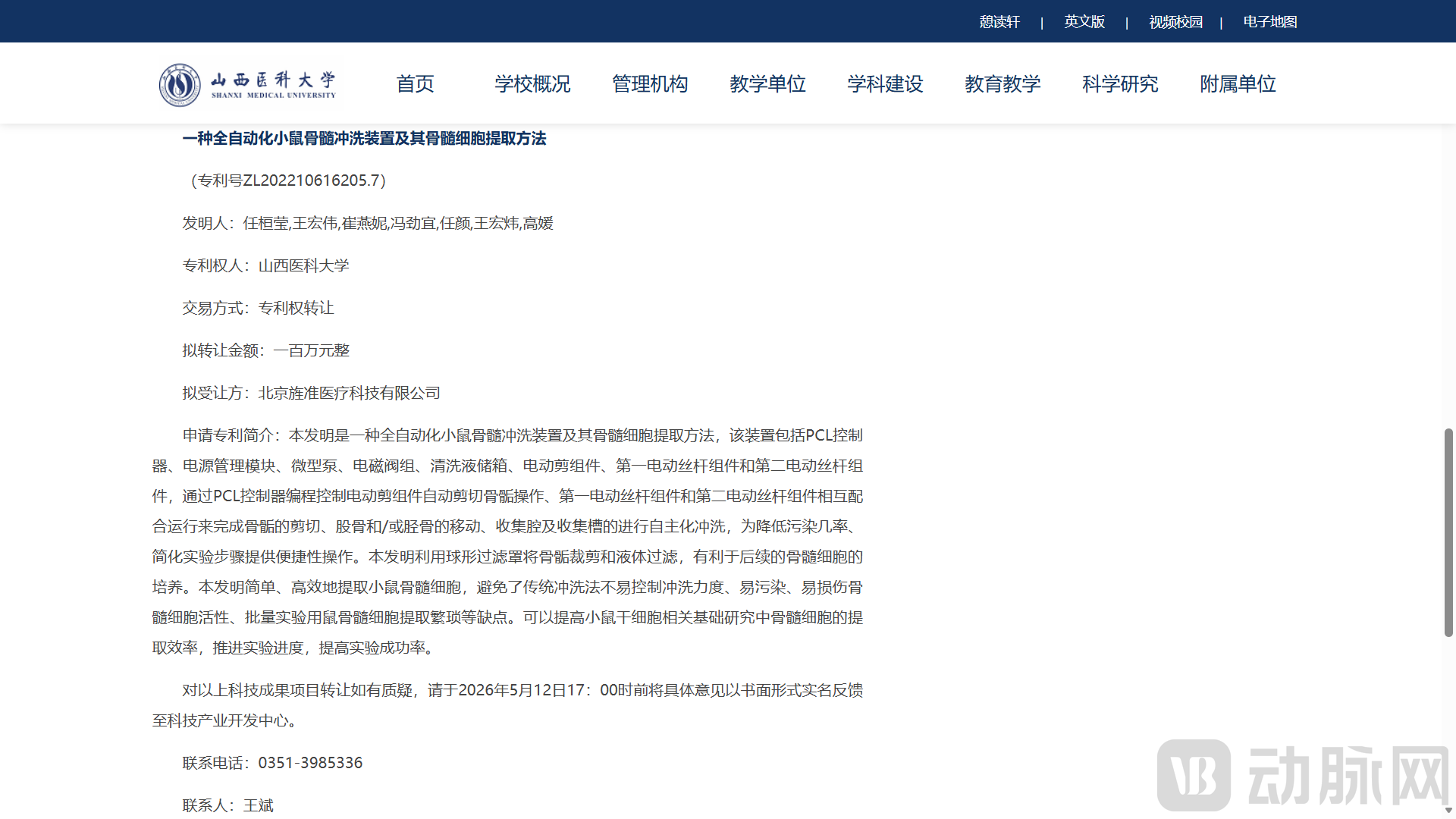
Image from the official website of Shanxi Medical University
Anyone engaged in hematological research knows that isolating mouse bone marrow cells is a task that is "easy to describe but maddening to perform."
Syringe Irrigation—Insufficient force fails to flush out the sample, while excessive force causes cell damage; Forceps with Scissors—Each additional step increases the risk of contamination; After considerable effort to extract the tissue, one must still hope for sufficient viability to proceed with subsequent experiments.
This "dirty and tedious work" remains the daily routine for most laboratories in China.
However, Shanxi Medical University believes that this task can be delegated to machines.
The university’s invention patent titled “Fully Automated Mouse Bone Marrow Flushing Device and Method for Extracting Bone Marrow Cells” is proposed to be transferred to Beijing GenomePrecision Technology CO.,LTD., with the transfer amount1 million yuan。
Bone marrow cells are fundamental to the study of hematologic diseases, immune disorders, and stem cell research—hematopoietic stem cells differentiate into various blood cell lineages, while bone marrow mesenchymal stem cells span multiple disciplines, including cardiology, neuroscience, and endocrinology. The efficient isolation of high-quality bone marrow cells represents the primary threshold for related research.
However, this threshold has long been sustained by manual labor.
The core pain points of traditional approaches are concentrated in four aspects:
· Low extraction efficiency: The irrigation force is difficult to control precisely, which easily leads to significant loss of bone marrow and unstable yield.
· Significant cellular damage: Inconsistent manual operation force; the puncture method causes severe damage to cell viability, resulting in reduced cell vitality and insufficient yield after extraction.
· Difficulty in Standardizing Operations: Requires the use of multiple instruments such as forceps and scissors, involves cumbersome steps, demands high operator proficiency, and exhibits significant batch-to-batch variability
· High risk of contamination: The numerous manual steps and frequent use of instruments result in a persistently high probability of sample contamination, which directly affects subsequent cell culture and experimental results.
Let's look at market supply.
Existing related equipment, both domestically and internationally, falls mainly into two categories: one includes general-purpose tissue processors such as the Medimachine II, which are suitable for processing various types of tissues but are not specifically designed for mouse bone marrow; the other includes large-scale clinical bone marrow processing systems such as the Boya PXP®, with unit prices ranging from hundreds of thousands to millions of RMB, targeting healthcare institutions rather than research laboratories.
Stuck in the Middle: General-Purpose Equipment Underperforms, While Specialized Systems Are Too Costly and Niche.
As the scale of domestic research in hematology, immunology, and stem cells continues to expand, the demand for mouse bone marrow samples by scientific research institutions has grown significantly—yet there is hardly a single product available on the market thatMiniaturized, Automated, Low-Cost, and Dedicated to Mouse Bone Marrow Extractionequipment.
This gap is real.
The technical solution of the patent being transferred can be broken down into four core modules, each addressing a specific pain point:
① Full-process automatic control
Centered on the PCL controller (based on the STM32 microcontroller), and integrated with servo motors, solenoid valve assemblies, and micro-pumps, the entire operational procedure—from epiphyseal shearing and bone marrow irrigation to sample collection—is fully automated through programmed control.
This means: no longer relying on the operator's tactile feedback, experimental procedures can be standardized and replicated.
② Integrated Cutting and Irrigation Mechanism
Integrated electric resection assembly (curved blade + drive motor) and precision irrigation system (micro pump + buffer chamber tube + hollow spherical irrigation needle).
The hollow ball needle features multiple irrigation ports distributed across its surface, ensuring more uniform irrigation and improved patency of the medullary cavity. The curved blade automatically shears the epiphysis, producing clean incisions and preventing bone fractures or residual tissue issues associated with manual cutting.
Key Improvements:The flushing intensity is precisely controlled by the program, avoiding cell damage caused by manual pipetting, and simultaneously improving bone marrow cell recovery rate and viability.
③ Constant Temperature and Humidity with Anti-Contamination Design
The device features a sealed enclosure that enables ultraviolet (UV) irradiation for sterilization and provides a constant temperature and humidity environment. The closed, automated operation significantly reduces sample exposure to the external environment, thereby markedly lowering the risk of microbial contamination.
④ Intelligent Fluid Pathway and Filtration System
The solenoid valve group controls multi-channel fluid paths, in conjunction with a spherical filter housing (300-mesh screen).
A 300-mesh screen effectively intercepts epiphyseal fragments, preventing them from entering the collection fluid and causing clogging; the multi-channel design supports simultaneous processing of multiple mouse samples, significantly enhancing batch experimental throughput.
Frankly speaking, RMB 1 million for a university patent is not considered a high price in the context of technology transfer. However, the highlight of this transaction lies not in the licensing fee itself, but in the market it represents.
Experimental Mice for Hematology, Immunology, and Stem Cell Research: Annual Consumption Continues to Grow in China—Relevant research teams are distributed across universities, hospitals, and pharmaceutical companies’ R&D departments. Behind these teams lies a substantial demand for experiments requiring repeated isolation of mouse bone marrow cells.
Currently, such procedures in domestic laboratories are still predominantly performed via manual syringe flushing, with a near-total absence of specialized automated equipment.
The device developed by Shanxi Medical University fills the gap in the niche market of **"miniaturized + automated + research-grade dedicated"** systems—it is not a large-scale clinical system like Boya’s PXP, but rather the type of product that university and research laboratories can truly afford and genuinely need.
From "manual labor" to "one-click extraction," once someone crosses this threshold, the demand is readily available.