

Sichuan University West China Hospital Licenses Real-Time Coagulation Early-Warning Patent for Critical Care Safety
Recently, West China Hospital of Sichuan University released a public notice on the transformation of scientific and technological achievements, proposing to transfer its “Method, System, Computer Device, and Storage Medium for Real-Time Coagulation Early Warning“The invention patent has been converted under a non-exclusive license, with the licensee being Wuhan Juzhi Huiren Information Technology Co., Ltd. The proposed transaction price is”150,000 yuan. The inventors of this achievement areZeng Xiaoqianand his/her team。
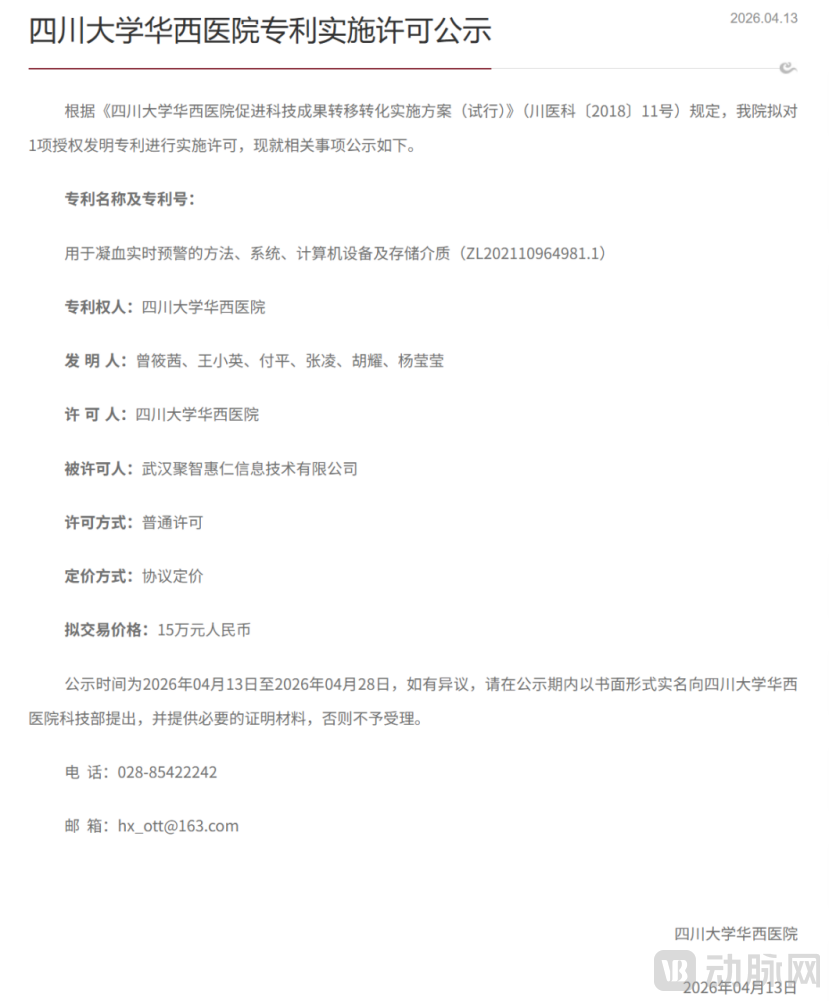
Image from the official website of West China Hospital, Sichuan University
By leveraging time-series pressure data from CRRT machines as the core input, this technology integrates functional data modeling, sliding-window AI classification, and dual-dimensional alert rules to achieve early identification, real-time assessment, and precise warning of clotting risks. It breaks through the industry bottlenecks of traditional CRRT clotting monitoring—namely, lag, passivity, and reliance on manual intervention—significantly enhancing treatment continuity and patient safety, while providing a domestically developed, intelligent, and practically deployable early-warning solution for critical care blood purification.
Continuous Renal Replacement Therapy (CRRT) is a core technology in the management of critically ill patients. Extracorporeal circuit coagulation is a key challenge limiting treatment safety and efficiency, with traditional models facing four major dilemmas:
Warning was severely delayed.Conventional CRRT machines only monitor single-point values such as transmembrane pressure (TMP) and pre-filter pressure, triggering alarms only after coagulation has occurred and pressures have significantly exceeded limits. Unable to predict trends, these systems often result in missed clinical intervention windows.
High Dependence on Manual Labor and Poor Stability. The assessment of coagulation heavily relies on nurses' visual inspection of the circuit and their clinical experience, making it highly susceptible to variations in workload and individual expertise. This approach lacks timeliness and consistency, leading to a heightened risk of missed or erroneous judgments.
Pressure parameters are susceptible to interference.Pressure fluctuations are perturbed by multiple factors, such as blood flow and circuit positioning, and do not exhibit a simple linear correlation with coagulation. Consequently, single-threshold alarms yield high error rates; clinical data indicate that the false alarm rate of traditional fixed-threshold warning systems exceeds 45%.
High risk of treatment interruption.Sudden clotting leads to filter failure and treatment interruption, increasing consumable costs and nursing workload, while also consuming platelets and coagulation factors, thereby elevating the patient’s risk of bleeding and anemia.
To address the industry pain points in CRRT therapy—namely, delayed coagulation warnings, inaccurate assessments, and reliance on manual intervention—this patent reconstructs the coagulation monitoring system through full-process intelligent innovation, achieving multidimensional breakthroughs from data, algorithms, and rules to clinical implementation.
This patent converts the time-series pressure data collected once per second by the CRRT machine—including transmembrane pressure (TMP), arterial outlet pressure (AOP), pre-filter pressure (PFP), effluent pressure (EP), and return infusion pressure (RIP)—into smooth, continuous functional data through B-spline basis function expansion combined with least squares fitting. This approach not only fully preserves the dynamic trends of pressure changes but also effectively eliminates noise interference caused by discrete data points, thereby laying a solid data foundation for subsequent precise analysis.
The model employs D-method and TAD-method classification based on functional data depth. By calculating the trimmed mean distance or weighted average distance between newly acquired curves and known class groups, it achieves precise trend-level judgment to accurately identify impending coagulation within a sliding window. During training, the dataset was split into two-thirds for training and one-third for testing, with 500–1,000 iterations of random sampling optimization. This approach reduced the model’s prediction error rate to 15.8%, improving early warning accuracy by more than 29 percentage points compared to traditional fixed-threshold alarms, thereby significantly enhancing reliability.
The patented design incorporates a dual-alert mechanism that accounts for both trends and extreme values, enabling earlier and more reliable safety warnings. The first component is trend assessment: an alert is triggered when more than two-thirds of consecutive multi-window classification results indicate coagulation risk and the latest pressure data point exceeds 180 mmHg. The second component is extreme-value assessment: an immediate alert is issued when five or more consecutive data points show pressures exceeding 250 mmHg. By combining these dual rules, the system preserves early trend recognition capabilities while maintaining a safety threshold for extreme values, thereby achieving proactive alerts with minimal false positives and no missed detections.
The system employs a sliding window analysis mechanism, with a window width of 2–4 hours and a sliding interval of 2–5 minutes, enabling second-level continuous assessment without interfering with routine CRRT therapy. Furthermore, this solution is compatible with the data interfaces of mainstream CRRT machines available on the market; it can be either integrated within the device or deployed independently, significantly reducing the complexity of clinical implementation and demonstrating strong on-site adaptability and promotional value.
Currently, coagulation monitoring in extracorporeal circulation and blood separation therapy have become core components in ensuring treatment safety and enhancing clinical efficiency in the fields of critical nephrology and blood purification. Addressing key needs such as early identification of coagulation, precise early warning, and intelligent separation of blood components, numerous innovative patented technologies and mature clinical devices have emerged, providing significant support for the safe and intelligent development of extracorporeal circulation.
"Applied for by West China Hospital of Sichuan University and University of Electronic Science and Technology of China, the “A Vortex-Type Venous Chamber Coagulation Early Warning Method and System” (Patent No. CN120267914B), which utilizes near-infrared LED light sources, macro lenses, and CMOS cameras for image acquisition, can accurately identify thrombi in continuous dynamic blood flow, eliminate interference from blood flow during detection, and track the thrombus formation process in real time. The system predicts the risk of venous drip chamber occlusion based on thrombus size and location, providing timely alerts to effectively reduce the workload of medical staff, minimize unnecessary replacements and medical costs, and significantly lower the incidence of venous drip chamber occlusion.
“Applied for by the PLA Navy Special Medical Center and East China Normal University”A Coagulation Early Warning Device“Utility Model Patent (Announcement No. CN216900177U): Intelligent Recognition of Early Coagulation in Hemodialysis Using Dual-Path Optical Detection. This device employs dual verification through 760 nm near-infrared transmission detection and 500 nm visible light reflection detection, combined with focusing, filtering, and light-shielding structures to eliminate interference from ambient light and variations in blood transmittance. It accurately captures early micro-coagulation, automatically determines the status, and triggers alarms, thereby eliminating reliance on manual visual inspection and reducing nurses’ monitoring burden as well as the risks of missed or incorrect diagnoses.”
SpectraOptia Apheresis SystemIt is an advanced therapeutic blood separation and cell collection platform that utilizes continuous-flow centrifugation combined with optical detection technology, enabling multiple blood separation procedures to be performed on a single device. The product features dedicated tubing sets compatible with multiple protocols, reducing training costs and inventory requirements. Equipped with the AIM™ Automatic Information Management system, it supports real-time monitoring, interpretation, and parameter adjustment, ensuring intuitive and efficient operation. The device boasts a compact and portable design with foldable monitor and IV pole for easy mobility and storage. Meanwhile, precise fluid balance, anticoagulant management, and low extracorporeal volume tubing ensure patient safety and comfort, significantly enhancing clinical operational efficiency.