

Closed-System Amniotic Membrane Rupture Device: A Minimally Invasive Innovation Ensuring Maternal and Fetal Safety

Tuoren
Medical Device Manufacturer and Distributor
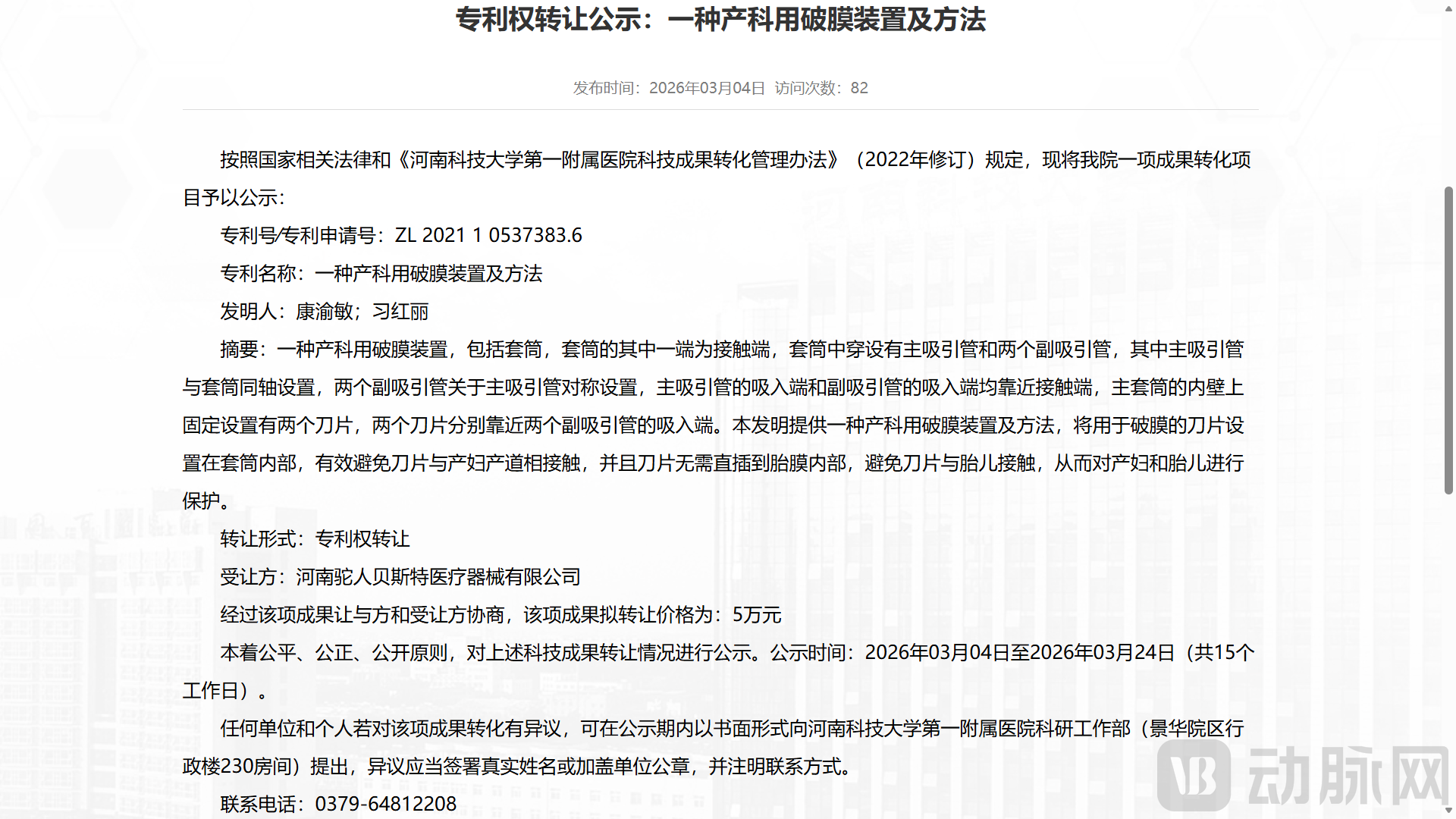
Image from the official website of Henan University of Science and Technology
“A mother’s amniotic fluid is the Meng Po Soup of ancient legend.” This phrase has recently gone viral online. Newborns enter this world through the maternal birth canal, breaking through the amniotic sac that envelops them to arrive in a new realm. The amniotic fluid demarcates the boundary between the yin and yang worlds, while the amniotic sac serves as the first barrier encountered upon entering life. Yet, by overcoming this barrier, we are rewarded with rebirth.
In modern medicine,Artificial Rupture of MembranesIt refers to commonly used methods of labor induction and intervention during the course of natural childbirth in obstetrics. This procedure involves artificially rupturing the amniotic membrane at the cervical os to assess fetal intrauterine status by observing the color of the amniotic fluid, while simultaneously enhancing uterine contractions and accelerating the progress of labor. It is a critical clinical operation for ensuring the smooth progression of delivery.
Currently, clinical routine adoptsAmniotomy Needle or Vascular ForcepsTo perform artificial rupture of membranes, the physician must advance the instrument through the maternal birth canal to the site of the fetal membranes. This approach has significant limitations and risks in clinical practice:
First, the exposed needle/forceps tip is prone to scratching the maternal birth canal during device advancement, resulting in high operational difficulty and strong dependence on physician experience;
Second, during amniotomy, the amniotic membrane must be punctured directly; excessive depth of insertion can easily injure the fetus, posing significant safety risks.
Third, after rupture of membranes, amniotic fluid drains directly through the birth canal, which increases the risk of contamination, interferes with subsequent labor management, and hinders standardized collection and testing of amniotic fluid samples.
As obstetric clinical practice continues to raise requirements for the safety, minimally invasive nature, and sterility of delivery procedures, existing traditional amniotomy instruments are no longer able to meet the demands for high-quality intrapartum care; therefore, there is an urgent clinical need for aNovel Membrane Rupture Techniques and Instruments Featuring Simple Operation, Comprehensive Protection, and Prevention of Cross-Injury and Environmental Contamination。
In this transaction, Henan University of Science and Technology50,000 yuanPatents Transferred to Xinxiang Beisite Medical Devices Co.,LTD.“A Membrane Rupture Device and Method for Obstetrics”This effectively addresses the aforementioned issues. Centered on the clinical pain points of traditional manual amniotomy, this patent introduces structural innovations, demonstrating prominent overall advantages and strong practicality.
First,Upgraded Safety Protection, innovatively integrating the amniotomy blade within the cannula, ensuring that the entire cutting process is completed inside the cannula. This design not only prevents direct contact between the blade and the maternal birth canal to avoid injury but also eliminates the need to penetrate deeply into the fetal membranes, thereby structurally eradicating the risk of fetal injury.
Second,Stable and reliable operation,This device features a coaxial main suction tube and symmetrical dual auxiliary suction tubes. It utilizes stepwise negative pressure to adsorb the fetal membranes, forming a protrusion that facilitates membrane rupture with a blade. The dual auxiliary suction tubes serve as backups for each other, significantly improving the success rate of amniotomy while reducing the operational difficulty and dependence on physician skill.
Thirdly,Contamination Prevention and Sample Control, amniorrhexis and amniotic fluid aspiration are performed synchronously, allowing direct collection of amniotic fluid into the suction tubing to prevent extensive contamination from leakage and facilitate the acquisition of intact amniotic fluid samples for clinical testing.
Fourth, the device is equipped with a limit ring, conical filter, regulator, and visualization components, which can prevent excessive tearing of the fetal membranes, avoid tube blockage, and support precise multi-level negative pressure adjustment.Balancing Operational Convenience with Clinical Safety, overall achieving an upgrade in obstetric artificial rupture of membranes from “invasive exposed procedures” to “minimally invasive, closed, and safe procedures.”
The assignee of this patent assignment isXinxiang Beisite Medical Devices Co.,LTD., the company was established in 2005 and is a core medical device enterprise under Tuoren Holding Group. With a registered capital of RMB 700 million, it is recognized as a National High-Tech Enterprise, a national-level specialized, refined, distinctive, and innovative “Little Giant” enterprise, and a National Intellectual Property Advantage Enterprise. It possesses comprehensive qualifications for the research and development, production, and operation of Class II and Class III medical devices.
The company primarily focuses onR&D, manufacturing, and sales of disposable medical devices in the fields of anesthesia, nursing, minimally invasive intervention, surgery, and medical protection, equipped with innovation platforms such as the Provincial Enterprise Technology Center and the Engineering Technology Research Center for Biomedical Material Products, it has long engaged in industry-academia-research collaborations with numerous universities and clinical institutions across China, establishing a mature technological system and industrialization capabilities in medical polymer materials, precision molding, and minimally invasive device design.
As the assignee of the patent for obstetric artificial rupture of membranes, the Company possesses the capabilities to rapidly translate clinical patented technologies into compliant medical device products, achieve scaled production, and promote them across the Chinese market. This effectively supports the practical application of this innovative obstetric technology, helping to enhance the safety and standardization of delivery procedures.
Leveraging Tuoren’s industrialization capabilities and channel resources, this technology is poised to rapidly establish a differentiated competitive advantage. It is expected to be widely adopted in secondary and tertiary hospitals, maternal and child health care institutions, and primary-level obstetric departments, emerging as the new mainstream product in the field of artificial rupture of membranes (amniotomy). The technology offers substantial market conversion potential, along with prominent clinical and commercial value.