

Keymed Biosciences Receives $257 Million Upfront Payment from Gilead’s Acquisition of Ouro Medicines, Validating Its BCMA/CD3 TCE Platform and NewCo Strategy
Ouro Medicines
Developer of Immune Reset Therapy
Today, Keymed Biosciences Inc. (02162.HK) announced that the Group has received a $257 million upfront payment from Gilead Sciences for its acquisition of Ouro Medicines (“Ouro”), the NewCo joint venture established in collaboration with Keymed. The amount is equivalent to approximately RMB 1.7 billion. The presentation slides related to the acquisition were also released.
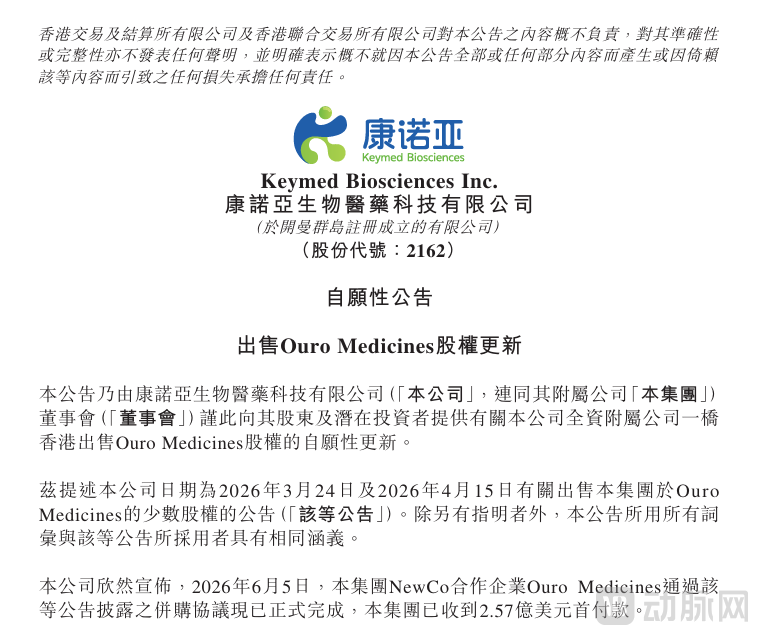
This funding simultaneously validates two things: first, the asset value of CM336, a BCMA/CD3 bispecific antibody independently developed by Keymed Biosciences;Recognized by Top Global Buyers; second, the feasibility of Chinese innovative pharmaceutical companies achieving a closed capital loop through the NewCo model (a global expansion strategy in which domestic pharmaceutical companies license overseas rights of their pipelines to newly established overseas entities in exchange for equity).
15% Equity Stake Valued at $257 Million
To understand the source of this funding, it is necessary to clarify the relationships among the three companies.
Conmed is the original developer of CM336. In November 2024, Conmed entered into an exclusive license agreement with Platina Medicines Ltd, a wholly-owned subsidiary of Ouro Medicines, granting it rights to CM336 worldwide (excluding mainland China, Hong Kong, Macau, and Taiwan).
In consideration, Keymed Biosciences received a $16 million upfront and near-term payment, an approximately 15% minority equity stake in Ouro Medicines, as well as up to $610 million in milestone payments and tiered royalties on net sales.
Ouro Medicines, co-incubated by Monograph Capital and GlaxoSmithKline (GSK), is dedicated to developing therapies for chronic immune-mediated diseases. Its name derives from “ouroboros,” the snake eating its own tail, symbolizing rebirth. In January 2025, Ouro completed a $120 million Series A financing round led by TPG and was named to Fierce Biotech’s 2025 Fierce 15 list.
In March 2026, Gilead Sciences announced the acquisition of 100% equity interest in Ouro Medicines for an upfront payment of $1.675 billion and potential milestone payments of up to $500 million (totaling $2.175 billion). Notably, Lakefront Biotherapeutics (formerly Galapagos) will share the upfront and milestone payments equally with Gilead, acquire the majority of Ouro’s team and operational assets, and be responsible for conducting Phase I/II clinical studies. Gilead will lead regulatory registration and late-stage development, retaining exclusive global commercialization rights (excluding Greater China).
As a shareholder of Ouro Medicines, Keymed Biosciences received an upfront payment of approximately $257 million and up to $70 million in milestones, with total proceeds from the equity sale reaching up to approximately $320 million. Meanwhile, the exclusive license agreement signed in November 2024 remains in effect, with Gilead Sciences and Lakefront Biotherapeutics responsible for paying up to $610 million in milestones and sales royalties. This means that Keymed Biosciences has achieved dual benefits from the same molecule: “equity exit + continued licensing.”
BCMA/CD3 Bispecific T-cell Engager (TCE): From Hematologic Malignancies to Autoimmune Diseases
After clarifying the three-party transaction structure, a core question emerges: What kind of molecule is CM336 that makes it worthy of Gilead’s bet?
CM336 is a bispecific antibody targeting BCMA (B-cell maturation antigen) and CD3 (T-cell surface receptor), belonging to the T-cell engager (TCE) class of therapeutics. Its mechanism of action involves simultaneously binding to BCMA and CD3, thereby directing T cells to the vicinity of target cells and activating their cytotoxic activity, ultimately eliminating diseased cells through T cell-mediated cytotoxicity (TDCC).
Compared with CAR-T, T-cell engager (TCE) bispecific antibodies are off-the-shelf therapeutics that do not require personalized manufacturing processes involving ex vivo extraction, genetic modification, and reinfusion. They offer lower costs and the potential for repeated dosing, providing inherent advantages in accessibility.
TCEs have been well-validated in the oncology field. Amgen’s tarlatamab (DLL3/CD3) and Janssen’s teclistamab (BCMA/CD3) have both received approval. CM336/OM336 has chosen to initially target multiple myeloma, a major indication among hematologic malignancies.
At the 66th Annual Meeting of the American Society of Hematology (ASH), Conmeda presented Phase I/II data on CM336 for the treatment of relapsed or refractory multiple myeloma (R/R MM).
During the dose-escalation phase, with a median follow-up of 12.1 months, 52% of subjects achieved stringent complete response (sCR) or complete response (CR). The overall objective response rates (ORR) in the higher-dose cohorts were 67% and 76%, respectively. Among the 19 patients evaluable for minimal residual disease (MRD), the MRD negativity rate was as high as 95%. Regarding safety, the vast majority of cytokine release syndrome (CRS) events were Grade 1, and no cases of immune effector cell-associated neurotoxicity syndrome (ICANS) were observed.
These data indicate that CM336 demonstrated deep and durable responses in patients who had failed multiple lines of therapy, with a manageable safety profile. Such a safety profile is particularly critical for the subsequent development of autoimmune disease therapies, as patients with autoimmune conditions typically do not require intensive cell depletion and have more stringent tolerance requirements for treatment.
The differentiated value of CM336 lies more in its application for autoimmune diseases. Ouro has focused its development on indications such as autoimmune hemolytic anemia (AIHA) and primary immune thrombocytopenia (ITP), based on the rationale of achieving an immune system “reset” by eliminating plasma cells that secrete pathogenic antibodies, rather than relying on long-term immunosuppression. This strategy has been granted Fast Track Designation (FTD) and Orphan Drug Designation (ODD) by the U.S. Food and Drug Administration (FDA), and the results of the AIHA study have been published in The New England Journal of Medicine.
Multi-Platform Strategy Underpins NewCo Partnership Valued at Over $1.1 Billion
Gilead is willing to offer $2.175 billion for Ouro Medicines, with the underlying valuation rationale never relying solely on single-point data for OM336. Keymed Biosciences possesses diversified technology platforms, including antibodies, antibody-drug conjugates (ADCs), T-cell engager (TCE) bispecific antibodies, oligonucleotides, small molecules, and blood-brain barrier-penetrating antibody delivery systems. This indicates that CM336 is a replicable engineered achievement.
The platform’s capabilities require commercialization for validation. The core product, spucibart (CM310, an IL-4Rα monoclonal antibody; brand name: Kangyueda), achieved net sales of RMB 315 million in 2025, representing a nearly eightfold year-on-year increase, and was included in the National Reimbursement Drug List. The company’s total revenue reached RMB 716 million in 2025, a 67% year-on-year growth.
More importantly, Keymed Biosciences has elevated its NewCo strategy from ad hoc transactions to a systematic layout. Between July 2024 and January 2025, the company densely completed three NewCo collaborations: licensing the bispecific antibodies CM512 and CM536 to Belenos; licensing the BCMA/CD3 bispecific antibody CM336 to Ouro Medicines; and licensing the CD38 monoclonal antibody CM313 to Timberlyne. These deals yielded a cumulative upfront payment of $61 million, with a total potential transaction value exceeding $1.1 billion.
The value of Ouro’s team is equally critical. Several senior executives among its 20-person founding team come from Human Immunology Biosciences (Hi-Bio), which was acquired by Biogen for over $1 billion in 2024. For Gilead, acquiring Ouro amounts to directly gaining a proven execution team specializing in autoimmune T-cell engagers (TCEs).
Gilead’s strategic intent behind acquiring Ouro Medicines is equally clear. In recent years, its oncology cell therapy business has faced growth pressure, with Yescarta’s sales declining by approximately 5% year-over-year in 2025 and overall cell therapy sales dropping by 7% year-over-year. Amid sluggish growth in oncology, bolstering its inflammation and immunology pipeline has become a strategic imperative.
The emerging three-tier structure of “MNC (Multinational Pharmaceutical Company) + NewCo + Local R&D Partner” is becoming the new normal for global pipeline development. Keymed Biosciences plays the dual role of both “R&D originator” and “early-stage shareholder,” which is the core reason it was able to secure a $320 million equity premium.
Commercial Expansion of Autoimmune TCEs: Domestic NewCos Enter the Monetization Phase
From an industry perspective, the significance of Ouro Medicines’ acquisition extends far beyond the $2.175 billion transaction itself.
First, it marks a significant expansion of T-cell engager (TCE) bispecific antibodies from oncology into autoimmune diseases. Over the past decade, TCEs have been primarily applied in the treatment of hematologic malignancies; however, as research into the pathogenesis of autoimmune diseases deepens, the strategy of leveraging T cells to precisely eliminate aberrant B cells has begun to garner attention.
Currently, no T-cell engager (TCE) drugs have been approved globally for autoimmune indications. However, the exploration of CM336 in autoimmune hemolytic anemia (AIHA) and immune thrombocytopenia (ITP), along with early-stage clinical trials of trispecific TCEs such as Huihe Biopharma’s CC312 (CD19/CD28/CD3) in indications like systemic lupus erythematosus (SLE), demonstrate that Chinese pharmaceutical companies have secured a first-mover advantage in this cutting-edge field.
Another trend worth noting is that the NewCo model has entered the phase of value realization.
In recent years, Chinese innovative drug companies have successively transferred overseas rights to NewCos, leveraging international capital to drive global development. However, the market remains focused on one key question: whether these assets can ultimately achieve successful exit and value appreciation.
Today, the answer is becoming increasingly clear. In 2024, Kailera Therapeutics, formed from assets licensed by Hengrui Medicine, successfully listed on the Nasdaq; in 2026, Ouro Medicines was acquired in its entirety by Gilead Sciences. One path led to the capital markets, while the other culminated in industrial M&A. Both distinct trajectories demonstrate that NewCos are evolving from mere financing vehicles into important platforms for global asset operation.
For Keymed Biosciences specifically, the receipt of a $257 million upfront payment marks a landmark achievement, reflecting the dual realization of value from its in-house pipeline and NewCo strategy. In addition to realizing substantial equity gains, the company has fully retained the domestic development and commercialization rights for CM336.
Looking ahead, the OM336 project will be accelerated through the collaboration between Gilead and Lakefront, with pivotal trials expected to commence in 2027. Meanwhile, Keymed Biosciences will leverage its accumulated R&D capabilities and technology platforms to continue advancing the regulatory approval and commercialization of CM336 in China. Whether this transaction can truly evolve from a capital loop to a clinical loop remains worthy of sustained industry observation.