

Shanxi Medical University Licenses Novel Drinkable Liver-Protective Formula Based on Medicinal-Food Homology to Agricultural Tech Firm
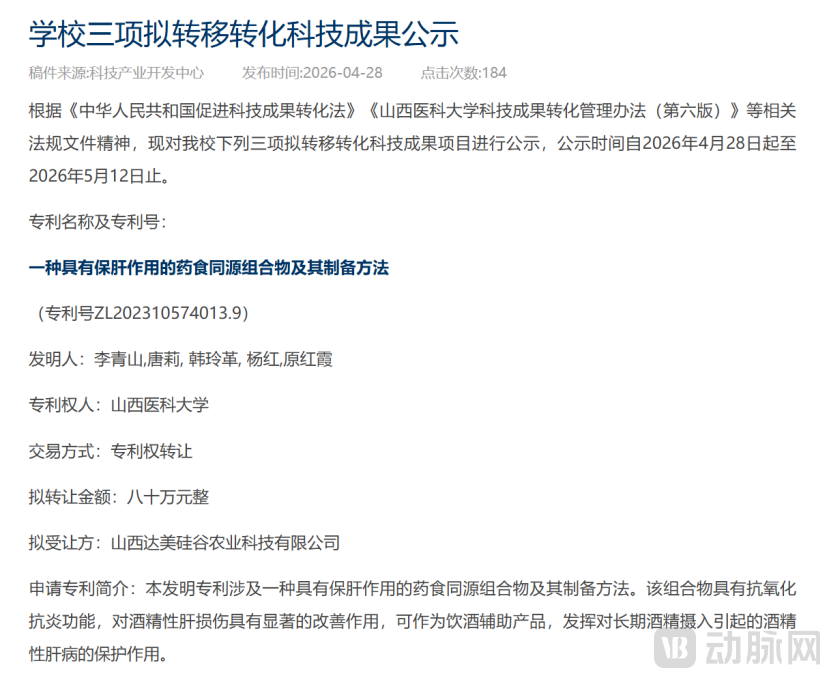
Image source: Official website of Shanxi Medical University
What Can You Buy with 800,000 Yuan?Shanxi Dami Silicon Valley Agricultural Technology Co., Ltd. provides the following answer: a clinically validated, liver-protective formula based on the concept of “medicine and food homology,” backed by 16 years of new drug R&D expertise from the School of Pharmacy at Shanxi Medical University.
Recently, a study by Shanxi Medical University"Hepatoprotective Drug-Food Homologous Composition"The invention patent has been fully assigned, with the assignee being Shanxi Damei Silicon Valley Agricultural Technology Co., Ltd., at a transaction price ofRMB 800,000. The inventor isProfessor Li Qingshan and His Team from the School of Pharmacy。
The logic behind this formula is not complex:Three grains form the base, while three traditional Chinese medicinal herbs provide support.
Black beans, oats, and millet provide foundational nutritional support; while Astragalus membranaceus, Codonopsis pilosula, and Angelica sinensis—three ingredients recognized as both food and medicine—targetedly modulate antioxidant and inflammatory pathways. Following multiple rounds of optimization, the mass percentages of each raw material were precisely defined: black beans 10%–30%, oats 10%–30%, millet 10%–30%, Astragalus membranaceus 10%–30%, Codonopsis pilosula 5%–20%, and Angelica sinensis 10%–30%. The final product exhibits dual antioxidant and anti-inflammatory activities, significantly ameliorates alcoholic liver injury, and is suitable for long-term use as a supplementary product for alcohol consumption.
Notably,All ingredients are derived from substances recognized as both food and traditional Chinese medicine, or are conventional food items, with no pharmaceutical side effects.—This is the fundamental difference between it and traditional hepatoprotective drugs. Silibinin may cause allergic reactions, bicyclol often leads to abdominal distension, and glycyrrhizic acid preparations may even elevate blood pressure and blood glucose levels, whereas the safety of this formula is built upon the selection of “food-grade” ingredients.
Alcoholic Liver DiseaseIt is becoming a neglected public health issue. The incidence rates of alcohol-related liver diseases, ranging from alcoholic fatty liver disease and alcoholic hepatitis to hepatic fibrosis and cirrhosis, continue to rise, yet clinical treatment options remain quite limited. Commonly used medications include polyene phosphatidylcholine, silibinin, and glycyrrhizin preparations; however, each has its own drawbacks, such as adverse reactions, the need for long-term administration, or a high likelihood of relapse after discontinuation. More importantly, these drugs are typically initiated only after diagnosis, making early prevention difficult to achieve.
In reality, alcohol consumption scenarios are difficult to completely avoid—business engagements, social gatherings, and casual daily drinking—meaning that a significant portion of the population is at"There is a risk, but medication is not yet necessary."state.A Safe, Gentle, Non-Pharmacological Intervention Plan Suitable for Long-Term Use, which represents a genuine unmet need in this population.
Existing liver-protective products predominantly feature single ingredients or individual active compounds, with limited research depth and underexplored potential for synergistic efficacy. This formulation aims to fill this gap.
The inventor, Li Qingshan, is a professor at the School of Pharmacy, Shanxi Medical University, and the former Vice Chairman of the Shanxi Provincial Committee of the Chinese People's Political Consultative Conference. His academic focus is on the discovery of innovative candidate drugs derived from traditional Chinese medicine and natural products, with the core methodology being "the prevention and treatment of major diseases through inhibition of chronic inflammatory responses."
This entire approach has been fully applied to this liver-protective formula:The Core Mechanisms of Alcoholic Liver Injury Are Oxidative Stress and Inflammatory Damage—The formula employs a dual-pronged approach combining antioxidant and anti-inflammatory actions, specifically targeting this mechanism.
The most notable achievement of Li Qingshan’s team to date is"LM49 Tablets," a Class 1 New Drug for the Treatment of Diabetic Nephropathy, in order to110 million yuan transfer amountSetting a historical record for the commercialization of original new drugs in Shanxi Province. Applying the logic and patience required for 16 years of new drug development to design a formula based on ingredients that are both food and medicine—this is perhaps the most intriguing aspect of this patent: it was not developed from a food perspective, but rather as a food product created through the downscaling of pharmaceutical R&D methodologies.
There are three anchors for the commercial value of this patent:
First, safety.Free from drug-related side effects, it is suitable for long-term use as a daily supplement to support liver health during alcohol consumption, catering to individuals who “do not require medication but wish to protect their liver.”
Second, flexibility.The formula can be processed into an aqueous extract via water extraction or directly decocted, making it compatible with various product forms such as oral liquids, solid beverages, and ready-to-eat dietary supplements, thereby offering a low barrier to entry for enterprises.
Third is the synergy effect.Synergistic multi-component interaction between grains and traditional Chinese medicine herbs yields superior bioactivity compared to single ingredients, establishing a technical barrier for subsequent product development.
The transfer price of RMB 800,000 corresponds not to “a single patent certificate,” but to a systematically developed formulation strategy, a scalable manufacturing process, and the research endorsement of Shanxi Medical University. For an agri-tech company like Damei Silicon Valley, this entry ticket is not prohibitively expensive—the real challenge lies in whether it can successfully achieve product commercialization and channel expansion.